

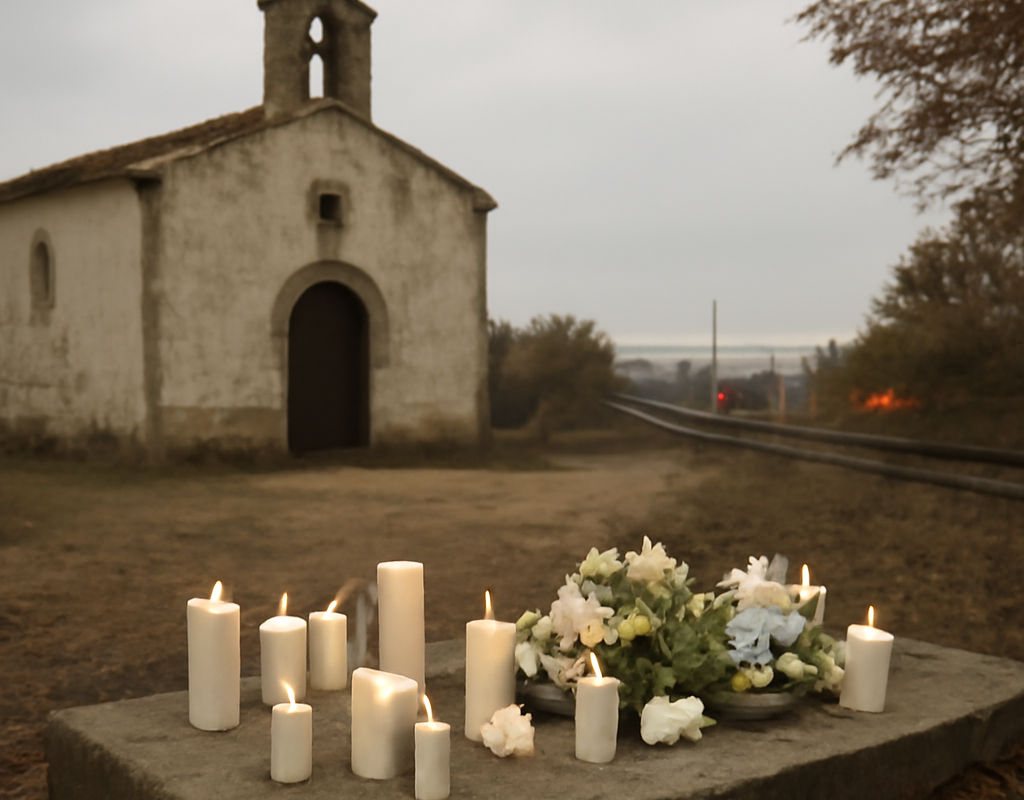
Spain is observing a third day of national mourning after a train collision near Urda in Toledo killed at least 69 people, leaving families waiting for answers and intensifying scrutiny of the country’s rail safety systems.
Memorial services were held near the crash site on Saturday as investigators examined a reported failure involving the LZB automatic train protection system. The cause of the collision has not been established, but train drivers’ unions are demanding immediate changes to procedures used when railway protection technology stops working.
Spain mourns victims as identification effort continues
Residents and local officials gathered at San Juan Bautista church for a memorial Mass. The church was filled, while other mourners listened outside as authorities continued the difficult process of identifying victims.
Prime Minister Pedro Sánchez said officials were working “tirelessly” to complete the identification process. Castilla-La Mancha regional leader Emiliano García-Page said emergency services had recovered 31 bags containing partial remains, making the work more complicated.
Authorities said 67 missing-person reports remained active. Fourteen of those cases involved foreign nationals from countries including the United States, Canada, Australia, France, Japan, Mexico, Argentina, Venezuela, Tunisia and the Czech Republic.
Portugal’s government confirmed that one Portuguese citizen who worked on one of the trains was among those killed. A further 39 injured people remained in hospitals in Castilla-La Mancha, according to regional authorities.
Rail safety systems under investigation
The Independent Authority for the Technical Investigation of Accidents and Incidents said preliminary information indicated that the LZB system stopped functioning at 8:31 a.m. on Wednesday, before the collision. Investigators have not determined whether that failure directly caused the crash.
The LZB system is an automatic railway protection technology used to help monitor train movements and enforce safe operating conditions. The investigation is also examining procedures connected with the European Rail Traffic Management System, or ERTMS.
The Spanish Union of Train Drivers and Railway Assistants, known as Semaf, has called for urgent action by the State Railway Safety Agency. It wants regulations clarified and amended so trains cannot resume normal operation when a technical failure creates a risk of two trains entering the same section of track.
Semaf said drivers had reported railway incidents for months without seeing corrective measures implemented. The union also pointed to delays in carrying out safety measures agreed with the government after a January accident in Adamuz, Córdoba.
What investigators have confirmed so far
- The collision took place near Urda in Toledo on Wednesday.
- At least 69 people were killed, according to the information available.
- Preliminary investigators reported that the LZB system stopped functioning before the crash.
- No final conclusion has been issued on whether the failure caused the collision.
- Authorities are continuing victim identification and missing-person investigations.
Government faces pressure to restore confidence
Transport Minister Óscar Puente, who ruled out resigning on Friday, announced that the government would introduce measures intended to reduce technical risks and rebuild confidence in the railway network. He has not yet provided details of the measures.
Sánchez acknowledged that public trust in Spain’s high-speed rail system had been “shattered” and promised solutions aimed at preventing further accidents. The collision occurred on a key route linking Madrid and Seville, a line that was also affected by a fatal crash in Andalusia in January, in which 46 people died.
The latest disaster has therefore become both a national tragedy and a wider political issue. Sánchez is facing elections in November, while the opposition People’s Party has criticised the government’s handling of railway safety. Its leader, Alberto Núñez Feijóo, said the government should have replaced what he described as an obsolete safety system.
The government has not accepted responsibility for the crash, and the technical investigation remains ongoing. Political claims about the condition of the network will need to be assessed alongside the findings of the independent inquiry.
Train drivers call further strikes
Semaf has announced two additional strikes at state rail operator Renfe, scheduled for 10 and 12 November. The union is seeking structural measures to improve rail safety.
The planned stoppages come after a strike on Thursday that had been arranged before the collision. Further industrial action could affect passengers and freight services, although the precise operational impact will depend on any minimum-service arrangements and developments in negotiations.
The union’s central concern is how trains should operate after the failure of automatic protection systems. Any regulatory response will need to clarify the responsibilities of drivers, operators and infrastructure managers while ensuring that trains cannot be placed in an unsafe configuration.
What happens next?
The technical investigation will be central to determining the sequence of events and whether failures in equipment, procedures or communication contributed to the collision. Investigators will also need to establish the role, if any, of the LZB system failure.
In the immediate term, authorities are completing identification work, supporting injured passengers and their families, and clearing the crash site. The government is expected to set out more detail on its proposed safety measures, while negotiations with railway unions may determine whether the November strikes proceed.
For passengers, the most important question is whether any changes will be introduced before services on affected routes return to normal. Until the investigation reaches conclusions, it would be premature to attribute responsibility to a particular individual, company or institution.
Conclusion
Spain’s third day of mourning reflects the scale of the loss following the Urda train collision, while the reported LZB failure has placed railway safety procedures under intense examination. The immediate priority is to identify victims and support families; the longer-term test will be whether the independent investigation leads to clear, enforceable measures that can restore confidence in Spain’s rail network.