

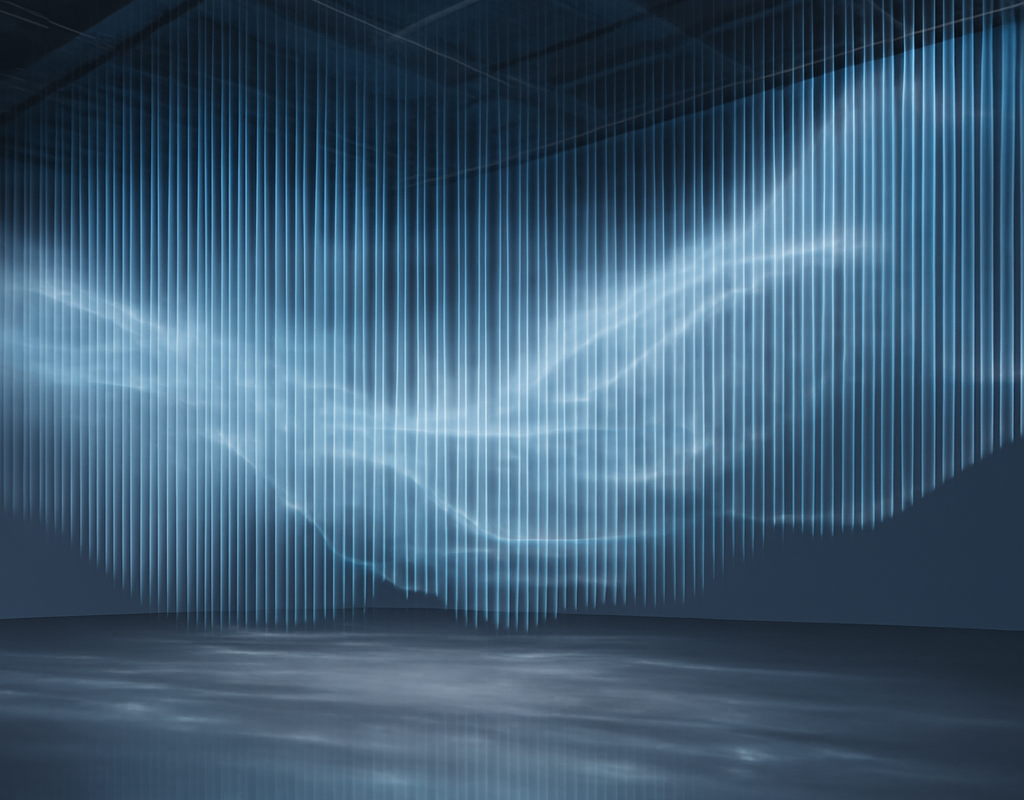
Wind is everywhere, yet almost impossible to see. Amsterdam-based art studio DRIFT explores that contradiction in Aeolus, a large-scale installation at London’s Ladbroke Hall that transforms air movement into a carefully choreographed visual experience.
Unveiled on 23 October 2026, the work uses hundreds of glass rods and concealed lights to suggest the shifting form, rhythm and energy of wind. Rather than depicting a landscape or recording weather, the installation gives physical presence to a force that normally remains invisible.
Aeolus turns air movement into an artwork
DRIFT’s installation is built around a simple artistic question: what might wind look like if it could be observed directly? The answer is a suspended field of glass elements illuminated by hidden lighting, creating the impression of motion across the installation.
The glass rods form the central visual material. Their transparency and reflective qualities allow light to move through the space, while their arrangement evokes currents passing through the atmosphere. The result is less a static sculpture than an environment that appears to breathe and change.
By focusing on movement rather than solid form, Aeolus sits at the intersection of sculpture, light art and experimental design. It also reflects a wider tendency in contemporary art to make natural processes perceptible through technology and spatial installation.
Why the work is called Aeolus
The title refers to Aeolus, the figure associated with the winds in Greek mythology. The name connects the contemporary installation to a long cultural history of trying to understand, personify and represent air in motion.
That reference does not turn the work into a literal mythological scene. Instead, it provides a conceptual framework for an installation concerned with a universal experience: feeling wind on the skin while being unable to see the force itself.
London’s Ladbroke Hall becomes part of the experience
The setting is central to the installation. Ladbroke Hall, a large arts venue in London, provides the scale needed for the work’s glass forms and lighting effects to be experienced as an immersive composition.
Inside the venue, the installation encourages visitors to consider how architecture changes the way natural phenomena are perceived. Wind is usually encountered outdoors, where it is associated with trees, waves, clouds or moving dust. In Aeolus, those familiar visual clues are removed, leaving light, transparency and spatial rhythm to communicate movement.
- Material: Hundreds of glass rods.
- Lighting: Concealed lights create changing visual effects.
- Subject: The invisible movement of wind.
- Location: Ladbroke Hall in London.
- Artist: Amsterdam-based studio DRIFT.
DRIFT’s continuing interest in natural forces
DRIFT is known for artworks and installations that draw attention to transformation, motion and the relationship between technology and the natural world. In this project, the studio does not attempt to reproduce wind scientifically. Instead, it creates an interpretation that is sensory and poetic.
The work invites visitors to slow down and observe subtle changes. As light interacts with the glass rods, the installation can appear to shift between delicacy and intensity. Its visual language is technologically controlled, but its subject remains elemental.
This balance is important to the experience. The hidden lighting and carefully arranged materials demonstrate the role of engineering, while the changing appearance suggests that nature cannot be reduced to a single fixed image.
Why Aeolus matters in contemporary art
Many contemporary installations ask audiences to reconsider ordinary experiences. Aeolus does so by isolating an aspect of daily life that is usually noticed only through its effects. People may see branches move, hear a whistle through a gap or feel a sudden change in temperature, but the air itself remains unseen.
Making wind visible also raises broader questions about perception and environmental awareness. The installation does not present a scientific lesson or claim to show weather data. Its contribution is more open-ended: it encourages viewers to think about the forces that shape their surroundings without always being visible.
That approach gives the work relevance beyond the gallery. In an era when climate, atmosphere and environmental change are increasingly discussed through measurements and forecasts, the installation offers a physical and emotional way to engage with the natural world.
What visitors can expect
Visitors encountering Aeolus should expect an installation centred on atmosphere rather than narrative. There is no conventional image of a storm or landscape. Instead, the work depends on space, light and the viewer’s own perception of movement.
The experience is likely to change depending on where a visitor stands and how long they observe the composition. From one angle, the glass rods may appear almost weightless; from another, the reflected light can make the installation feel denser and more dynamic.
DRIFT’s work therefore rewards attention. Its subject is invisible, but the installation asks audiences to look closely at the signs, patterns and sensations through which wind becomes perceptible.
Conclusion
Aeolus gives contemporary art a distinctive way to explore a familiar natural force. Through glass rods and hidden lights, DRIFT makes the movement of wind visible without reducing it to a literal illustration. The installation’s central takeaway is simple: even forces that cannot be seen can shape how we understand space, movement and the world around us.