

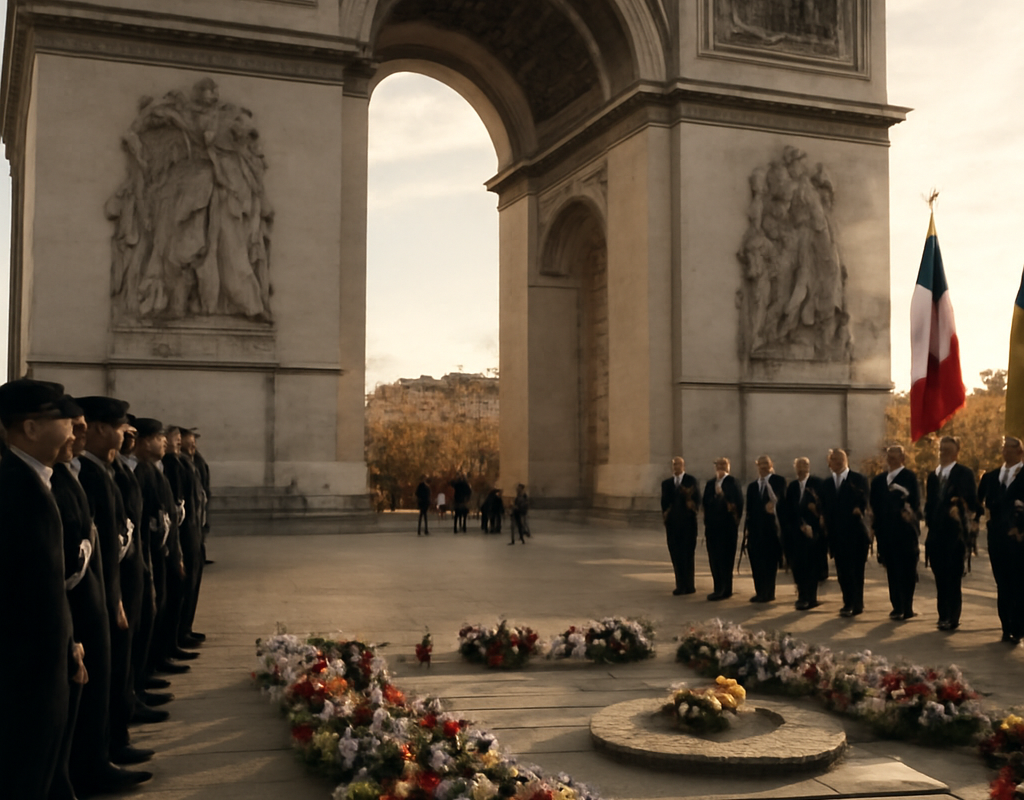
France marked the 108th anniversary of the 1918 armistice on 11 November 2026, with President Emmanuel Macron leading the national ceremony in Paris while Marine Le Pen and Jean-Luc Mélenchon commemorated the day at politically significant locations of their own.
The ceremonies honoured those who died in the First World War, but they also carried a clear political dimension. With France approaching another presidential election, the three figures used remembrance, national unity and opposition to war to present distinct visions of the country’s future.
Macron leads the national ceremony in Paris
Emmanuel Macron presided over the official ceremony beneath the Arc de Triomphe in what was described as his final 11 November commemoration as president.
The ceremony began with a tribute to Georges Clemenceau, followed by the laying of a wreath near his statue on the Champs-Élysées. At Place de l’Étoile, Macron reviewed the troops, rekindled the flame of the Unknown Soldier and observed a minute’s silence.
The names of five service members who have died for France since the beginning of 2026 were read aloud. They included personnel killed in the Levant, Iraq and Lebanon. The French army choir later performed “La Marseillaise”.
Macron did not deliver a speech during the ceremony. In a message published on X, however, he described the Bleuet de France as a symbol of remembrance and solidarity with people still affected by the consequences of war.
Marine Le Pen calls for national cohesion
Marine Le Pen chose Hénin-Beaumont in Pas-de-Calais, an area associated with her political movement, for her Armistice Day tribute. Her remarks focused on military sacrifice, the role of women who remained on the home front and the importance of preserving collective memory.
Le Pen linked remembrance to national sovereignty, freedom and attachment to France. She also invoked the example of the “Poilus”, the name commonly used for French soldiers who fought during the First World War.
Her central message was a call for action and unity in response to national difficulties. She argued that citizens should not remain passive observers and said national cohesion could not be built on a loss of historical reference points.
The appearance gave Le Pen an opportunity to frame Armistice Day around national belonging and political responsibility, while keeping the ceremony separate from the official presidential event in Paris.
Mélenchon chooses a monument associated with pacifism
Jean-Luc Mélenchon travelled to Gentioux-Pigerolles in the Creuse department, where he attended a ceremony at a memorial carrying the inscription “Cursed be war”. The monument depicts an orphan raising a fist towards the names of local soldiers killed in combat.
The location is strongly associated with pacifist and anti-militarist traditions. Mélenchon’s choice therefore placed opposition to war at the centre of his Armistice Day message.
The La France Insoumise leader said remembrance should involve understanding how conflicts begin and recognising the conditions that allow them to recur. He also repeated his opposition to preparing for or organising future wars.
His comments followed remarks made at a rally in Le Bourget, where he had advocated consulting residents of Donbas about their future as part of a potential settlement to the war between Russia and Ukraine. Ukrainian diplomacy rejected that proposal, arguing that Ukrainians, including people in Donbas, had already expressed their choice of borders in the 1991 independence referendum.
In Gentioux-Pigerolles, Mélenchon combined his pacifist position with a call for national unity and a denunciation of racism and hatred directed at others.
One commemoration, three political perspectives
Armistice Day remains a national day of remembrance in France, bringing together public officials, armed forces personnel, veterans and members of the public at memorials across the country. The 2026 ceremonies showed how the same historical event can support different political narratives.
- Macron: a formal state ceremony centred on military remembrance, institutional continuity and national tribute.
- Le Pen: a message focused on sovereignty, national identity and collective responsibility.
- Mélenchon: a pacifist commemoration emphasising opposition to militarism and the prevention of future conflict.
The contrasting settings were significant. The Arc de Triomphe represented the national state ceremony, Hénin-Beaumont connected Le Pen to her political base, and Gentioux-Pigerolles provided a setting closely identified with anti-war activism.
Why the ceremonies matter in French politics
The events were not election rallies, but their timing gave them added political importance. Each figure used the day to connect historical memory with a present-day argument about France’s priorities.
Macron’s ceremony emphasised the responsibilities of the presidency and the armed forces. Le Pen presented remembrance as a foundation for national cohesion and sovereignty. Mélenchon used the memorial’s anti-war symbolism to argue against military preparation and to promote a pacifist approach to international affairs.
The different messages also reflect wider debates in European politics about national identity, military policy, Russia’s war against Ukraine and the meaning of patriotism. The commemorations therefore had significance beyond the individual ceremonies, even though they remained centred on the memory of the First World War.
What happens next?
France’s Armistice Day ceremonies have concluded, but the political arguments expressed during them will continue to feature in public debate as the presidential election approaches. The central questions include how France should define national unity, what role its armed forces should play and how the country should respond to international conflict.
For now, the 2026 commemorations demonstrated that remembrance can unite the country around the sacrifices of the past while still exposing sharply different views about France’s future.
Conclusion
France’s Armistice Day ceremonies brought together shared national remembrance and competing political messages. Macron led the formal state tribute in Paris, Le Pen highlighted sovereignty and cohesion in Hénin-Beaumont, while Mélenchon used a pacifist memorial to oppose war and militarism. The key takeaway is that the commemoration remained a common national ritual, even as its political meaning differed from one venue to another.