

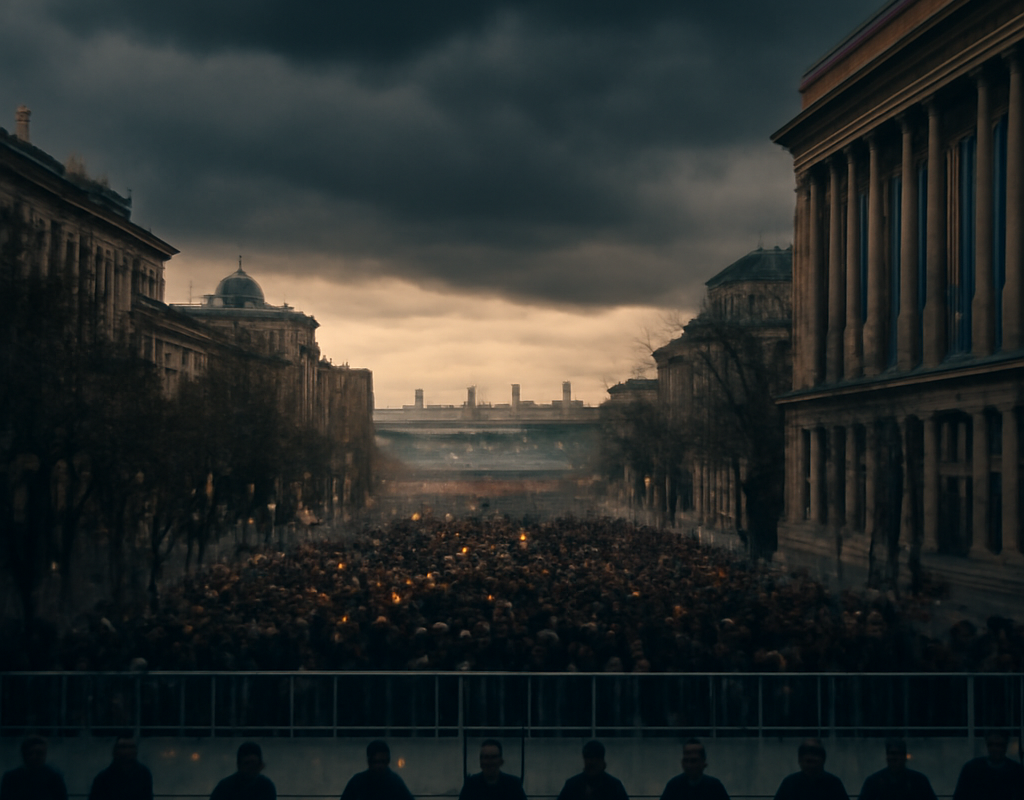
Europe news is being shaped by a fresh wave of protests, security alerts and political disputes across the continent on 24 October 2026. Demonstrations in France and Albania, concerns over Russia-linked activity in the Black Sea and continuing debate over energy and migration are among the main developments drawing attention.
The stories involve both national governments and European institutions. Their consequences range from public order and transport disruption to questions about energy security, defence, migration policy and the European Union’s response to external threats.
France prepares for another day of demonstrations
France has deployed a substantial security operation as new protests get under way. Authorities reported that 135 people had been arrested across the country by early Saturday afternoon, while police used tear gas to disperse approximately 150 people near Lyon 3 University, where demonstrations had been prohibited.
Further tension has surrounded a congress of Marine Le Pen’s National Rally party in Orléans. Supporters, counterprotesters, left-wing politicians and trade union representatives have gathered in the area ahead of the 2027 presidential election. Officials have introduced protest bans and curfews in some locations, while President Emmanuel Macron convened a defence council with intelligence officials.
The unrest has also affected local infrastructure. Limoges Town Hall, a historic building dating from 1883, was extensively damaged by fire during riots on 17 October. Images released by the city council showed the scale of the destruction inside the building.
Albania protests bring police and students into confrontation
In Albania, opposition supporters and students gathered outside the prime minister’s office in Tirana. Police deployed riot units and a water cannon near the Ministry of Education after some demonstrators reportedly threw rocks at the building and officers.
The events underline the continuing importance of national political stability in the Western Balkans, a region closely watched by the European Union because of its enlargement and security interests. The available information does not establish any new EU decision linked directly to the demonstrations.
Black Sea incident raises European security concerns
Romania and the European Commission have accused Russia of a new drone attack involving a commercial vessel in the Black Sea. A search-and-rescue operation was reported to be under way off the Romanian coast.
The incident has wider significance because it involves a commercial maritime route close to an EU member state and comes amid the continuing Russia-Ukraine war. It adds to concerns about the safety of shipping, the protection of critical infrastructure and the risk of spillover from the conflict into neighbouring waters.
Separately, Ukraine said it had restored a stable connection to Starlink, the satellite communications system used by its military. Starlink and the military-focused Starshield service have been important to Ukrainian battlefield communications, according to the report.
Energy costs continue to drive disruption
High energy prices are also contributing to political and economic pressure. In southern Italy, truck drivers’ protests over fuel costs disrupted deliveries to supermarkets and left some petrol stations without supplies. The Italian government warned that blocking roads could result in criminal penalties as authorities moved to clear demonstrations.
Belgium, meanwhile, increased targeted heating-oil support for vulnerable households. The measure is intended to help people facing higher heating costs, although the available reporting indicated that the assistance may not fully offset rising prices.
These developments highlight the difficulty governments face in balancing household support, transport costs and public finances. They are national measures rather than a single EU-wide energy decision, but energy prices and supply remain central issues in European policy discussions.
Migration and political debate in Ceuta
Migration has become a major political issue in Spain’s North African enclave of Ceuta ahead of a regional election. The arrival of large numbers of migrants has intensified debate about border management, reception capacity and the responsibilities of public authorities.
Spanish police also reported finding 74 migrants in overcrowded conditions in a house in Ceuta’s Príncipe district. Ten were unaccompanied minors, and a man was arrested on suspicion of labour exploitation, assault and facilitating irregular immigration.
The case illustrates why migration reporting requires careful distinctions between migrants, asylum seekers and unaccompanied children. It also reflects the practical pressures faced at the EU’s external borders, where national authorities operate within a wider European framework on asylum and returns.
European Parliament takes positions on climate and international justice
Members of the European Parliament voted to delay methane-related rules, arguing that their position could ease supply pressures while maintaining climate objectives. The development concerns the balance between emissions reduction and energy security, an issue that continues to influence EU policy news.
In another decision, Parliament awarded its Sakharov Prize to the International Criminal Court. The award was presented as a show of support for the court after the United States imposed sanctions on it. The outcome followed a closely divided process in which abstentions by the Patriots for Europe group helped determine the final choice.
Parliamentary votes and prize decisions do not have the same legal effect. A vote on legislation may form part of the EU law-making process, while the Sakharov Prize is a political and symbolic act rather than a binding regulation.
What happens next?
The immediate focus will remain on public safety in France, the investigation into the Black Sea incident and the effects of fuel disruption in Italy. European institutions may also face renewed pressure over energy resilience, external-border management and security cooperation.
- French authorities will continue monitoring protests and political gatherings.
- Romanian and international authorities are expected to investigate the reported maritime attack.
- Italy will assess the effects of fuel protests on transport and food distribution.
- Debates on methane rules and energy security will continue through the EU legislative process.
Conclusion
The latest EU news and wider European developments show a continent dealing simultaneously with street protests, energy pressure, migration challenges and security risks. While many of the decisions described remain national, their cross-border consequences make them important European affairs. The key takeaway is that public order, energy security and regional stability are increasingly connected—and will continue to shape Europe news in the days ahead.