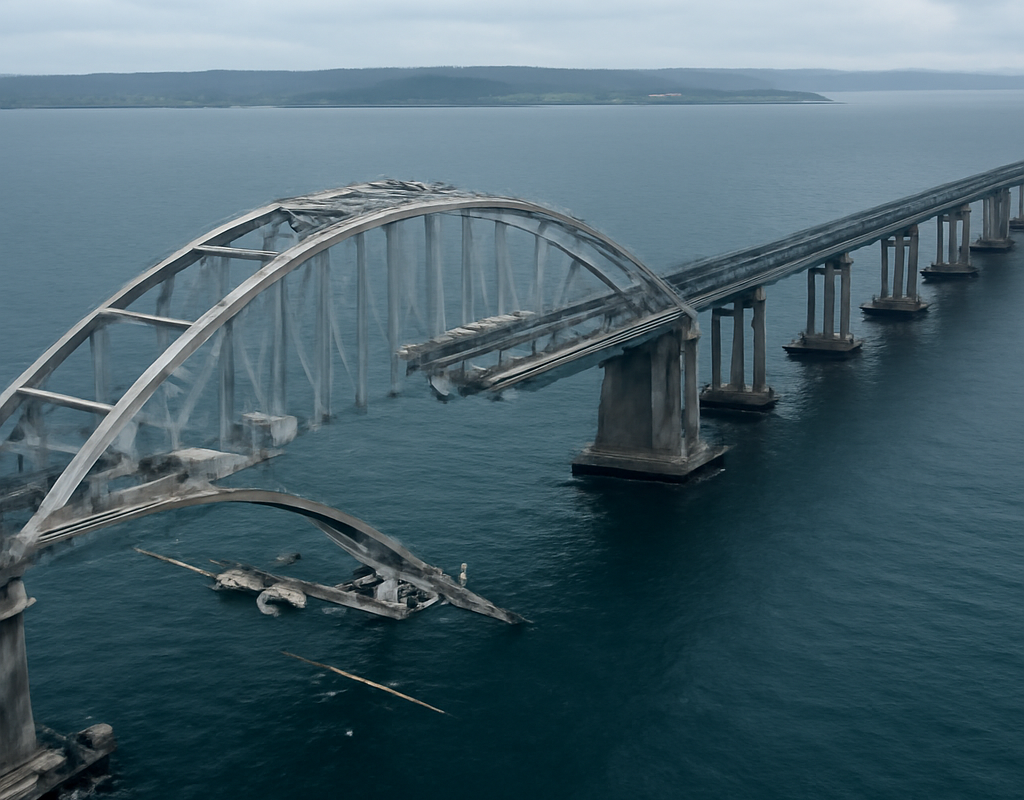
The collapse of a key section of the Crimean Bridge has created a serious new challenge for Russia’s military logistics and exposed the vulnerability of one of Moscow’s most heavily protected symbols. Ukrainian officials say the strike followed a multi-stage operation targeting the bridge’s surrounding defences.
The 12-mile crossing over the Kerch Strait connects Russia with the occupied Crimean Peninsula. It has served both as a major transport link and as a powerful political symbol since it opened in 2018.
How the Crimean Bridge was damaged
Ukraine’s Security Service and General Staff said the operation was carried out over several weeks. The reported targets included air-defence systems, radar installations, electronic-warfare equipment and other military assets protecting the crossing.
Drones struck the bridge on 16 November, briefly interrupting traffic. Images showed damage to the road section, but the structure remained standing. The following day, further attacks hit the weakened span.
Verified footage filmed from a Ukrainian-made Flamingo missile shows the weapon approaching the bridge’s steel arches before the recording ends. Weapons expert Justin Bronk of the Royal United Services Institute said the missile may have been adapted for remote control, potentially improving its accuracy. He also said its heavy warhead made it suitable for attacking reinforced concrete spans and supports.
Ukrainian President Volodymyr Zelensky said several types of missiles and drones were used. The main road arch, measuring roughly 227 metres and weighing thousands of tonnes, subsequently collapsed into the strait. Daylight images indicated that around 200 metres of roadway had also fallen into the water.
Why the damage is considered critical
The fallen arch was not merely a decorative element. It played a structural role by transferring loads and helping support the road span. The parallel railway arch remains standing, although its condition is not yet fully clear.
Structural experts described the damage to the road crossing as catastrophic. Colin Capriani, a structural engineer at Monash University, said rebuilding would be difficult while the bridge remained within range of Ukrainian weapons. David MacKenzie of engineering consultancy COWI said restoring full road traffic could take more than a year, even if the wreckage is removed relatively quickly.
Previous Ukrainian attacks in 2022 and 2023 damaged road sections but did not destroy the crossing’s most vulnerable central structure. This latest strike is therefore more consequential: it has hit the part of the bridge most essential to the road route’s stability and capacity.
What the collapse means for Crimea
Russia uses Crimea as a military hub, with airbases, troop concentrations, training areas and stockpiles of artillery and other equipment. The peninsula also supports Russian operations in southern Ukraine and acts as a launch point for attacks elsewhere in the country.
The bridge’s collapse does not create a complete blockade. Russia still has access to a land corridor through occupied areas of Zaporizhzhia and Kherson, while ferries can cross the Kerch Strait. However, both alternatives face serious limitations.
- Ukraine has targeted transport routes in northern Crimea and crossings near Chongar.
- Disruptions to those routes have already affected the movement of fuel, supplies and military cargo.
- The ferry service has limited capacity compared with the bridge.
- Ships and ferries operating in the Black Sea face risks from Ukrainian naval and aerial drones.
- Debris from the collapsed arch could obstruct the shipping channel and affect access to ports in the Sea of Azov.
If the channel is blocked, occupied ports including Mariupol and Berdyansk could face additional operational difficulties. The effect would depend on the extent of the obstruction and how quickly authorities can inspect and clear the area.
A major symbolic blow to Moscow
The Crimean Bridge has long represented Russia’s claim over the peninsula, which Ukraine and most of the international community regard as Ukrainian territory under Russian occupation. In 2018, Vladimir Putin drove across the newly opened bridge in a Russian-made truck during a ceremony presenting the crossing as a link between Russia and Crimea.
Its partial collapse now carries significance beyond transport. The attack demonstrates that Ukrainian forces can reach a structure protected by layered military systems and regarded by the Kremlin as a prestige project.
Kremlin spokesman Dmitry Peskov said the bridge would be rebuilt and would be “even better than before”. Whether that promise can be delivered quickly will depend on the scale of the structural damage, the security environment and Russia’s ability to maintain supplies while reconstruction takes place.
What happens next?
The immediate priorities are likely to include assessing the railway span, securing the damaged roadway, checking the navigation channel and finding alternative routes for civilian and military transport.
For Ukraine, the strike supports its stated aim of isolating Crimea from Russia. For Moscow, it creates a logistical problem at a time when the peninsula remains central to military operations. The crossing may eventually be repaired, but its collapse shows that the route can no longer be treated as invulnerable.
The key takeaway is clear: the destruction of the Crimean Bridge’s main road span is both a practical disruption and a significant strategic setback for Russia, with consequences for the movement of forces and supplies across the occupied peninsula.