

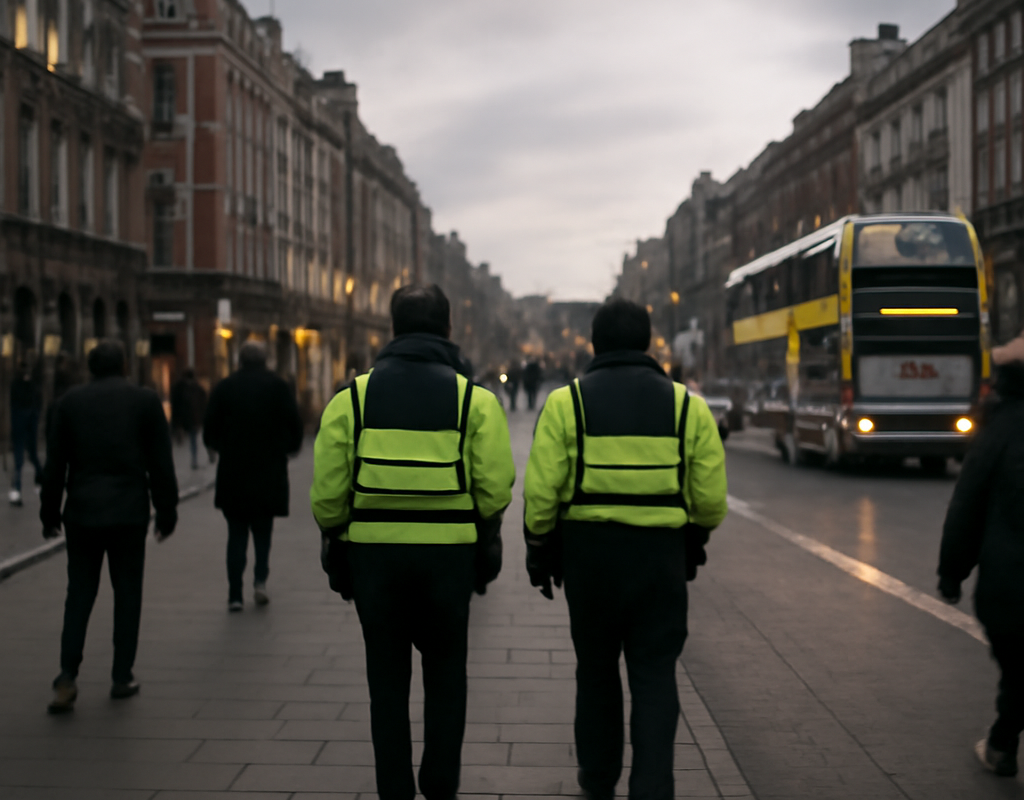
Private security patrols are being planned for Dublin city centre as business representatives and the city’s new regeneration authority consider ways to improve safety around O’Connell Street and surrounding areas. The proposed “safety operatives” would work alongside An Garda Síochána, but the plan has already prompted concerns about accountability, civil liberties and public oversight.
What is happening in Dublin city centre?
A tender is being prepared to appoint a private security company to provide patrols in central Dublin. The service is expected to focus on visible safety work and reporting concerns to gardaí rather than replacing the statutory role of the police.
The proposal follows discussions between business representatives and the Dublin City Development Company, the authority being established to lead the regeneration of O’Connell Street and nearby parts of Dublin 1.
Initial funding is expected to come from prominent city businesses. Dublin Town, a business lobby group, is understood to be acting as the contracting body for the proposed service.
Why are private patrols being considered?
The initiative comes amid continuing concern about antisocial behaviour, public disorder and the concentration of social and support services in the capital’s north inner city. The regeneration authority is being created in response to recommendations from the Dublin City Taskforce, which reported after the November 2023 riots in the city.
Those riots followed the stabbing of three children and a care worker on Parnell Square and were inflamed by far-right agitators. The taskforce subsequently examined how Dublin city centre could be made safer, more welcoming and more resilient.
Robert Watt, who previously served as secretary general at the Department of Health, has been appointed to lead the regeneration body. Although the company has not yet been legally incorporated, an interim project management unit is already operating under his direction.
- A tender is being drafted for a private security provider.
- The proposed operatives would complement Garda resources.
- Dublin Town is understood to be handling the contracting process.
- Dublin city councillors have requested full scrutiny of the proposal.
- A report is due to be presented to councillors next month.
Concerns over accountability and civil liberties
The proposal has not been put before Dublin city councillors for consideration during its development. That has led several councillors to demand greater transparency before a contract is awarded or patrols begin.
Green Party councillor Janet Horner said the plans raised “multiple red flags” and questioned whether private personnel should have responsibility for safety in public spaces. Her concerns include the legal limits of private security work, the treatment of vulnerable people and the need for democratic oversight.
People Before Profit councillor Conor Reddy and Sinn Féin councillor Kourtney Kenny joined Horner in tabling an emergency motion seeking urgent scrutiny of the plan. The motion was not taken at the relevant council meeting, but councillors agreed that a report would be brought forward next month.
The debate reflects a wider question facing cities across Ireland: how can public spaces be made safer without creating unclear policing arrangements or weakening protections for people who use them?
How would the proposed safety operatives work?
The exact duties, powers and operating procedures have not been published. However, the proposal is understood to involve patrols that would provide a visible presence and report incidents or emerging problems to An Garda Síochána.
Social Democrat councillor Cian Farrell, who sits on the regeneration authority’s advisory board, said his understanding was that the operatives would liaise closely with gardaí. He described them as “eyes and ears” who could relay information when Garda personnel were not immediately present.
That distinction is important. Private security guards do not have the same powers, training or legal status as members of An Garda Síochána. Any final tender would need to set out clearly what operatives could do, what they could not do and how complaints would be handled.
What happens next?
The tender is still being drafted, so no private security company has yet been appointed. The proposed arrangement also remains subject to decisions about funding, governance and the legal structure of the regeneration authority.
The next significant step is expected to be a report to Dublin city councillors. That review could examine:
- the proposed contract and source of funding;
- the boundaries and hours of patrols;
- coordination with An Garda Síochána;
- training, identification and complaints procedures;
- the impact on vulnerable people and civil liberties; and
- the legal responsibilities of the contracting organisation.
Robert Watt and Dublin Town have declined to comment on the proposal at this stage. As a result, several practical details remain unconfirmed.
Why this matters for Dublin
O’Connell Street, O’Connell Bridge and Westmoreland Street are among the busiest public areas in the capital. They connect major transport routes, retail districts, workplaces and cultural destinations, making safety and public order issues highly visible to residents, workers and visitors.
Supporters of the plan may argue that a dedicated presence could help identify problems quickly and reassure businesses and the public. Critics, however, want guarantees that private patrols will not become an alternative form of policing without the same level of accountability.
The outcome will depend on the detail of the tender and the scrutiny applied before implementation. For now, the proposal is under development rather than an operating service.
Frequently asked questions
Will private security replace the Gardaí?
No. The stated aim is for safety operatives to complement Garda resources. The exact relationship with An Garda Síochána has not yet been finalised publicly.
Who would fund the patrols?
Initial funding is expected to come from prominent Dublin businesses, with Dublin Town understood to be involved in the contracting process.
Have Dublin councillors approved the plan?
No. Councillors were not consulted during the early development of the proposal. A report is expected to be presented to Dublin City Council next month.
When will patrols begin?
No start date has been announced. A tender is still being prepared, and governance, legal and operational questions remain unresolved.
Conclusion
The proposed private security patrols mark a significant development in the debate over safety and regeneration in Dublin city centre. The plan could offer businesses and visitors a more visible safety presence, but it must be matched by clear legal boundaries, public accountability and proper consultation. The next council report will be central to determining whether the proposal can proceed and how it would operate. For the latest Breaking News from Dublin, the focus now turns to the promised scrutiny and the details of any eventual tender.