

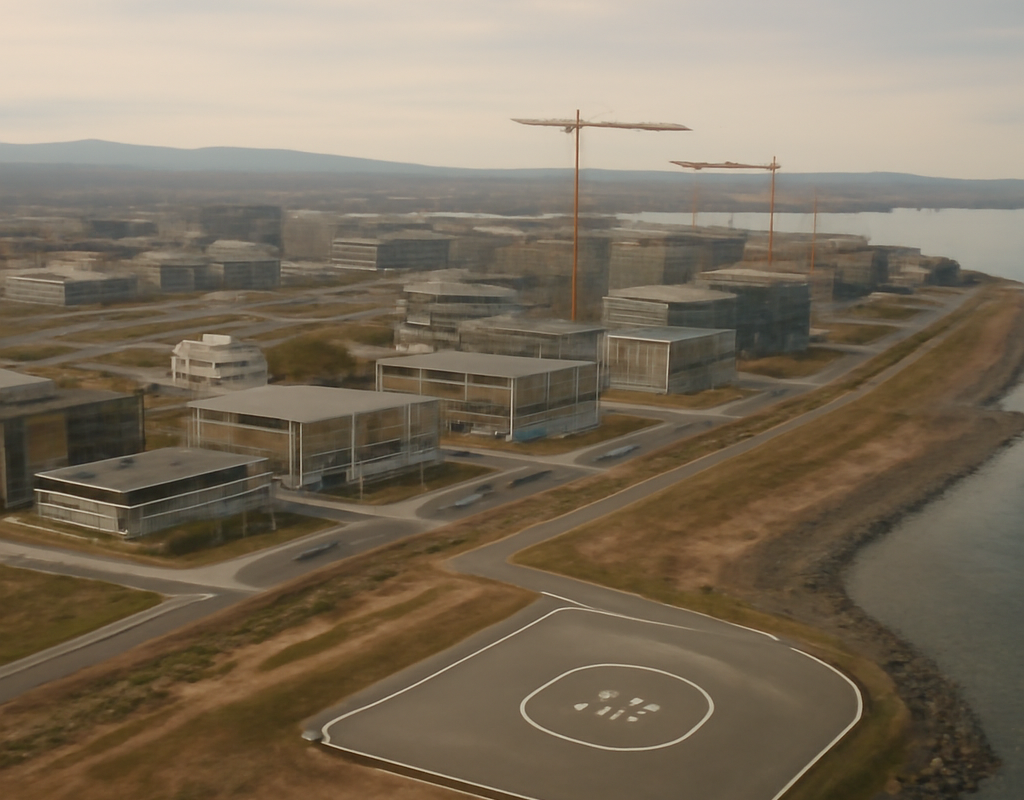
A proposed €55 million innovation hub near Dublin’s former Irish Glass Bottle site has met a cautious response from Government officials. The project, promoted by developer Johnny Ronan, could include facilities for testing drone deliveries and air taxi services alongside a major residential development in Poolbeg West.
Government response to the proposed Dublin innovation hub
The Ronan Group has been seeking ministerial support for the proposed hub, but officials are understood to be unconvinced by the plan at this stage. The project would be located close to the planned development on the former Irish Glass Bottle site, where about 4,000 homes are proposed.
The proposal reflects the growing interest in urban technology, aviation innovation and new forms of delivery infrastructure. However, Government backing is not confirmed, and the project remains dependent on further consideration, planning and approvals.
What Johnny Ronan is proposing
The proposed facility would be designed as an innovation centre with a “live testbed” area. This could allow companies and researchers to trial emerging technologies in a real-world urban setting.
The technologies associated with the proposal include:
- Drone-delivery services
- Air taxi operations
- Urban mobility systems
- Technology testing and innovation projects
The idea would place the hub near one of Dublin’s largest planned housing developments. That location could offer a direct connection between new residential communities and experimental transport or logistics services, although the practical, regulatory and safety requirements would need to be addressed.
Why the Poolbeg West location matters
The former Irish Glass Bottle site in Poolbeg West has been associated with plans for a large-scale redevelopment, including approximately 4,000 homes. Its location near Dublin Bay and the city’s established employment and transport networks makes it a significant site in Ireland’s housing and regeneration debate.
Adding an innovation hub to the area could broaden the project beyond housing by introducing space for technology companies, research activity and new mobility services. It could also connect the development to wider discussions about Dublin’s future infrastructure and Ireland’s technology sector.
At the same time, a project of this type would have to fit within the planning framework for the area. Questions about airspace, public safety, noise, environmental impact, transport access and the relationship with nearby communities would be central to any formal assessment.
Why officials may be cautious
The Government’s reported lack of enthusiasm does not amount to a final decision on the proposal. It indicates that ministerial support has not been secured and that officials may have concerns about the project’s readiness, public value or compatibility with existing plans.
Large innovation and transport schemes typically require evidence that they can operate safely, comply with regulations and deliver clear benefits. Drone deliveries and air taxis also involve complex issues, including:
- Regulation of low-altitude airspace
- Protection of residents and pedestrians
- Noise and visual impacts
- Emergency procedures and insurance
- Integration with existing transport networks
These considerations would be particularly important in a densely populated part of Dublin. Any future application would need to explain how experimental services could operate without creating unacceptable disruption or risk.
What happens next?
The immediate position is that the Ronan Group is seeking support, while Government officials remain cool on the proposal. No confirmed approval, funding commitment or operational timetable has been announced in the available information.
The next stages could include further discussions with ministers and public bodies, refinement of the hub’s design, and consideration of planning and regulatory requirements. If the proposal advances, more details would be expected about its cost, governance, construction timeline and relationship with the planned housing scheme.
For now, the innovation hub remains a proposal rather than an approved development. The future of the project will depend on whether its proponents can demonstrate that it offers practical benefits and can be delivered safely within Dublin’s planning and infrastructure systems.
Frequently asked questions
What is the proposed project?
It is a proposed €55 million innovation hub near the former Irish Glass Bottle site in Poolbeg West, Dublin.
Who is behind the proposal?
The proposal is being advanced by developer Johnny Ronan’s Ronan Group.
What would the hub be used for?
The plan could include a live testing area for technologies such as drone deliveries and air taxis, alongside wider innovation activity.
Has the Government approved the hub?
No. Government officials are reported to be cautious about the proposal, and ministerial support has not been confirmed.
Where would it be built?
The proposed hub would be located near the former Irish Glass Bottle site in Poolbeg West, alongside a planned development of about 4,000 homes.
Conclusion
The proposed €55 million Dublin innovation hub would bring ambitious ideas about drone delivery and air taxis to the Poolbeg West redevelopment. But this Breaking News Ireland story remains at an early stage: Johnny Ronan’s group is seeking Government support, while officials have yet to show clear enthusiasm. Any progress will depend on further details, regulatory scrutiny and evidence that the project can work safely alongside the planned homes and surrounding Dublin community.