

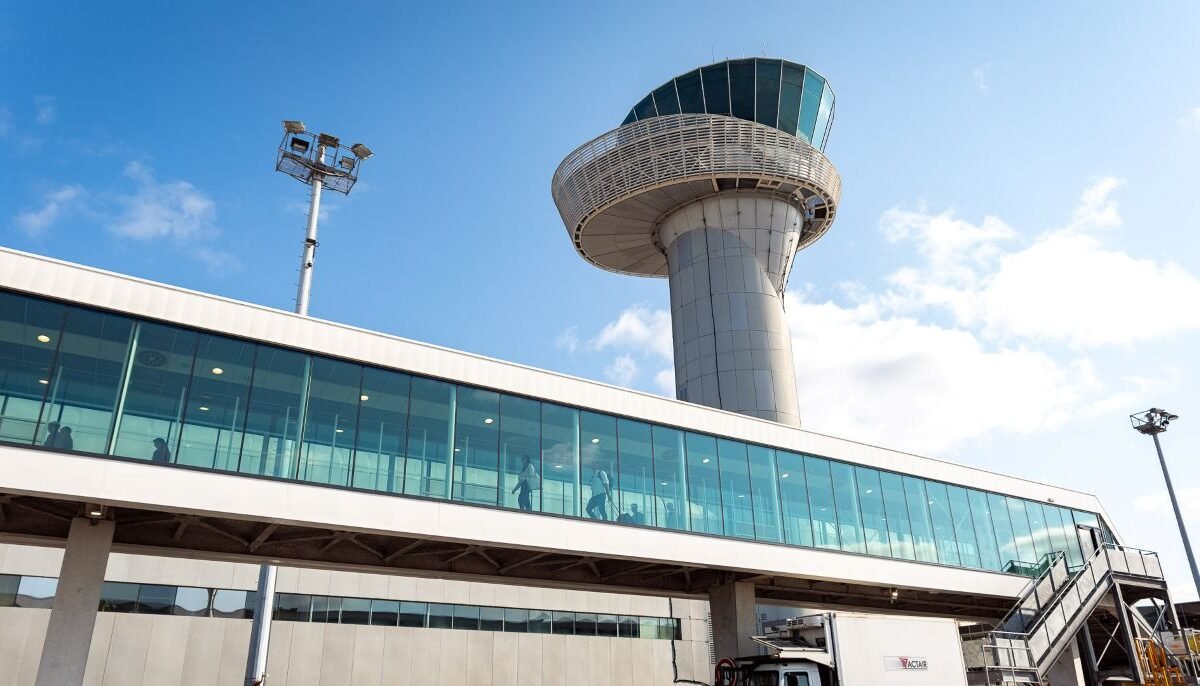
Standfirst: Bordeaux Airport has completed a €6.5 million ground-electrification project covering all 29 passenger parking stands. The upgrade allows aircraft to use renewable electricity and mobile cabin-conditioning equipment instead of running auxiliary power units during turnarounds.
Bordeaux Airport has finished a major infrastructure upgrade designed to reduce emissions, noise and fumes while aircraft are parked between flights. The project provides fixed electrical ground power at every passenger stand and adds mobile pre-conditioned air units for cabin climate control.
For passengers, the change is mainly operational rather than visible. Aircraft can switch off their auxiliary power units, or APUs, while on the ground. That should create quieter conditions around the terminal and reduce local exhaust emissions without changing the normal boarding process.
What the Bordeaux Airport project includes
The €6.5 million scheme covers all 29 passenger parking positions at the French airport. Twenty of those stands have been newly electrified, while the wider installation provides power capability across the passenger parking area.
The main equipment consists of:
- 400 Hz fixed electrical ground-power outlets for parked aircraft
- 20 mobile pre-conditioned air, or PCA, units
- Ground-handling infrastructure designed to support lower-emission turnarounds
The electrical systems supply aircraft with renewable electricity while they are at the stand. PCA units provide heating or cooling inside the cabin, reducing the need for aircraft to keep their fuel-burning APUs operating.
Why the upgrade matters for European aviation
Aircraft commonly use APUs on the ground when they are not connected to airport power. These compact engines provide electricity and climate control, but they also burn jet fuel and produce noise and exhaust emissions.
Providing ground power addresses emissions linked to airline operations that airports do not directly control. Bordeaux Airport expects the project to contribute to a reduction of about 4,100 tonnes of carbon dioxide each year by 2027. The precise outcome will depend on how consistently airlines use the available equipment.
The investment also supports wider European decarbonisation policy, including the European Union’s Alternative Fuels Infrastructure Facility and the objectives of the European Green Deal. Airport electrification is increasingly becoming part of the continent’s strategy for reducing emissions from transport infrastructure.
Funding from European and French institutions
The project received European support through the Alternative Fuels Infrastructure Facility, with the European Climate, Infrastructure and Environment Executive Agency involved in managing the funding framework. Banque des Territoires also provided a €2.2 million mezzanine loan.
This combination of grant funding and institutional finance is significant because regional airports often face high upfront costs when replacing conventional ground equipment. Bordeaux’s installation provides a model that could be adapted at airports with different traffic levels and infrastructure requirements.
What passengers travelling to Bordeaux should expect
Travellers are unlikely to need new documents, arrive earlier or make changes to their bookings because of the electrification work. The main effects should be environmental and operational:
- Less aircraft-engine noise while planes are parked
- Reduced fumes around passenger stands
- Lower fuel consumption during turnarounds
- More access to electrically powered cabin climate control
The airport has not announced that the project changes flight schedules or passenger procedures. Flight status, check-in deadlines and boarding arrangements remain determined by the airline and the airport’s usual operational information.
Ground electrification can also support more consistent turnarounds, although it does not eliminate the main causes of flight disruption. Weather, air-traffic-control restrictions, aircraft technical problems, crew availability and airport congestion can still cause delays or cancellations.
A wider shift at European airports
Bordeaux is part of a broader move towards electric airside operations. Amsterdam Airport Schiphol has installed fixed electrical power at numerous aircraft stands and is also deploying electric ground-power units. Paris Charles de Gaulle is developing the CLEARCDG28 programme, which focuses on wider airside electrification and has a target of operational readiness in 2028.
Venice Airport is pursuing a separate programme aimed at reducing emissions from ground handling and improving mobility infrastructure. These projects differ in scale and design, but they share the same principle: aircraft and service vehicles should rely less on diesel generators and onboard fuel while stationary.
For airlines, airports and regulators, the challenge is making the equipment available and ensuring that aircraft can connect to it safely and reliably. It also requires sufficient electrical-grid capacity, trained ground staff and compatible systems across different aircraft types.
What happens next for airport decarbonisation?
Ground power is only one part of aviation’s transition. Airports and airlines are also assessing sustainable aviation fuel, electric ground vehicles and, further ahead, possible hydrogen-powered aircraft. Those technologies involve different infrastructure and safety requirements, but electrified stands can provide an immediate way to reduce emissions during aircraft turnarounds.
Bordeaux’s completed project demonstrates that regional airports can introduce this infrastructure across a full passenger parking area rather than limiting it to a small trial. Its performance will be measured through actual airline use, energy demand and emissions reductions over time.
Conclusion
Bordeaux Airport’s €6.5 million electrification upgrade is unlikely to change the way passengers check in or board, but it changes what happens around the aircraft between flights. With renewable ground power and mobile PCA units available across its passenger stands, the airport can reduce APU use, noise and local emissions. For travellers, the practical takeaway is simple: no new travel action is required, but the upgrade represents a meaningful step in the wider transition towards cleaner European aviation.