

Standfirst: Student teams from 15 countries have tested miniature satellite systems in Uzbekistan, launching drinks-can-sized devices on rockets before recovering their data by parachute. The international challenge highlights the growing importance of practical space engineering, satellite communications and teamwork.
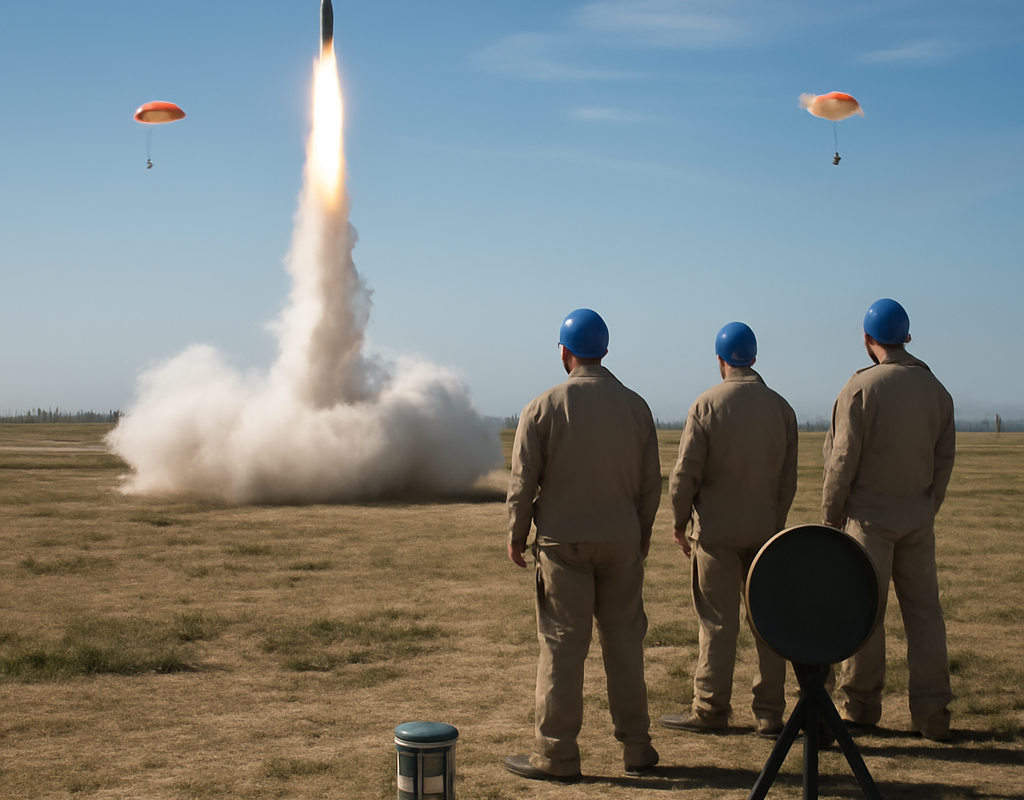
Young engineers from 15 countries have taken part in an international CanSat competition near Tashkent, Uzbekistan, building miniature satellite models designed to operate during a real flight. Their devices were launched by rockets, released at altitude and brought back to Earth under parachutes.
The event is not an orbital mission. Instead, each CanSat reproduces selected functions of a conventional satellite while remaining small enough to fit inside a standard drinks can. The format gives students hands-on experience with sensors, telemetry, onboard data storage and recovery systems.
How the CanSat challenge works
Conventional satellites can require years of development, specialist facilities and significant investment. CanSats offer a more accessible way to test the same basic engineering principles in a controlled atmospheric flight.
Teams assembled their systems at Turin Polytechnic University in Tashkent before carrying out launch preparations. Their devices contained electronics and communications equipment designed to gather and transmit information during descent.
The challenge required each team to keep its CanSat functioning independently while it collected measurements. Depending on the design, the instruments could record factors including:
- Temperature
- Air pressure
- Flight and descent data
- Images or video
- Communications performance
Each device also stored information internally. That backup was important because data could still be retrieved after landing if the wireless connection with the ground station was interrupted.
Students test sensors, telemetry and parachutes
The flight phase provided a direct comparison between computer calculations and real-world performance. After the CanSats landed, teams recovered the hardware and examined the data collected by their sensors and communication systems.
One Uzbek team added a camera and attempted to transmit live video during the descent. That introduced an additional technical challenge: maintaining reliable telemetry between the airborne device and the ground station while the CanSat was moving through the atmosphere.
The systems also had to survive launch, descend safely and remain operational after landing. In that sense, the competition combined several disciplines that are central to space missions, including mechanical design, programming, electronics, communications and data analysis.
Fourteen teams competed in the final stage. Team Nebula finished first, followed by Pegasus and Sky Lab, according to the organisers.
An international space engineering programme
The competition formed part of the fifth international CanSat training workshop. It was organised by Uzbekistan’s space agency, Uzcosmos, together with the Islamic World Educational, Scientific and Cultural Organization and Turin Polytechnic University in Tashkent.
The programme brought together 50 international participants and more than 100 students from Uzbekistan. Its international structure reflects the collaborative nature of modern space projects, where research, engineering and mission operations frequently involve institutions across several countries.
Instructors at the workshop emphasised that a real satellite must both send information to a ground station and preserve data onboard. The CanSat challenge recreated that relationship on a smaller scale, allowing participants to see how design decisions affected mission performance.
Why CanSat projects matter beyond the classroom
Although the devices do not enter orbit, the skills developed through the project have applications across the wider space sector. Satellite technology supports Earth observation, telecommunications, agricultural monitoring, climate research and food-security planning.
Participants also gained experience in areas increasingly connected to space technology, including artificial intelligence, data processing and remote sensing. These skills can be applied to future satellite missions as well as to industries that use information collected from space-based systems.
The programme also supports Uzbekistan’s efforts to develop expertise for its emerging space sector. For national space agencies, student competitions can help identify and train engineers who may later contribute to satellite design, launch operations, communications or scientific research.
International cooperation at the centre of the challenge
The workshop’s organisers presented cooperation as a core part of the exercise. Students had to apply their own technical knowledge while working with teammates and participants from different educational and national backgrounds.
That emphasis is particularly relevant to the future of space activity. Even when a mission is led by one organisation, satellite programmes often depend on international suppliers, research partners, launch providers and ground-station networks.
For students, a CanSat flight offers more than a competition result. It provides a complete project cycle: designing a system, assembling and programming it, launching it, recovering it and assessing whether it performed as expected.
What the Uzbekistan event shows
The CanSat challenge demonstrates how practical engineering programmes can broaden access to space technology. Students do not need to build an orbital spacecraft to learn how mission systems work; a compact device launched for a short flight can expose them to many of the same operational problems.
It also shows why education and international partnerships are becoming important parts of national space strategies. As satellite applications expand, demand is likely to grow for specialists who understand both hardware and the data those systems produce.
The key takeaway: the Uzbekistan competition used miniature satellites to deliver a realistic space-engineering experience, giving young teams from 15 countries practical lessons in telemetry, sensing, programming, recovery and international cooperation.