

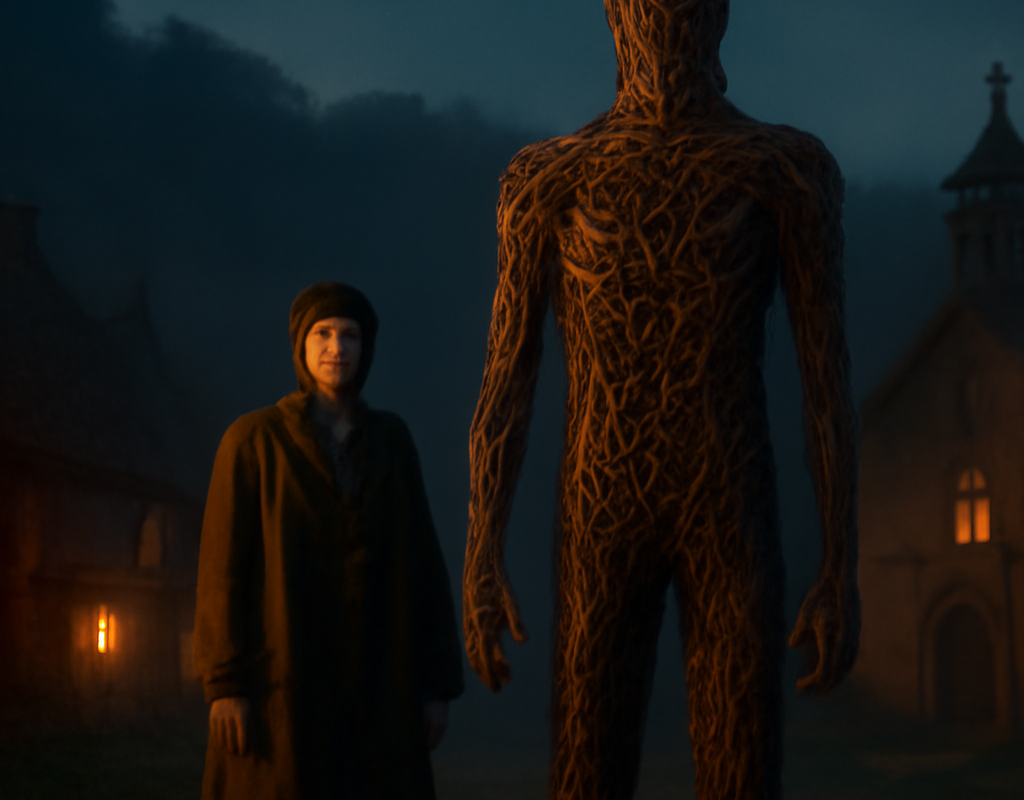
Standfirst: Olivia Colman and Alexander Skarsgård lead this unusual romantic fairytale about a woman who commissions a wicker husband and challenges the rigid traditions of her village. The film is charming, visually inventive and often funny, even if its darker possibilities are not fully explored.
Wicker is a romantic fantasy with an unusual premise: a lonely fisherwoman, rejected by her conservative community, asks a basket weaver to make her a husband. The result is a gentle giant made entirely from willow, played by Alexander Skarsgård, whose arrival unsettles the village’s assumptions about marriage, gender and domestic life.
Directed by Alex Huston Fischer and Eleanor Wilson, the film adapts Ursula Wills’ short fable The Wicker Husband. Although its trailers may suggest a more explicit or outrageous comedy, the finished film is chiefly interested in loneliness, emotional freedom and the pressure exerted by social conventions.
A village built on restrictive traditions
Olivia Colman plays the Fisherwoman, a woman treated as an outsider by villagers who mock her appearance, her smell and her refusal to follow their rituals. The community’s marriage customs are particularly oppressive: weddings involve a collar being placed around a woman’s neck, turning romance into another form of control.
The Fisherwoman is not simply looking for companionship. She is trying to escape a system that has already decided what her life should look like. Her decision to commission a husband from the Basket Weaver, played by Peter Dinklage, is therefore both a practical act and a quiet rebellion.
That setup gives Wicker a clear emotional foundation. Beneath the jokes and visual oddity is a story about how communities can isolate people who refuse to conform.
The Wicker Husband changes everything
When the Basket Weaver delivers the Fisherwoman’s unusual husband, the village is immediately fascinated. Skarsgård’s character is imposing but affectionate, physically extraordinary but emotionally sincere. He offers the attentiveness and kindness that the village’s established marriages appear to lack.
His presence creates a crisis for the local men, who feel threatened by the new standard of tenderness and affection. The women, meanwhile, begin to question whether the domestic ideal they have been taught to pursue is genuinely fulfilling.
The film uses this disruption for comedy, particularly through the villagers’ fascination with the Wicker Husband’s construction. Yet the humour is usually connected to a larger point: a society that claims to protect tradition may simply be protecting unequal expectations.
Colman and Skarsgård anchor the fantasy
Colman gives the Fisherwoman a combination of awkwardness, resilience and emotional honesty. She can play the film’s whimsical tone, but her strongest scenes are grounded in believable hurt and longing.
Skarsgård takes a deliberately restrained approach to a role that could easily have become a one-note joke. The character is not merely an attractive object or a comic invention. Like Pinocchio, he gradually emerges as a being capable of choice and self-definition.
Wētā Workshop’s practical effects, prosthetics and creature design are central to that achievement. The Wicker Husband feels tactile and physical, allowing the film to balance its fairytale logic with a convincing emotional presence.
Where the film falls short
Wicker is at its most intriguing when it approaches the darker traditions of folklore. Its themes include misogyny, collective repression and the danger of allowing a community to dictate the limits of happiness.
However, the film does not always pursue those ideas as boldly as its premise suggests. The second half becomes less strange and less unpredictable, while the eventual movement towards a happier resolution softens some of the story’s more unsettling implications.
A tragic turn gives Colman an opportunity to deliver one of the film’s most affecting performances. The conclusion also offers a sharp moral twist, suggesting that social pressure can damage love while also transforming it into something new. Even so, a more devastating or unconventional ending might have left a stronger impression.
Some supporting performances are underused, including Richard E. Grant in a cameo role. Dinklage’s philosophical speeches also do not consistently land, despite an imaginative opening story about a fish confronting its own reflection.
A charming but cautious fairytale
The central achievement of Wicker is that it remains sweet without becoming entirely sentimental. It has enough irreverence to avoid the most obvious fairytale clichés, while its practical effects give the romance a distinctive visual identity.
Its weakness is that the film sometimes appears to hesitate between being a dark folk tale, a romantic comedy and a broader satire of social expectations. The strongest version of Wicker might have committed more fully to its strangeness.
Still, the result is entertaining and warmly performed. Colman provides the emotional centre, Skarsgård brings surprising soul to an impossible character, and the filmmakers create a world where love can challenge the rules of an entire village.
Verdict
Wicker is an imaginative and good-natured film about a woman refusing to accept the life chosen for her. It does not entirely fulfil the promise of its darker premise, but its performances, handmade creature design and humane themes make it an appealing fairytale for audiences looking for something unusual.
Wicker is in cinemas now.
Takeaway: Wicker works best as a tender fantasy about emancipation and belonging, even if it stops short of becoming the truly strange and unsettling fable it might have been.