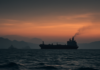
A tanker caught fire in the Gulf of Oman on Thursday after Iranian monitoring teams detected it inside a restricted maritime zone, according to Iranian state media. The incident came shortly after two commercial vessels sank in waters near the Strait of Hormuz, increasing concern about shipping safety along one of the world’s most important energy routes.
Iranian authorities said the vessel’s tracking systems had been switched off when it entered the prohibited area. The tanker’s name, flag, crew status and the cause of the blaze had not been confirmed at the time of publication.
What happened near the Strait of Hormuz?
Iran’s navy reportedly said monitoring teams operating in the eastern sector of the Strait of Hormuz identified the unnamed tanker on fire inside a restricted zone. The statement was cited by Iran’s Mehr news agency.
The report did not establish whether the fire resulted from an attack, an accident, a technical failure or another cause. No independent confirmation of the incident was immediately available, and key details about the ship remained unknown.
The fire was reported one day after Iranian media described a separate tanker fire in the same wider region. That vessel had also reportedly disabled its tracking equipment before the incident.
Two commercial ships have already sunk
The latest tanker fire follows the loss of two cargo vessels in recent days. The container ship GFS Pride sank after catching fire, although all 21 crew members were rescued.
Accounts of what happened to the ship differ. Iran’s Islamic Revolutionary Guard Corps said it had struck a sea mine, while maritime sources cited by international reporting referred to an unidentified projectile.
The cargo vessel Cape Dao also sank after previously being hit by a projectile. One crew member was reported killed in the initial attack.
These conflicting accounts mean that the causes of the incidents have not been independently established. They also underline the difficulty of verifying events in a strategically sensitive maritime area where several military and commercial actors operate.
Unverified footage circulates online
Videos shared on social media appeared to show containers, mobile phones and luxury goods floating in the water near the Strait of Hormuz. Other footage reportedly showed debris and containers in nearby waters.
The material was carried by several international media organisations, but its authenticity and precise location had not been independently verified. Images circulating online should therefore not be treated as conclusive evidence about the latest fire or the earlier sinkings.
Why the Strait of Hormuz matters
The Strait of Hormuz connects the Persian Gulf with the Gulf of Oman and the wider Arabian Sea. It is a critical route for commercial shipping, particularly energy cargoes moving between Gulf producers and global markets.
Any disruption or uncertainty in the waterway can affect:
- Oil and gas shipping operations;
- Marine insurance and freight costs;
- Commercial vessel routing and transit times;
- Energy-market confidence;
- Crew safety and emergency response planning.
The incidents do not, on the information available, establish that the strait is closed to all shipping. However, repeated fires, attacks or navigational restrictions could increase pressure on ship operators and governments to reassess routes and security measures.
Iran’s restricted-zone claims
Iran’s Islamic Revolutionary Guard Corps declared waters leading to the Strait of Hormuz a prohibited zone in September, according to the supplied report. Iranian officials have said the zone extends across parts of the Gulf of Oman and the Arabian Sea approach to the strait.
Iranian military officials have also said vessels attempting to transit the area must obtain permission. Tehran has described its approach as “smart control” of the waterway and has warned that vessels breaching its rules could face penalties.
Those claims are part of a wider dispute over authority and navigation rights in the region. Iran has previously said it closed the Strait of Hormuz at the start of the war with the United States in late February, while Washington subsequently imposed its own naval blockade, according to the source material.
What is known about the latest incident?
- Location: The Gulf of Oman, near the eastern approach to the Strait of Hormuz.
- Vessel: An unidentified oil tanker.
- Reported condition: The tanker was ablaze.
- Iranian account: The vessel entered a prohibited zone with its tracking systems disabled.
- Cause: Not independently established.
- Crew: Their condition was not immediately known.
- US response: US Central Command had not commented as of the report’s publication.
What happens next?
The immediate priority will be determining whether the tanker’s crew is safe and identifying the cause of the fire. Authorities and maritime organisations may also examine tracking data, distress communications, vessel records and physical evidence from the scene.
Further official statements from Iran, US Central Command, shipping authorities or the vessel’s operator could clarify whether the incident was connected to the earlier sinkings. Until then, claims about attacks, mines or deliberate targeting should be treated as unconfirmed.
European governments and shipping companies will also be watching developments because vessels linked to European trade frequently operate through major Middle Eastern maritime routes. Any sustained deterioration in security could have consequences for commercial planning, insurance and energy prices, although the available information does not establish a specific market impact.
Conclusion
The tanker fire near the Strait of Hormuz adds to a series of serious maritime incidents involving commercial vessels in the Gulf of Oman. Iran has attributed the latest discovery to a vessel entering a restricted zone with its tracking system disabled, but the ship’s identity and the cause of the fire remain unknown. The key next step is independent verification, particularly as authorities assess the safety of crews and the wider risks to shipping through this strategically vital waterway.