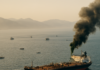
The latest developments in Iran point to a widening conflict around the Strait of Hormuz, with commercial shipping disrupted, military threats escalating and diplomatic channels under strain. Although the fighting is centred in the Middle East, the consequences are extending into Europe through energy markets, maritime security, sanctions policy and pressure on international diplomacy.
Reports published in October 2026 describe attacks involving vessels near Qatar, Fujairah and the Strait of Hormuz. Iranian officials and Revolutionary Guard-linked outlets have issued increasingly broad warnings, while the United States has expanded its military presence in the region. The claims and counterclaims remain contested, making independent verification of individual incidents essential.
What is happening around the Strait of Hormuz?
The Strait of Hormuz is a vital maritime route linking the Persian Gulf with the Gulf of Oman. Any sustained threat to shipping through the passage can affect energy supplies, insurance costs, freight routes and global oil prices.
The source material reports that two commercial vessels were hit within a 24-hour period: one off Qatar and another near Fujairah in the Gulf of Oman. These incidents followed earlier claims by Iran and the United States involving oil tankers and naval vessels.
Iranian military officials have insisted that Tehran retains control of the waterway. Iranian Foreign Minister Abbas Araghchi reportedly said the strait could reopen within seven days if US conditions were met, while Washington has disputed Tehran’s account of events and continued to assess its military options.
A conflict involving competing claims
Information from the conflict is difficult to verify. Iranian authorities have claimed successful attacks on US-linked ships and military assets, while US officials have rejected some of those accounts. The source material also describes US strikes on Iranian tankers and a growing American naval presence.
That uncertainty matters for governments, ship operators and financial markets. Decisions about rerouting vessels, suspending voyages or increasing security measures depend on reliable information about the location and nature of attacks.
Why the crisis matters for Europe
The developing conflict is not an EU military operation, but it has clear implications for European foreign policy and security. European countries rely heavily on stable global shipping routes and remain exposed to changes in energy prices, freight costs and supply chains.
The main European consequences could include:
- Higher oil and gas prices if shipping through the Gulf is restricted.
- Increased insurance and transport costs for European importers.
- Pressure on governments to strengthen maritime security.
- New diplomatic efforts involving the European Union and its member states.
- Additional debate over sanctions, nuclear monitoring and regional de-escalation.
Europe’s response will also depend on whether the conflict remains concentrated around Hormuz or expands to other countries and shipping corridors. Reports of threats involving Jordan, Kuwait, Bahrain and wider Gulf infrastructure have increased concern about a broader regional confrontation.
Nuclear monitoring and diplomatic pressure
The International Atomic Energy Agency has said that Iranian authorities were blocking access for nuclear inspectors and had not provided information required for monitoring declared nuclear material, according to the source material. If confirmed through official IAEA reporting, reduced access would further complicate efforts to assess Iran’s nuclear activities.
For European governments, nuclear verification is a central part of the diplomatic picture. The European Union has historically supported international monitoring and negotiations designed to prevent nuclear proliferation. A breakdown in inspections could therefore become a major issue in EU foreign policy and transatlantic discussions.
The crisis is also unfolding alongside disagreement inside Iran. Iranian lawmakers reportedly approved a bill criminalising interviews with foreign media designated as hostile, although the measure had not yet become law and still faced review by the Guardian Council. Separately, hardline MPs sought action against the foreign minister over alleged unauthorised contact with US officials, while another senior official said the talks had been approved.
Economic pressure inside Iran
The conflict is placing additional strain on Iran’s economy. The source material describes a sharp fall in the value of the rial, reduced oil exports, rising fuel and food costs, and shortages of medicines including insulin and less common pharmaceuticals.
Families are also reportedly facing higher education costs and falling enrolment. These pressures matter beyond Iran’s borders because economic deterioration can affect migration patterns, humanitarian needs and regional stability.
European governments and humanitarian organisations will be watching access to essential medicines and the ability of civilians to obtain food, healthcare and other basic goods. Any future sanctions policy will need to balance pressure on Iranian authorities with the risk of worsening hardship for ordinary people.
What happens next?
The immediate priority is to establish whether attacks on commercial vessels continue and whether shipping through Hormuz can operate safely. Governments, naval forces and maritime authorities are likely to monitor vessel movements closely while seeking to prevent further escalation.
Several developments will be important:
- Whether the United States and Iran resume or expand direct talks.
- Whether Iranian authorities allow the return of nuclear inspectors.
- Whether attacks spread to additional Gulf states or energy facilities.
- Whether European governments announce new diplomatic, humanitarian or maritime measures.
- Whether the United Nations can secure agreement on monitoring and de-escalation.
For Ireland, the most direct effects would likely come through energy prices, shipping costs, humanitarian policy and the country’s position within EU diplomatic discussions. Ireland is not part of the military confrontation, but Irish consumers and businesses could still feel the consequences of disruption to global energy and transport markets.
Conclusion
The latest EU news and Europe news implications of the Iran conflict are centred on security, energy and diplomacy rather than direct European involvement in the fighting. Attacks near Hormuz, competing military claims and uncertainty over nuclear inspections have created risks that reach far beyond the region. The key test now is whether diplomatic engagement can restore maritime security and international monitoring before the crisis develops into a wider regional war.