


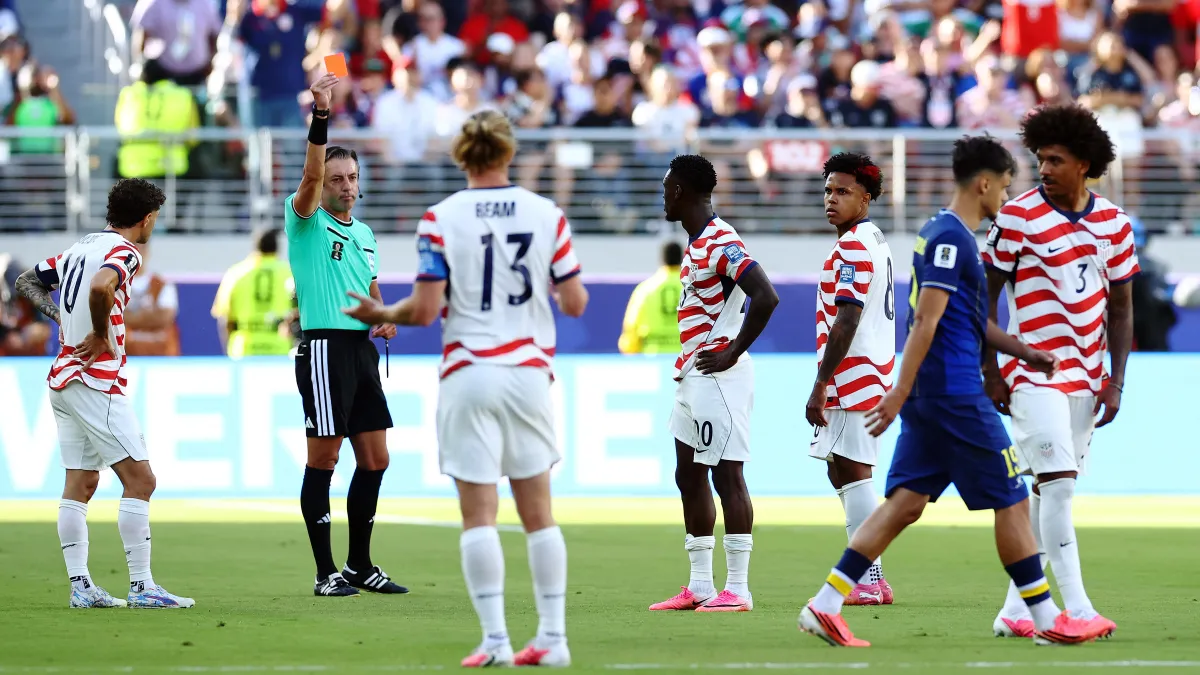
FIFA reached the right football decision on Folarin Balogun, but it did so in a way that exposed a deeper flaw in tournament governance. The forward was cleared to return for the United States after a disputed sending-off, yet the method used to reverse the ban raised fresh questions ahead of the World Cup 2026, when scrutiny on officiating, discipline and transparency will be even more intense.
At the centre of the debate was a red card many observers felt should never have stood. Former referees, television analysts and ex-players broadly agreed the challenge did not meet the threshold for a dismissal. That consensus made Balogun’s availability feel justified. Still, the bigger issue was not simply whether FIFA corrected an error, but how it chose to do it.
Why the decision felt fair but the process did not
FIFA reportedly relied on a rarely discussed disciplinary provision to suspend the suspension rather than using a clear, public appeals route. For a competition of this scale, that is an uncomfortable reality. Elite leagues around the world have structured review systems for red cards, usually with strict deadlines, written submissions and independent panels. FIFA, by contrast, appeared to lean on internal discretion.
That matters because tournament football depends on trust. Players, coaches and supporters want to believe major calls are judged through a transparent framework, not improvised under pressure. With the FIFA World Cup 2026 set to be the biggest edition yet, governance cannot feel opaque when the stakes are so high.
- A controversial red card triggered the dispute
- Balogun’s return was widely viewed as the correct sporting outcome
- The lack of a visible appeals system became the real story
- Questions now linger over consistency in future cases
Read more: Explore the latest sports stories and match analysis
What this means before World Cup 2026
The World Cup 2026 will bring more matches, more teams and even greater pressure on referees and review systems. As debate builds around the World Cup 2026 schedule, World Cup 2026 teams and the 48 team World Cup format, FIFA also faces a parallel challenge: proving that its disciplinary structure is fit for purpose.
Supporters already want clarity on the World Cup 2026 dates, World Cup 2026 host countries and World Cup 2026 venues. They will expect the same clarity around suspensions, appeals and player eligibility. If confusion emerges in a knockout match, the fallout will be impossible to contain, especially when every call is replayed and debated globally within seconds.
A modern tournament needs modern accountability
Football has accepted technology as part of the sport, but technology alone does not guarantee fairness. Video review can correct mistakes, yet it can also deepen controversy if the review process itself lacks consistency. Balogun’s case underlined that point. The issue was not only a questionable decision on the pitch, but the absence of a trusted path to fix it.
Explore: More football coverage, media reaction and tournament insight
Pressure is growing on FIFA to clarify its system
From the outside, this looked like a governing body correcting an officiating mistake while avoiding a direct explanation of its mechanics. That invites criticism from rival teams and fuels claims of inconsistency, even when the final outcome is reasonable. In major tournaments, perception matters nearly as much as precedent.
As attention turns to the World Cup 2026 draw, World Cup 2026 fixtures and the World Cup 2026 knockout stage, FIFA would be wise to formalise a visible appeal model that mirrors top domestic competitions. A transparent process would protect referees, reassure teams and reduce the sense that big rulings are being settled behind closed doors.
- Create a dedicated tournament appeals panel
- Set firm deadlines for disciplinary reviews
- Publish brief written explanations for major reversals
- Apply identical standards across all teams and matches
Read more: Explore broader international stories and event features
The takeaway for football’s biggest stage
Balogun’s reinstatement was, in sporting terms, the sensible conclusion. But football’s governing body cannot rely on ad-hoc fixes if it wants the World Cup 2026 to be remembered for the action rather than administrative confusion. Fairness is only fully convincing when the rules are visible, consistent and easy to understand. That is the standard FIFA must meet before the next global tournament begins.