

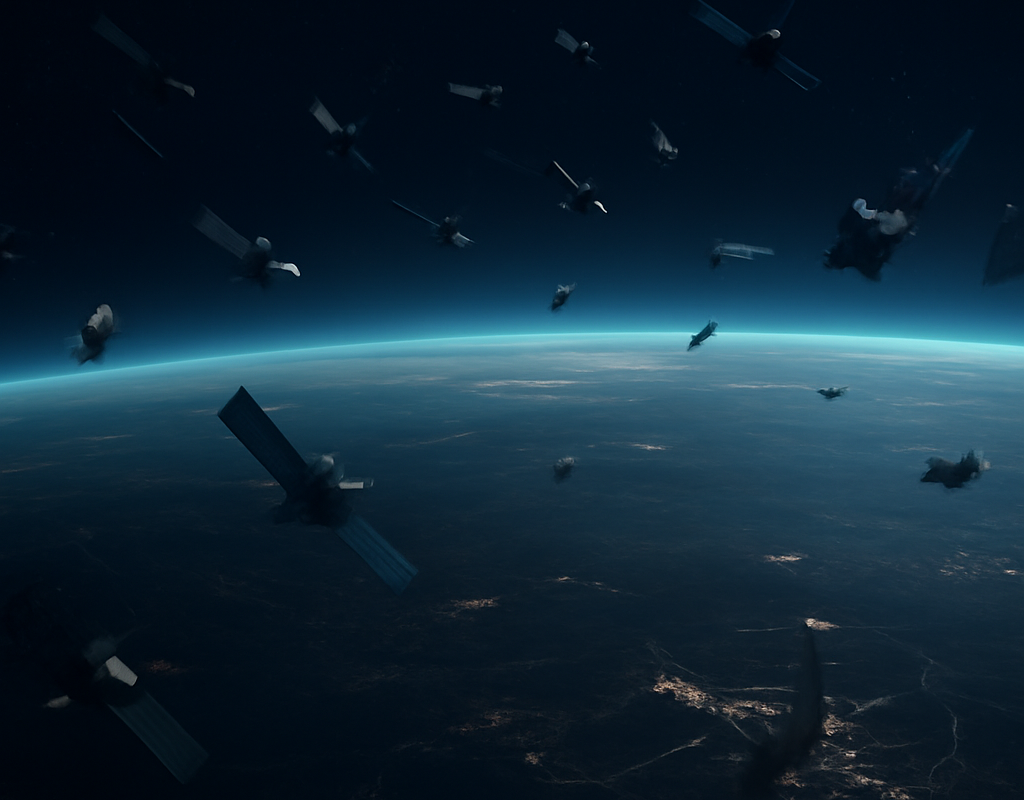
Russian President Vladimir Putin has praised Elon Musk as a “genius” while confirming that Moscow is developing its own satellite internet network to rival Starlink. The remarks highlight the growing strategic importance of satellite communications, an area increasingly linked to connectivity, national security and space competition.
Putin made the comments during an exhibition in Moscow held alongside the Russia-Africa summit. According to the report, he was told that Musk had more than 5,000 satellites in orbit before describing the US technology entrepreneur in highly favourable terms.
Putin says Russia is developing its own Starlink rival
Russia is seeking to establish an independent satellite internet system capable of providing communications coverage through a large network of spacecraft in low Earth orbit. The project would offer an alternative to Starlink, the satellite broadband service operated by Musk’s SpaceX.
Putin said Russia was proud to have begun developing its own system. However, the remarks did not include a launch timetable, details of the network’s planned size or information about when commercial services could become available.
Satellite internet systems use large groups of satellites to transmit data between ground terminals and users. Compared with conventional fixed-line networks, they can help connect remote areas and may remain operational where terrestrial infrastructure is limited or damaged.
Why satellite connectivity has become strategically important
Satellite communications are no longer viewed solely as a commercial technology. They are also relevant to government services, emergency response, transport, defence and communications resilience.
Starlink has become one of the most prominent examples of a low-orbit satellite network. Its development has placed Musk and SpaceX at the centre of a global race involving commercial companies and national space programmes.
For governments, building a domestic network could reduce dependence on foreign operators and provide greater control over data, access and infrastructure. It could also support communications in rural or difficult-to-reach regions.
Key issues for any competing system would include:
- the number and capability of satellites required;
- ground stations and user terminals;
- launch capacity and production costs;
- frequency coordination and orbital safety;
- cybersecurity and protection against interference.
Putin refers to contacts with US partners
Despite political tensions between Moscow and Washington, Putin said Russia remained in contact with American partners, including Musk. He linked cooperation in orbit to the need to avoid interference and preserve what he described as discipline and order in space.
His comments reflect a broader challenge facing the satellite sector. As more spacecraft are launched, operators must coordinate orbital positions and radio frequencies to reduce the risk of collisions, disruption and harmful interference.
Space activity is governed by international rules and technical coordination procedures, but the rapid expansion of satellite constellations has increased pressure on existing systems. The issue has implications not only for commercial broadband but also for Earth observation, navigation and scientific research.
What is known about Russia’s proposed network?
The report confirms that Russia is working on an alternative to Starlink, but provides limited information about the project’s design or progress. It does not establish whether the network has reached an operational phase, how it would be financed or which organisations would manage it.
That distinction matters. A government announcement or expression of support is not the same as a completed satellite constellation. Such projects require years of planning, spacecraft manufacturing, launch arrangements, ground infrastructure and regulatory approval.
Russia’s ambitions also face practical challenges. Satellite internet networks require continuous investment and reliable access to launch services. They must compete for spectrum, manage orbital congestion and provide affordable terminals to users. Service quality can also depend on geography, weather, network capacity and the availability of ground equipment.
International and European implications
The development is primarily a Russian national and international space-policy story rather than an EU decision. It does not represent a new European Union rule or an announcement by the European Commission.
Nevertheless, the expansion of competing satellite networks is relevant to European security and digital infrastructure discussions. European governments and institutions are also examining how to improve secure connectivity, reduce strategic dependence and protect critical communications.
For European businesses and public authorities, the growth of satellite broadband could create additional options for backup connectivity, maritime communications, disaster response and remote services. At the same time, it raises questions about spectrum management, cyber resilience, space debris and the governance of privately operated infrastructure.
There is no specific measure affecting Ireland in the reported announcement. Any future European or Irish response would depend on later decisions involving telecommunications regulation, security policy, space cooperation or sanctions frameworks.
What happens next?
The next significant indicators will be technical and institutional rather than rhetorical. They would include the publication of a formal programme, identification of the responsible operators, satellite production milestones, launch schedules and details of user access.
Until those details are made public, Russia’s project should be understood as a developing ambition rather than an operational replacement for Starlink. The comments do, however, underline how satellite internet has become part of the wider competition over digital infrastructure and strategic autonomy.
Conclusion
Putin’s praise for Musk comes as Russia seeks to build an independent satellite internet network capable of challenging Starlink. The immediate announcement does not provide evidence that the Russian system is operational, but it confirms Moscow’s intention to compete in a strategically important sector. The project’s credibility will ultimately depend on concrete plans, launches and service deployment—not only political declarations.