

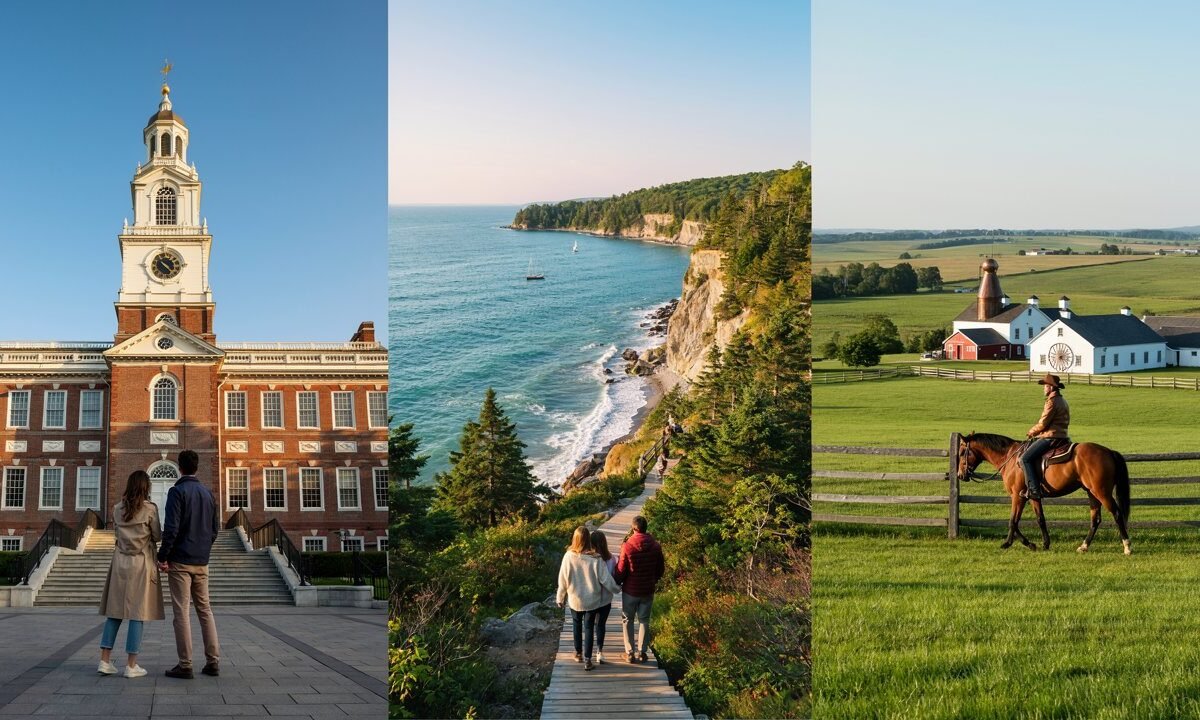
Tourism growth in Pennsylvania, Michigan and Kentucky is showing how destinations beyond America’s biggest metropolitan centres are strengthening the visitor economy. The three states recorded substantial visitor numbers and economic contributions in 2025, while 2026 projections point to continued expansion driven by heritage attractions, major sporting events, outdoor experiences and cross-border travel from Canada.
The figures come from the supplied comparative analysis and should be read carefully: 2025 results are presented as recorded benchmarks, while 2026 figures are forecasts rather than confirmed year-end totals. Together, they highlight the different reasons travellers are choosing regional US destinations, from Philadelphia’s historic landmarks and Michigan’s Great Lakes coastline to Kentucky’s bourbon and horse-racing traditions.
Three states, three distinct tourism economies
Pennsylvania recorded the largest visitor volume among the three states, with 206.2 million visitors in 2025. Direct traveller spending reached $51.6 billion, while the total economic impact was reported at $87.2 billion. Tourism supported 521,021 jobs across the Commonwealth.
Michigan welcomed more than 125 million visitors in 2025 and generated approximately $28.2 billion in direct traveller spending. Its overall tourism impact reached $54.8 billion, supporting 351,292 jobs. Kentucky recorded 81.1 million visitors, $10.4 billion in direct spending and a total economic impact of $14.6 billion, with nearly 97,000 tourism-supported jobs.
These figures are not directly interchangeable in every respect because the states use different tourism environments and visitor profiles. Pennsylvania benefits from its population centres, historic sites and major events, while Michigan relies heavily on regional drive travel, lakeside holidays and outdoor recreation. Kentucky’s visitor economy is smaller in volume but has a strong identity built around bourbon, equestrian sport, caves and rural tourism.
Pennsylvania tourism gains momentum through history and major events
Pennsylvania’s 2025 visitor total included travellers from neighbouring US states as well as international markets. New York, New Jersey, Maryland, Ohio and Virginia were identified as important domestic sources, while Canada, the United Kingdom, Germany and Japan were highlighted among leading international markets.
Philadelphia is expected to remain a central tourism hub in 2026. The city is linked to celebrations surrounding the United States Semiquincentennial, as well as major sporting fixtures including 2026 FIFA World Cup matches, the MLB All-Star Game and the PGA Championship. These events may increase demand for accommodation, restaurants, transport and attractions, although the final economic results will depend on visitor behaviour and event attendance.
What draws visitors to Pennsylvania?
- Revolutionary-era sites including Independence Hall, the Liberty Bell and Valley Forge.
- Gettysburg and other historic destinations connected with US history.
- The Pocono Mountains, Pennsylvania Wilds and Laurel Highlands.
- Fallingwater and other architecture and cultural attractions.
- Lancaster County’s heritage, food and countryside experiences.
Canada remains particularly relevant because of Pennsylvania’s road connections and proximity to the Great Lakes region. Visitors from the United Kingdom and Germany are more likely to build longer cultural or heritage itineraries, while Japan is identified as an important market for sports, education and cultural travel.
Michigan combines Great Lakes escapes with urban culture
Michigan’s tourism economy is closely tied to its coastline, islands and outdoor landscapes. The state has more than 3,200 miles of Great Lakes shoreline, creating demand for summer road trips, cottage stays, boating and beach holidays. Mackinac Island and Sleeping Bear Dunes National Lakeshore are among the destinations identified as major draws.
Canada is the leading international market in the supplied analysis, with visitors arriving particularly from Ontario through crossings connected to Detroit and Port Huron. Cross-border shopping, lakeside breaks and longer summer stays support hotels, rentals, restaurants and retail businesses.
Michigan’s visitor offer also extends beyond nature. Detroit’s Motown heritage, automotive attractions and urban redevelopment provide a cultural draw, while Grand Rapids is associated with craft beverages and city breaks. In northern Michigan, Pictured Rocks, the Upper Peninsula, autumn colour tours and winter snowmobiling broaden the travel season.
Michigan’s projected 2026 direction
The analysis projects roughly 127.5 million to 128.5 million visitors in 2026, with direct spending estimated at $29.2 billion to $29.8 billion. These numbers remain projections. The state’s tourism performance will be influenced by seasonal conditions, cross-border travel demand, major infrastructure developments and the continued appeal of four-season experiences.
Kentucky builds on bourbon, horses and outdoor travel
Kentucky’s 81.1 million visitors in 2025 represented an all-time high according to the supplied figures. Direct traveller spending reached $10.4 billion, with a total economic impact of $14.6 billion. Tourism supported 96,993 jobs.
The state’s strongest international source markets were identified as Canada, the United Kingdom, Germany and Japan. Canadian travellers benefit from established road connections through the Midwest and South, while British visitors are drawn to bourbon, thoroughbred racing and Kentucky’s cultural heritage.
Key Kentucky attractions
- The Kentucky Bourbon Trail and wider craft-distillery network.
- The Kentucky Derby at Churchill Downs and racing at Keeneland.
- Mammoth Cave National Park and the state’s resort parks.
- Red River Gorge and other outdoor destinations in eastern Kentucky.
- Louisville Slugger heritage and sports-related travel in Louisville and Lexington.
The analysis forecasts approximately 82 million to 82.5 million visitors in 2026, with direct spending between $10.8 billion and $11.1 billion. Again, these are forward-looking estimates rather than confirmed results.
Why Canadian visitors matter to all three states
Canada is identified as the leading international feeder market for Pennsylvania, Michigan and Kentucky. The reasons differ by destination, but proximity is a consistent advantage. Many Canadian visitors can reach these states by car, making short breaks, family holidays, shopping trips and multi-stop road journeys practical.
For Pennsylvania, the appeal includes Philadelphia, the Poconos and Lake Erie. Michigan offers direct access to Great Lakes destinations and Detroit. Kentucky benefits from established interstate corridors leading to bourbon country, Mammoth Cave and equestrian venues.
Cross-border travellers also spread spending beyond major cities. Accommodation providers, restaurants, attractions, fuel stations, retailers and rural businesses can all benefit when visitors extend their stays or travel through less densely populated areas.
What the 2026 outlook means for travellers
The projections suggest continued investment and demand across several types of US travel:
- Heritage travel: Pennsylvania’s historic sites and major national events may support higher demand in Philadelphia and surrounding regions.
- Outdoor holidays: Michigan and Kentucky offer coastlines, caves, forests, lakes and trails across multiple seasons.
- Special-interest trips: Bourbon tourism, motorsport, baseball, golf and horse racing create reasons to travel outside traditional city breaks.
- Road travel: Canada’s importance underlines the role of cross-border driving and regional touring.
Travellers planning a visit should check official attraction schedules, event ticketing information and accommodation availability before booking. Major events can affect prices and capacity, while outdoor destinations may have seasonal access rules.
Conclusion
Pennsylvania, Michigan and Kentucky demonstrate how regional destinations can expand the US visitor economy through different combinations of history, nature, sport, food and cross-border access. Pennsylvania leads in visitor volume and overall economic impact, Michigan stands out for its Great Lakes and four-season offer, and Kentucky continues to build its reputation around bourbon, horses and outdoor adventure.
The most important takeaway is that the 2026 figures are projections, not final results. Even so, the direction is clear: travellers are increasingly finding compelling experiences beyond America’s traditional gateway cities, while Canadian visitors remain an important source of international demand.