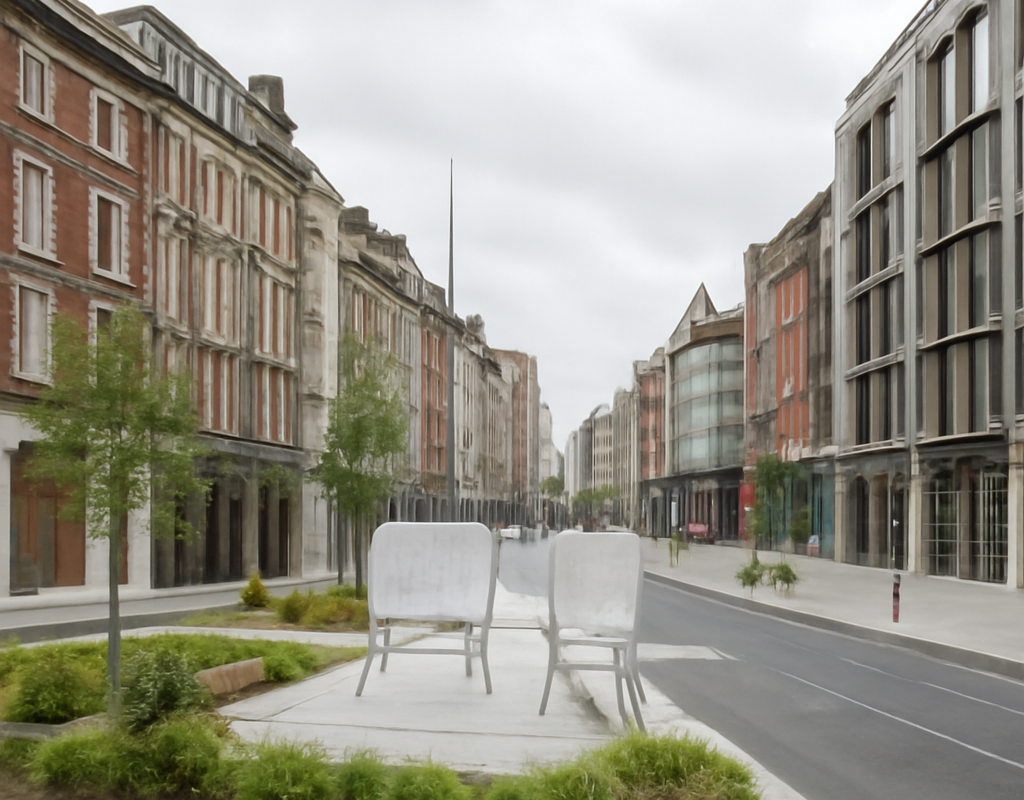
Dublin’s O’Connell Street regeneration is expected to prioritise one- and two-bedroom apartments, alongside the conversion of vacant buildings and redevelopment of derelict sites. The plans mark a proposed shift towards a more residential city centre, while also raising questions about whether Dublin needs a broader mix of homes for families.
O’Connell Street regeneration will prioritise homes
Robert Watt, who has been appointed to lead the Dublin City Development Company, said the area around O’Connell Street needed a new purpose. Speaking at an architecture conference in Dublin, he described the district as having “lost its way” and said it required a different mission.
The proposed O’Connell Street regeneration programme is expected to focus primarily on residential development. Watt said changing conditions in Dublin’s office market made housing a likely use for many buildings and sites, with entertainment also potentially forming part of the future mix.
One- and two-bedroom apartments are likely to make up much of the new accommodation. Watt suggested that these homes could suit people starting out in the city centre before they later move elsewhere when they have children.
Debate over family housing in Dublin city centre
The proposed housing mix prompted discussion among architects and delegates at the conference. Some challenged the assumption that central Dublin is unsuitable for families, arguing that a successful urban neighbourhood should support residents at different stages of life.
Watt acknowledged that there was a debate to be had about the appropriate residential balance. The issue is significant for Dublin’s housing strategy, as the city needs both smaller apartments and suitable family homes if regeneration is to create a permanent community rather than short-term accommodation.
The plans described so far do not set out a final number of homes, a confirmed construction timetable or a definitive breakdown of apartment sizes. Those details are expected to form part of the work of the development company once it is formally established.
Vacant buildings and derelict sites at the centre of plans
A major element of the O’Connell Street regeneration proposal will be the adaptation and conversion of underused or vacant buildings. Watt said Dublin had not made enough use of the space above shops, unlike some other cities where central neighbourhoods have substantial residential populations.
The development company will also examine larger vacant sites through mixed-use master plans. One example is the Carlton site above the planned O’Connell Street MetroLink station, which was acquired earlier in 2026 by Transport Infrastructure Ireland.
Watt highlighted the length of time the Carlton site has remained vacant, describing its condition as a striking example of dereliction in the heart of the capital. Its future could therefore become an important test of how effectively public bodies can coordinate transport, housing, commercial space and public-realm improvements.
- Conversion of vacant and underused buildings
- Residential redevelopment of derelict sites
- Mixed-use planning for larger landholdings
- Better integration between housing and the planned MetroLink station
Call for a stronger State role in major developments
Watt also criticised what he described as a developer-led approach to assembling and managing large urban sites. In his view, the State should be more active in controlling land and coordinating redevelopment where projects have strategic importance for the city.
He argued that public authorities had not done enough to manage and assemble land, and said this had contributed to some of Dublin’s largest urban failures. The comments suggest that the new development company could have a role beyond approving individual projects, potentially helping to shape how multiple sites work together.
The company is due to be established in December 2026. It will then work on priorities identified by Dublin city councillors and by the Dublin City Taskforce report published two years earlier.
Safety is essential to O’Connell Street regeneration
Housing and land management are only part of the challenge. Watt said antisocial behaviour would also need to be addressed if people were to return to O’Connell Street as residents, workers and visitors.
He said many Dublin residents who live and work in the city are afraid to visit the street at certain times of day, describing that as unacceptable. Improving safety will therefore be central to any successful regeneration programme, alongside better maintenance, public spaces, transport connections and services.
A residential population could help bring more activity to the area, but new apartments alone will not resolve concerns about public safety or the quality of the surrounding environment. The success of the plan will depend on whether housing is delivered as part of a wider, coordinated neighbourhood strategy.
What happens next?
The immediate next step is the formal establishment of the Dublin City Development Company. Its work is expected to translate broad regeneration priorities into plans for individual buildings, sites and public spaces.
Important details remain to be confirmed, including the number of apartments, the role of family-sized homes, delivery arrangements and the timetable for construction. The Carlton site and other vacant properties will be closely watched as the strategy develops.
For now, the proposal points towards a more compact and residential O’Connell Street, with smaller apartments forming the likely foundation. The wider debate is whether that approach can also create a diverse and lasting community in the centre of Dublin.
The key takeaway for Dublin
The O’Connell Street regeneration plans are centred on bringing people back into one of Dublin’s most important urban areas through new apartments, building conversions and redevelopment of long-vacant sites. One- and two-bedroom homes are expected to dominate, but the final housing mix has not been decided. For the scheme to succeed, housing delivery will need to be matched by action on safety, public space and the long-term management of major city-centre land.