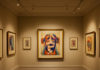
A gold statue depicting Donald Trump fully naked has been unveiled inside the European Parliament building in Strasbourg, France, in a provocative installation titled The Orange Plague. The work shows the former US president crushing the shoulders of a smaller figure, combining political satire with deliberately confrontational public art.
The installation is one of the more unusual stories in current European cultural coverage, but its setting gives it wider significance. Displaying the sculpture at the European Parliament places a highly charged artistic statement inside one of the European Union’s most recognisable institutional venues, where debates over democracy, political power and transatlantic relations regularly take place.
What is The Orange Plague?
The sculpture is a gold-coloured representation of Trump shown without clothing and pressing down on a smaller man. Its title, The Orange Plague, refers to the work’s satirical treatment of the politician’s appearance, public image and perceived influence.
The installation is not an EU decision, European Parliament resolution or official institutional policy. It is an artwork displayed in the Parliament’s Strasbourg premises. That distinction matters: the presence of a piece in the building should not be interpreted as an endorsement by the European Parliament or its political groups.
Political sculpture has long used exaggeration, nudity and symbolism to challenge powerful figures. In this case, the visual language is intentionally direct. The larger figure represents authority and dominance, while the smaller figure beneath him creates an image of pressure and subordination.
Why the setting matters
The European Parliament’s Strasbourg chamber is associated with European legislation, democratic representation and public debate. Art shown in or around such an institution can attract attention precisely because it sits at the boundary between cultural expression and political commentary.
The installation arrives at a time when European politics continues to be closely connected to debates about:
- the future of democracy and political accountability;
- relations between the European Union and the United States;
- the use of satire in public debate;
- the role of cultural institutions in addressing controversial political figures.
Although the source information does not identify the artist, organiser or exhibition programme behind the display, the statue’s location and imagery have made it a notable item in European art news.
Satire, public art and political controversy
Political art often provokes disagreement because it does more than depict a person. It interprets power. A sculpture can be viewed as criticism, parody, activism or an attempt to generate publicity, depending on the perspective of the viewer.
The use of gold gives the figure a monumental, almost celebratory appearance, while the pose undermines that impression. The statue’s exaggerated form turns a recognisable political personality into a symbol of authority, spectacle and controversy.
Its placement inside a parliamentary environment also raises familiar questions about the limits of political expression. Supporters of provocative art may argue that democratic spaces should accommodate criticism and satire. Others may consider imagery of this kind unnecessarily personal or inflammatory. Without an official statement from the Parliament or the organisers, it is not possible to attribute a particular institutional position to the display.
What does this mean for European politics?
The sculpture does not change European legislation, EU policy or the work of the European Parliament. It has no legal effect and does not represent a vote, formal announcement or diplomatic decision.
Its importance is cultural and symbolic. European institutions are increasingly used as settings for exhibitions, installations and public events that reflect wider arguments about identity, leadership and democratic values. In that context, The Orange Plague belongs to a tradition of political art that seeks to make power visible through humour, discomfort and exaggeration.
The work may also attract interest because European and US politics are closely linked. Trade, security, defence, technology regulation and support for Ukraine are among the issues that shape transatlantic relations. However, the available information does not connect this installation to any specific policy dispute or parliamentary proceeding.
How the story fits into European art news
The installation appears alongside a busy programme of exhibitions and cultural events across Europe, including major museum retrospectives, contemporary art biennials and politically themed public works. European cultural coverage increasingly spans traditional galleries as well as installations in public buildings and historically significant locations.
For audiences following Europe news and European cultural affairs, the statue illustrates how art can become part of political conversation without being a formal act of government. The work’s location is central to its impact: the same sculpture displayed in a private gallery would carry a different institutional association.
What happens next?
The source information confirms that the statue has been unveiled, but it does not provide details about how long it will remain on display, who commissioned it or whether the installation forms part of a wider exhibition. Further information from the European Parliament, the organisers or the artist would be needed to clarify those points.
For now, the confirmed position is straightforward: The Orange Plague is a provocative artwork shown at the European Parliament in Strasbourg. It should be understood as a cultural installation rather than a new EU measure or an official parliamentary decision.
Conclusion
The Orange Plague uses an exaggerated gold statue of Donald Trump to turn political power into a visual spectacle. Its appearance at the European Parliament makes the work especially conspicuous, but the display remains an artistic event, not an act of EU policy. The main takeaway from this unusual piece of European news is how public art can bring political symbolism into the spaces where democratic debate takes place.