


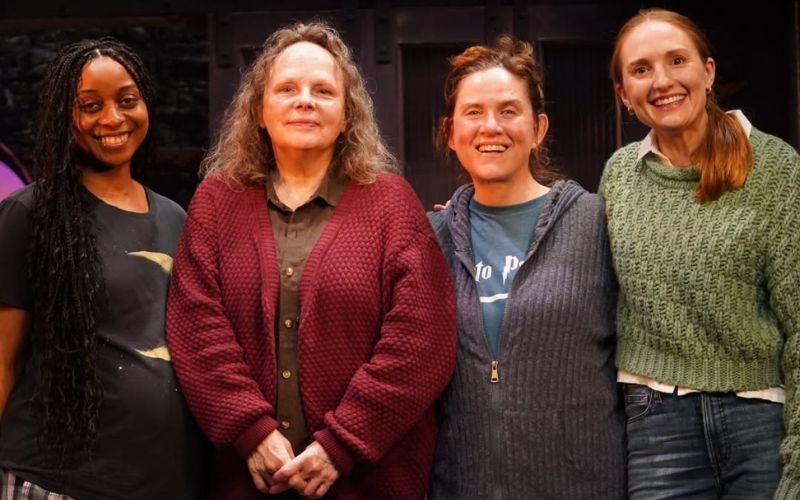
Irish News readers looking for a compelling theater recommendation should put The Loved Ones at the top of the list. Erica Murray’s play, now at Irish Repertory Theatre in New York City through August 2, turns a quiet day in County Clare into an emotionally charged examination of loss, betrayal, motherhood, and the surprising grace people can show one another when life falls apart.
Set almost entirely in an Airbnb cottage in West Clare, the drama begins with absence: a beloved man has died, and those closest to him are left to sort through the wreckage of what he meant to them. What they discover, however, is that the dead are not always who the living believed them to be. That revelation drives the play, but its real strength lies in how it follows the people left behind.
Irish News Take on “The Loved Ones” at Irish Rep
Murray structures the story with patience and precision, allowing new truths to surface gradually over the play’s two-hour runtime. Under the direction of Nicola Murphy-Dubey, the production avoids melodrama and instead builds tension through conversation, hesitation, and emotional misfires. Moments of humor arrive at exactly the right time, giving the audience space to breathe before the next difficult truth lands.
The central figure is Nell, played by Maryann Plunkett, a grieving mother and Airbnb host still reeling from the death of her son Robin. She expects a quiet visit from her daughter-in-law Orla, who plans to mark six months since Robin’s death by scattering his ashes at the Cliffs of Moher. But Nell’s day is disrupted by the unexpected arrival of Gabby, a pregnant student seeking answers and support, and by Cheryl-Ann, an American tourist whose birdwatching holiday places her in the middle of an unfolding family crisis.
For Irish News audiences, this setup feels especially effective because it blends intimate family drama with a distinctly Irish setting. The County Clare landscape, though mostly offstage, hangs over the action, adding a sense of beauty and stillness that contrasts with the turmoil inside the cottage.
A Story of Hidden Lives, Grief, and Moral Upheaval
The real engine of The Loved Ones is the way each character is forced to confront not only Robin’s secret life, but also the stories they tell themselves about love, loyalty, and identity. Nell must ask whether she truly knew the son she adored. Her grief becomes more complicated as accusations and revelations chip away at her certainty, yet she resists easy judgment and clings to empathy even when anger would be simpler.
Gabby arrives carrying both vulnerability and frustration. She believes Nell may understand her situation and offer meaningful guidance as she faces an uncertain future. At first, she presents herself with careful restraint, but that calm eventually breaks under the pressure. Her pregnancy is not just a plot point; it becomes a lens through which the play explores responsibility, dependence, and the difficult gap between youthful plans and adult realities.
Nell, grounded by experience, tries to impress upon Gabby that motherhood demands more than hope. Financial stability, practical support, and reliable family connections matter. That exchange becomes one of the production’s most revealing moments because it shows how compassion in this play is rarely sentimental. It is often blunt, uncomfortable, and honest.
Orla’s heartbreak gives the play its emotional center
Orla enters the cottage expecting solitude and remembrance, only to discover that her marriage may have been built on truths she never knew. Her mourning is therefore doubled: she is grieving Robin’s death while also grieving the future she thought they were building together. One of the hardest questions she faces is whether to continue IVF treatment and pursue the child they had planned.
Clare O’Malley’s Orla moves convincingly between rage, sorrow, and generosity. What makes the character so affecting is that she never stops hurting, even when she chooses to help someone else. That decision to turn outward, despite personal devastation, says a great deal about the play’s moral vision.
Cheryl-Ann is more than comic relief
At first, Cheryl-Ann seems designed to lighten the mood. She is talkative, distinctly American, enthusiastic about birding, and charmingly nerdy in her pop-culture interests. But Murray gives the character much more depth than a stock outsider. Donna Lynne Champlin reveals a woman with her own buried pain, someone whose past has taught her how to sit with discomfort and offer perspective without demanding attention.
Her reflections on birds and their ability to live in the present provide one of the play’s clearest statements of purpose. In a story crowded with regret, fear, and what-ifs, Cheryl-Ann becomes a gentle reminder that survival sometimes begins with accepting the moment in front of you.
Why This Production Resonates Beyond the Plot
What makes this production memorable is not simply the twist of Robin’s hidden life, but the emotional intelligence with which the fallout is handled. Rather than punishing its characters for their flaws, The Loved Ones watches them adjust, listen, and slowly recognize one another’s pain.
- Erica Murray’s script carefully layers revelations without losing emotional clarity.
- Nicola Murphy-Dubey’s direction keeps the pacing taut while preserving warmth and humor.
- The ensemble cast delivers nuanced performances that deepen as the play unfolds.
- The setting in County Clare gives the intimate drama a rooted Irish atmosphere.
For Irish News readers interested in contemporary Irish theater, this is a work that shows how personal tragedy can open the door to unexpected solidarity. There is no glossy ending and no tidy resolution, but there is something more believable: the possibility that damaged people can still care for one another.
Final Verdict
In Irish News terms, The Loved Ones stands out as a thoughtful, deeply felt drama that values compassion over spectacle. Its secrets may draw the audience in, but its humanity is what lingers after the curtain falls. Playing at Irish Rep through August 2, this is a production worth seeing for anyone who values Irish storytelling that is emotionally honest, sharply observed, and quietly hopeful.