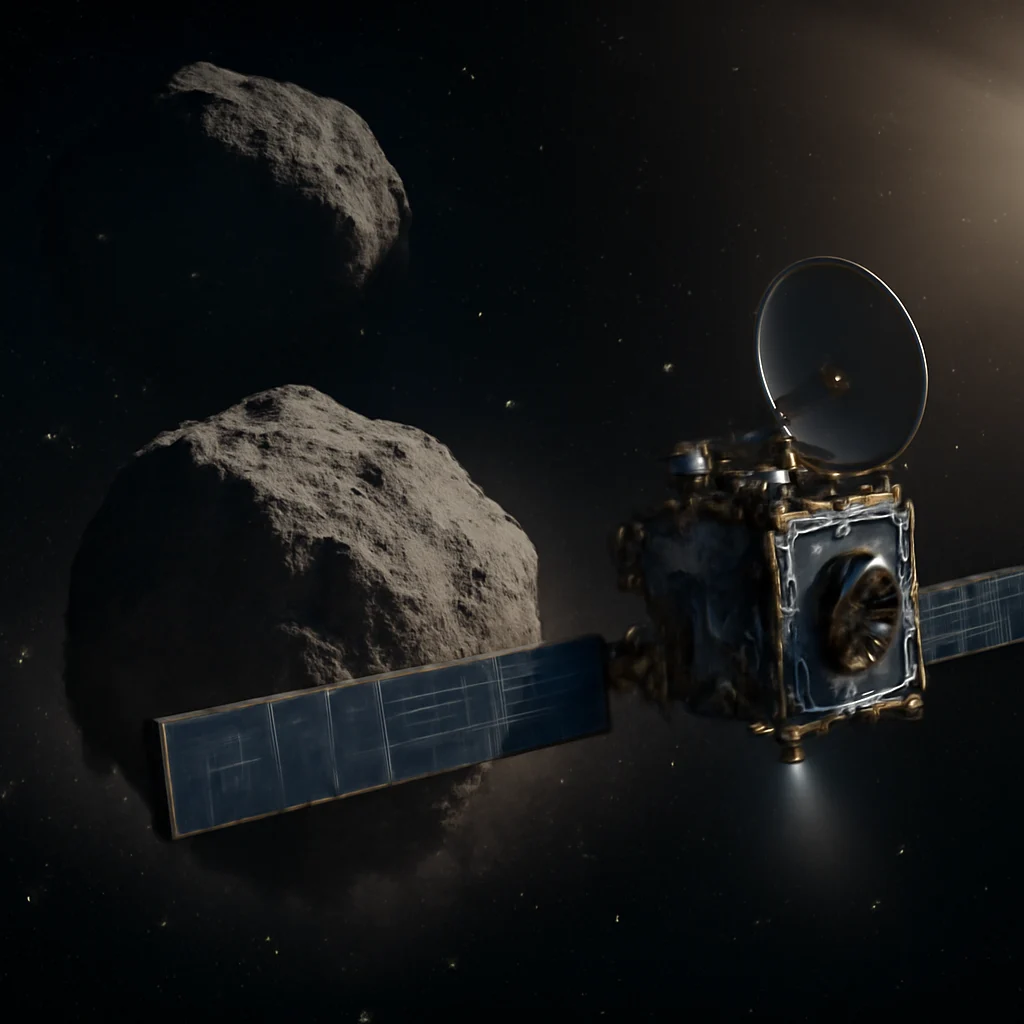
A European spacecraft has reached the asteroid Dimorphos to examine the aftermath of NASA’s deliberate collision in the first major test of planetary defence. The Hera mission will investigate how the 2022 impact changed the space rock and what the findings could mean if an asteroid ever threatened Earth.
Hera is expected to begin a detailed survey of the 150m-wide asteroid, with its first images due to be released on Wednesday. The European Space Agency mission will spend about a year studying Dimorphos and its larger companion, Didymos.
Hera spacecraft returns to the scene of the DART impact
NASA’s Double Asteroid Redirection Test, known as DART, struck Dimorphos in September 2022 at roughly 22,000km/h. The spacecraft was destroyed, but the collision demonstrated that a kinetic impact could alter an asteroid’s movement.
Before the impact, Dimorphos took 11 hours and 55 minutes to orbit Didymos. Afterwards, its orbital period became approximately 33 minutes shorter. Telescopes also observed a debris trail stretching around 10,000km.
However, observations from a distance could not reveal precisely what happened beneath the surface. Scientists do not yet know whether DART carved a crater into Dimorphos or substantially reshaped the asteroid. Hera’s close-range measurements are intended to provide those answers.
What will the mission examine?
The spacecraft carries instruments designed to map the impact area and assess the physical properties of both asteroids. It also has two small companion satellites that can approach Dimorphos, study the crash site and eventually attempt to land.
One of the most important objectives is to measure Dimorphos’s mass. That figure will help scientists calculate how efficiently DART transferred momentum to the asteroid and how reliable the technique could be in a future emergency.
- The size and depth of any impact crater
- Whether Dimorphos remained intact or was reshaped
- The asteroid’s mass and surface characteristics
- How the collision produced the observed change in its orbit
Why asteroid deflection matters for Earth
Dimorphos poses no danger to Earth. The mission was designed as a controlled experiment to test whether a spacecraft could move an asteroid’s path sufficiently to prevent a future impact.
Large asteroids more than a kilometre across could cause global devastation, while objects around Dimorphos’s size could potentially destroy a city. The greatest uncertainty concerns medium-sized asteroids that have not yet been identified.
Researchers say the largest potentially hazardous objects have largely been detected and none is currently known to be on a collision course with Earth. Smaller objects are often weakened or destroyed by the atmosphere. Between those groups, however, there remains a population that scientists are working to find and understand.
Hera’s data could help establish how much warning would be needed, how large a deflection spacecraft would have to be and how the asteroid’s composition affects the outcome. Those details would be essential in planning any real planetary-defence response.
Future missions will improve asteroid monitoring
Hera is part of a wider effort to identify and study near-Earth objects. NASA’s Near-Earth Object Surveyor space telescope is scheduled to launch in 2027 and will search for potentially hazardous asteroids.
Another important opportunity will come in 2029, when the roughly 450m-long asteroid Apophis passes about 32,000km above Earth’s surface. Scientists once considered an impact possible, but improved observations now show that Apophis will not collide with Earth for at least the next century.
Its close approach will nevertheless allow detailed study. NASA’s OSIRIS-APEX and the ESA-JAXA Ramses mission are among the spacecraft planned to observe Apophis.
What Hera could teach scientists
The DART impact proved that an asteroid’s orbit can be changed, but the result alone is not enough to create a dependable defence strategy. Scientists need to understand why the manoeuvre worked, how much material was displaced and whether different types of asteroid would respond in the same way.
Hera’s investigation will turn a dramatic space experiment into a better-tested scientific method. By measuring the impact’s consequences directly, the mission should help researchers move from a successful demonstration towards practical planning for a genuine asteroid threat.
The key takeaway: Hera is not responding to an immediate danger. It is gathering the evidence needed to determine whether humanity could deflect a hazardous asteroid early enough to protect Earth.