

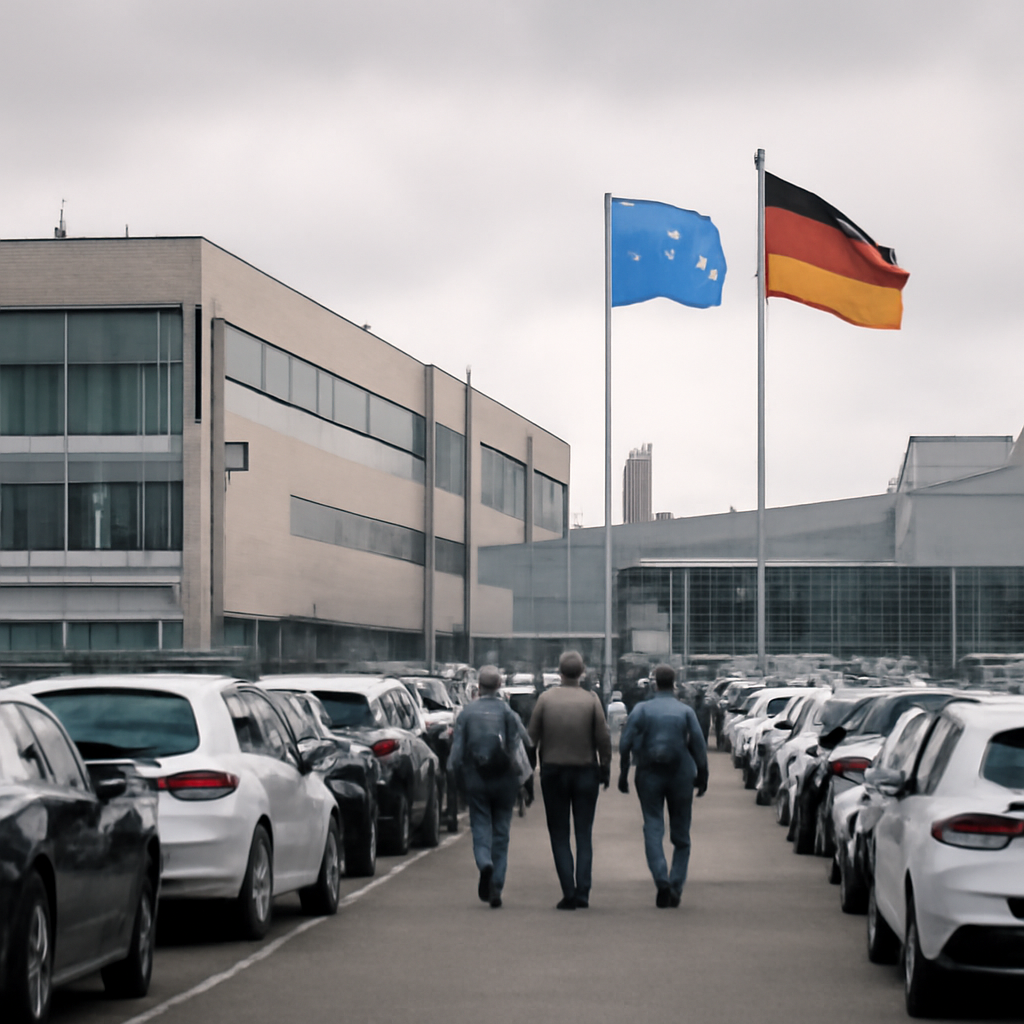
Germany’s finance minister has called for tougher European Union trade measures against Chinese carmakers, warning that rising imports are intensifying pressure on Volkswagen and other established manufacturers. The appeal came during a visit to Volkswagen’s headquarters as Chinese brands move towards selling more than one million vehicles in Europe in 2026.
Lars Klingbeil said the EU should consider extending tariff coverage to plug-in hybrid vehicles and introduce local-content requirements. His intervention highlights growing concern in Germany about factory closures, job losses and the competitiveness of Europe’s automotive industry.
Germany calls for a stronger EU response
Klingbeil argued that Germany must adopt a more robust approach towards countries that threaten its industrial base. Speaking after meetings with Volkswagen employees and local politicians, he said Europe could not afford to be naïve in its dealings with China.
The comments represent a notably tougher position from Germany, whose automotive sector has deep commercial links with the Chinese market. They also reflect pressure from workers and regional communities facing uncertainty as traditional carmakers restructure.
Volkswagen is undertaking what it has described as the deepest restructuring in its history, with cumulative job reductions approaching 100,000. Mercedes-Benz and BMW are also reducing their workforces as manufacturers confront weaker demand, the cost of the electric transition and increasingly competitive Chinese brands.
Why existing EU tariffs do not cover hybrids
The European Union introduced higher duties on Chinese-built electric vehicles after concluding that state support gave producers an unfair competitive advantage. However, the measures do not cover plug-in hybrid vehicles, creating a potential route around the existing tariffs.
Chinese manufacturers have increasingly focused on this segment. According to the figures cited in the source report, their share of European plug-in hybrid sales rose from 2.5% to 13.7% in a single year.
Germany is now seeking what Klingbeil described as concrete action in two areas:
- Extending additional tariffs to Chinese plug-in hybrid vehicles.
- Introducing local-content rules requiring a larger proportion of components to come from European suppliers.
Any change to EU tariffs or trade requirements would need to follow the bloc’s formal procedures. A statement by a national minister does not itself alter EU trade law, and further institutional action would be required before new measures could apply.
Chinese car sales in Europe continue to climb
The debate is being driven by the rapid expansion of Chinese brands. Five years ago, Chinese-brand vehicles accounted for about 66,000 sales in Europe, in a market exceeding 11 million new cars. Their share had risen to approximately 3% by 2023, 6.1% in 2025 and 9.2% during the first half of 2026.
Chinese manufacturers are now reported to be outselling well-known European and US brands, including Ford, Audi and Mercedes-Benz, in some individual months. Sales are on course to exceed one million vehicles in Europe during 2026 for the first time.
The growth has been especially visible in electric and plug-in hybrid vehicles, where Chinese companies have competed through pricing, production capacity and an expanding range of models. The shift is forcing European manufacturers to reassess supply chains, product strategies and investment plans.
Volkswagen workers add pressure on Berlin and Brussels
The trade dispute is closely connected to employment concerns. Daniela Cavallo, chair of Volkswagen’s supervisory board and a prominent labour representative, supported calls for tariffs covering Chinese hybrids, describing competition with China as exceptionally difficult and unfair.
IG Metall, Germany’s largest industrial union, has also been pressing Volkswagen management over the pace and scale of restructuring. The union has organised walkouts and protests at plants including Zwickau and Hanover and is planning further demonstrations involving carmakers and suppliers.
For workers, the argument is not limited to trade policy. It concerns whether European factories can remain viable as the industry moves towards electric vehicles while competing with companies benefiting from different cost structures and state support systems.
What could happen next?
Germany’s proposal is likely to intensify debate within the European Commission and among EU member states. The Commission is responsible for the bloc’s common commercial policy, but significant trade measures involve legal, economic and political assessments.
Possible next steps could include:
- Further analysis of Chinese plug-in hybrid imports and their impact on European producers.
- Discussions among member states and the European Commission about tariff coverage.
- Consideration of how local-content requirements would comply with EU and international trade rules.
- Consultation with manufacturers, workers, suppliers and other affected industries.
The outcome is not yet settled. Some member states may support stronger protection for European production, while others may be concerned about higher vehicle prices, possible retaliation from China or the effect on European companies operating in the Chinese market.
Why the dispute matters for Europe
The controversy sits at the intersection of trade policy, industrial strategy and climate goals. European governments want to support domestic manufacturing and skilled employment, but consumers and companies also need access to competitively priced lower-emission vehicles.
Higher tariffs could give European manufacturers additional time to improve their electric and hybrid offerings. They could also increase costs for importers and buyers if companies pass duties through to retail prices. The effect would depend on the design, scope and duration of any future measures.
For Ireland, the immediate issue is not a national tariff decision but a potential change to EU trade policy. Ireland’s businesses and consumers could be affected through vehicle prices, supply chains and the wider performance of the European automotive market. Any formal proposal would need to clarify which vehicle categories and components were covered.
Conclusion
Germany’s call for tougher EU tariffs on Chinese cars shows how quickly competition in electric and hybrid vehicles has become a strategic issue for Europe. The request to include plug-in hybrids and local-content requirements is still a political demand, not an adopted EU measure.
The key test for Brussels will be balancing support for European jobs and manufacturers with consumer choice, affordability, climate objectives and the risk of trade retaliation. The next stage will depend on whether Germany can build sufficient support among the European Commission and other EU member states.