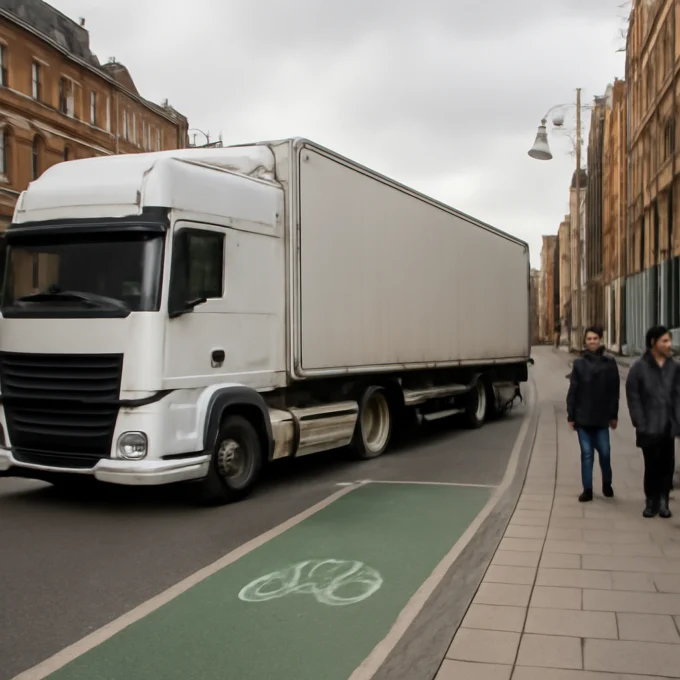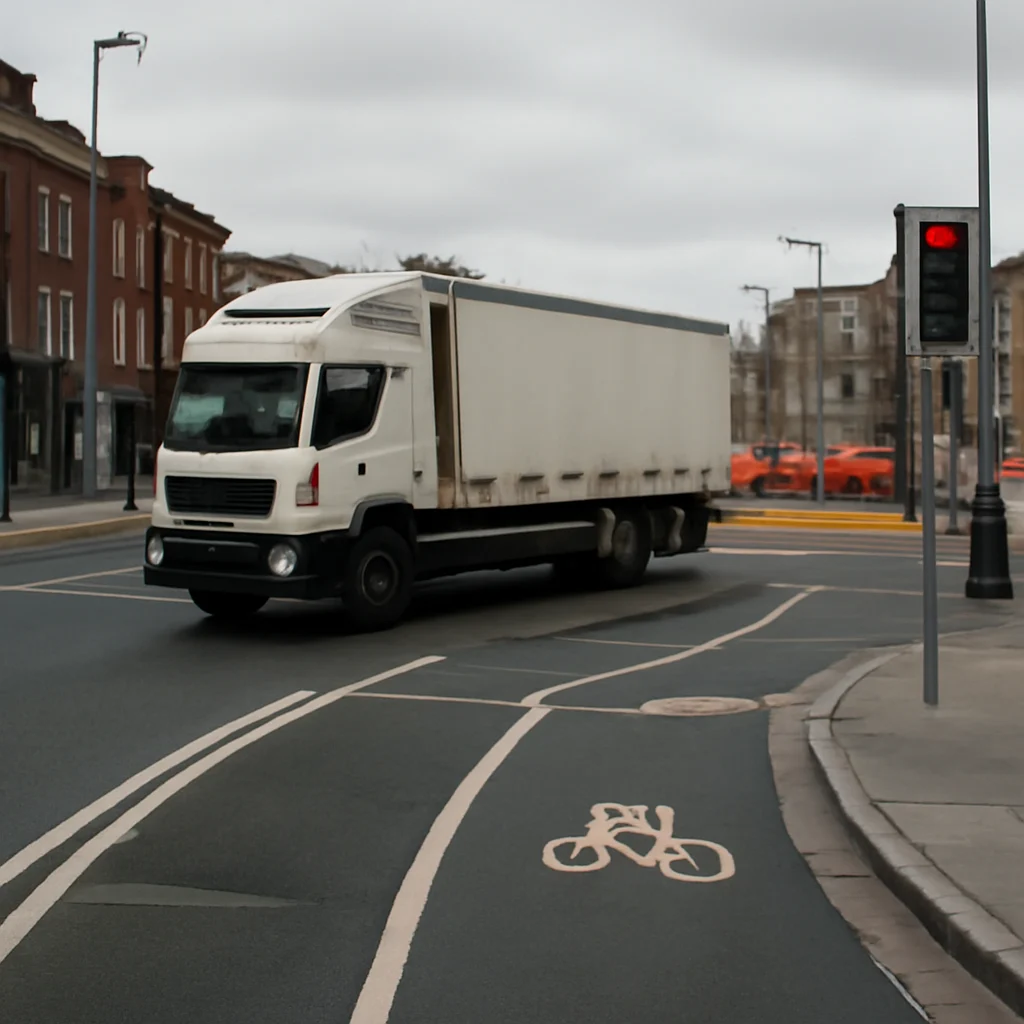
New Dublin road safety rules will prevent certain heavy goods vehicles from entering the city unless they are fitted with blind-spot monitoring and anti-crush safety technology. The measures are intended to reduce the risk of fatal and serious collisions involving pedestrians and cyclists.
The requirements will apply to five-axle articulated lorries using Dublin city streets, with the first vehicles expected to meet the new standard by the end of 2027. Dublin City Council also plans to apply the rules to every construction vehicle used on the MetroLink rail project.
What the new Dublin lorry rules will require
Vehicles covered by the permit system will need three specific safety systems. These technologies are designed to address some of the most dangerous situations involving large vehicles, including left turns, moving away from a stationary position and reversing.
- Blind Spot Information System: Cameras or sensors monitor the area on the left-hand side of the lorry. If a cyclist or another road user is detected, the driver receives audible and visual warnings.
- Moving Off Information System: Cameras or sensors check the area in front of a stationary lorry as it prepares to move, alerting the driver if a pedestrian or cyclist is nearby.
- Reversing Information System: Cameras or sensors warn the driver about obstacles directly behind the vehicle while it is reversing.
The systems are intended to help drivers identify people in areas that can be difficult to see from a lorry cab. They are an additional safeguard rather than a replacement for careful driving, traffic management or awareness among all road users.
Why the rules are being introduced
Dublin councillors requested mandatory safety measures after a number of deaths and injuries involving pedestrians and cyclists, including collisions linked to lorries turning left. Large vehicles have extensive blind spots, and a person beside the vehicle may not be visible to the driver without additional monitoring equipment.
The change will be built into the city’s heavy goods vehicle permit arrangements. At present, the council says permit applications do not specify that particular safety equipment must be installed. Under the new system, a permit will become invalid if the vehicle is later found not to have the required features.
Older lorries may need retrofitting
EU-registered articulated five-axle vehicles have been required to include a range of safety features since July 2024. However, Dublin City Council says only about one-quarter of vehicles applying for permits to enter the city were registered after that date.
That means many older lorries covered by the Dublin rules will need to be retrofitted. The council’s timetable requires five-axle articulated vehicles operating in the city to have all three systems installed by the end of next year.
How the restrictions fit with existing Dublin HGV controls
Dublin already limits the movement of heavy goods vehicles with five axles or more on city streets between 7am and 7pm. The restriction was introduced after the Dublin Port Tunnel opened in 2007 and led to an immediate reduction of about 1,500 lorries inside the M50 each day.
Hauliers can apply for permits where a city-bound delivery cannot reasonably be completed using smaller vehicles or where a lorry is needed at a building site. Vehicles cannot use the city as a through route or travel through it to reach Dublin Port without the appropriate permission.
The controlled area is broadly bounded by Dublin’s Royal and Grand canals, although the restriction also covers some surrounding suburban locations. The new safety conditions will therefore operate alongside, rather than replace, the existing access rules.
MetroLink construction vehicles will face wider requirements
The council intends to apply the safety standard more broadly to the MetroLink project. Unlike the rule focused on five-axle articulated vehicles in the city, the MetroLink requirement is expected to cover all types and sizes of lorries involved in construction work.
MetroLink construction is expected to involve HGVs delivering materials to work sites and removing excavated material. Dublin City Council and Transport Infrastructure Ireland have identified lorry safety as an important issue for the project because vehicles will operate around busy urban areas and construction sites.
All vehicles used on the project will be required to have the Blind Spot Information System, Moving Off Information System and Reversing Information System as standard. Drivers will also need mandatory training in the use of the equipment.
What the change means for hauliers and road users
Hauliers seeking access to Dublin will need to factor the equipment and training requirements into their permit applications and fleet planning. Operators of older vehicles may face retrofit costs before they can continue making permitted deliveries into the city.
For pedestrians and cyclists, the systems should provide extra warnings in situations where a driver may not otherwise see someone close to the vehicle. However, the technology cannot remove every risk. People walking and cycling should continue to take care around large vehicles, particularly at junctions and when a lorry is moving off or reversing.
The permit change also gives Dublin City Council a clearer enforcement mechanism. A vehicle that does not retain the required equipment will no longer satisfy the conditions attached to its permit, even if it was previously authorised to enter the city.
A new safety baseline for Dublin’s heavy vehicles
The Dublin measures will add specific technology requirements to the city’s existing HGV controls. The central aim is to reduce the danger posed by blind spots and limited visibility, especially during left turns, vehicle start-up and reversing manoeuvres.
With the same three systems planned for MetroLink construction vehicles, the rules will also establish a wider safety standard for lorries working on one of the capital’s major transport projects. The key takeaway is clear: from the end of next year, covered vehicles will need approved safety technology and properly trained drivers to operate under Dublin’s permit arrangements.