




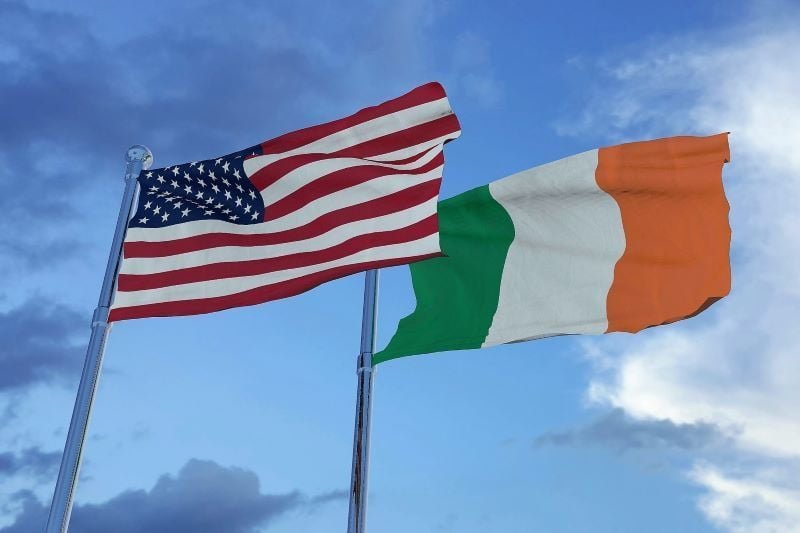
America’s Fourth of July story is usually told through Boston, Philadelphia, and the Founding Fathers. But a closer look reveals that Irish Around World history runs through key moments of US independence, from music and printing to politics and identity.
These lesser-known connections show how Irish heritage worldwide shaped one of the most important events in American history. For readers interested in irish diaspora history, history of irish immigration, and the global irish community, the story of July 4 has far more Irish influence than many people realize.
How Irish Around World history appears in the US independence story
The strongest Irish connection may be heard before it is seen. Some historians point to the 1723 composition “Bumper Squire Jones” by famed Irish harper Turlough O’Carolan as an early musical ancestor of the melody later associated with “The Star-Spangled Banner.” The tune is often described as metrically similar to the air that evolved into America’s national anthem.
The commonly accepted path is that the melody became associated in Britain with “To Anacreon in Heaven,” a popular late-18th-century song, before Francis Scott Key used it for his famous lyrics. While the anthem’s history is layered, O’Carolan’s place in this chain remains one of the most fascinating examples of Irish Around World cultural reach.
This type of crossover is exactly why irish culture abroad continues to resonate: traditions, melodies, and stories often travel far beyond their original home.
George M. Cohan and the July 4 myth
George M. Cohan, long celebrated through the phrase “born on the Fourth of July,” also had strong Irish family roots. Born to an Irish Catholic family in Rhode Island, Cohan became a symbol of patriotic American entertainment. Yet records indicate he was actually born on July 3, 1878, despite the family’s enduring public claim that it was July 4.
His family name traced back to Keohane, and his stage success reflected a wider pattern seen across the global irish community: Irish immigrants and their descendants helped define American popular culture while maintaining distinct ethnic roots.
Read more: irish heritage worldwide | global irish community
Irish-born figures who helped shape Independence Day history
Another striking figure is Charles Carroll, the only Catholic signer of the Declaration of Independence. Carroll’s family roots led back to County Offaly, and his life reflected the legal and religious barriers Catholics faced in colonial America. Because of anti-Catholic laws in Maryland, he was initially blocked from political participation.
That background helps explain why he emerged as a forceful supporter of independence. Carroll went on to become one of the most important Catholic figures in early US public life and was the last surviving signer of the Declaration, dying at age 95.
Then there was John Dunlap, the Irish-born printer from Tyrone who produced the first broadside copies of the Declaration in July 1776. After emigrating to Philadelphia as a child, Dunlap built a career in printing and secured official work from the Continental Congress. His now-famous “Dunlap broadsides” became the first printed versions of the Declaration of Independence.
Historical accounts also note that Dunlap later struggled with alcohol in retirement, a reminder that major historical figures often had deeply human and imperfect personal lives.
- Turlough O’Carolan is linked to a tune associated with the anthem’s musical ancestry
- George M. Cohan’s Irish family helped shape patriotic American theater
- Charles Carroll brought Irish Catholic roots into the founding era
- John Dunlap printed the first published Declaration broadsides
Explore more: tracing irish ancestry | famous people with irish heritage
An Irish media scoop that reached Europe first
One of the most remarkable details in this story involves journalism. The first newspaper in Europe to publish the Declaration of Independence was the Belfast Newsletter in August 1776. According to the paper’s own historical account, the news crossed the Atlantic by ship, was delayed off Donegal by bad weather, and then made its way north for publication in Belfast.
That meant readers in Ireland learned details of the Declaration before King George III had been fully informed in London. It was a major scoop and a vivid example of how Irish Around World stories were woven into global news long before the modern media age.
Why this history still matters
These links are more than trivia. They reveal how migration, music, faith, and publishing connected Ireland and America in powerful ways. For anyone exploring irish genealogy search, find my irish roots, or the wider history of Irish influence overseas, July 4 offers an unexpected lens on shared heritage.
It also speaks to modern irish culture and craic in a broader sense: Irish identity has long traveled, adapted, and left its mark far from home, whether in politics, newspapers, songs, or public life.
Conclusion
The story of American independence is not solely American; it is also part of a larger Irish Around World narrative. From an Irish-linked anthem melody to an Irish-born printer and an Irish-rooted signer of the Declaration, the Fourth of July carries echoes of Ireland in surprising places. For readers drawn to irish culture abroad and irish diaspora history, these facts are a reminder that the Irish imprint on world events is often deeper than it first appears.