

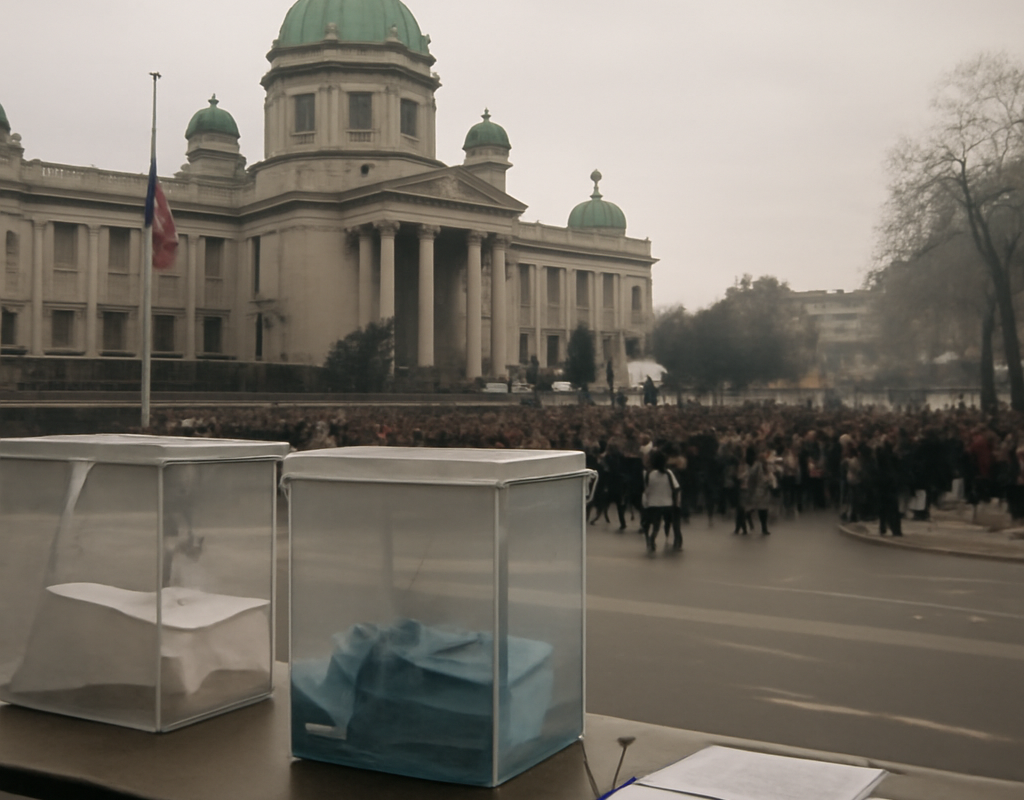
Standfirst: Serbian voters are choosing a new 250-seat parliament in an early election shaped by two years of protests and deep distrust in state institutions. The result could determine whether Aleksandar Vučić’s political network retains power or whether the student-led “Students Win” list becomes a new force in Serbian politics.
Serbia is holding snap parliamentary elections on Sunday, 25 October 2026, in a contest widely viewed as a referendum on Aleksandar Vučić’s influence and the country’s political direction. More than 6.45 million people are eligible to vote, with 18 electoral lists and 2,418 candidates competing for seats in the National Assembly.
The election follows the dissolution of parliament on 9 September, after a proposal from the Serbian government. Its significance, however, extends well beyond the formal decision to call an early vote. The campaign has unfolded after nearly two years of protests triggered by the deaths of 16 people in the collapse of a concrete canopy at Novi Sad railway station on 1 November 2024.
Why this election matters
The Novi Sad tragedy prompted student demonstrations demanding accountability, access to reconstruction documents and clearer political responsibility. Over time, the protests expanded into a national movement focused on corruption, public procurement, the rule of law and the independence of state institutions.
During 2025, students organised university blockades, road blockades and large rallies across Serbia. In 2026, they decided to contest the election themselves, transforming a protest movement into a parliamentary challenge.
This has changed the central political divide. Instead of a conventional contest between the governing Serbian Progressive Party and established opposition groups, voters are now being asked to choose between the ruling political structure associated with Vučić and a new movement that rejects the traditional party model.
The main political forces
Vučić’s governing bloc
The largest bloc is running under the list “Aleksandar Vučić – United Serbia”, built around the Serbian Progressive Party, or SNS. Although Vučić is no longer president, he remains the campaign’s dominant figure. He resigned from the presidency in September to lead the SNS campaign and seek the position of prime minister.
That decision has made the election a direct test of his political future. A strong result would give him a mandate to attempt to form a new government after months of unrest.
Traditional parties and potential coalition partners
Other lists include “Ivica Dačić – Stability Factor”, which brings together the Socialist Party of Serbia and smaller parties. Right-wing and nationalist voters are represented by lists including “Authentic Right – Miloš Jovanović – Boldly Serbian”, while the pro-European centre is represented by “European Serbia”.
Several minority parties are also competing, including the Alliance of Vojvodina Hungarians, the SDA of Sandžak, Usama Zukorlić’s list and the Albanian Coalition. If the result is close, these groups could become important in coalition negotiations.
The student list
The most unusual participant is the “Students Win” list. It is not organised as a conventional party and has no traditional single leader. Candidates were selected through student plenums and include professors, doctors, artists, activists and other people without senior political experience.
With 250 candidates, the list is seeking to carry the energy of the protest movement into parliament. Its performance will show whether a movement built outside the established party system can convert public mobilisation into electoral representation.
A contest shaped by institutional distrust
The dispute in Serbia is no longer simply between a government and its traditional opponents. At its centre is a wider question: can citizens trust public institutions to investigate failures, enforce accountability and operate independently of political influence?
Protesters describe the Novi Sad disaster as a symbol of deeper concerns about corruption, oversight and the relationship between the state and its critics. Government officials have portrayed the demonstrations as destabilising and have questioned whether the student movement has the experience needed to govern. Authorities have also alleged foreign involvement, while Vučić has claimed that foreign intelligence services are financing an attempted “colour revolution”.
These competing narratives have produced two sharply different visions:
- The governing bloc stresses stability, economic development, national interests and protection from foreign interference.
- The student movement emphasises accountability, anti-corruption measures, the rule of law and institutional independence.
How the election differs from 2023
The traditional opposition has lost its position as the main challenger. In the 2023 parliamentary election, parties grouped around the “Serbia Against Violence” coalition won about 24% of the vote and 65 seats. Fragmentation and internal disagreements subsequently weakened that bloc.
The student movement has since absorbed much of the political momentum that previously belonged to established opposition parties. Turnout and the number of lists passing Serbia’s 3% threshold could therefore have a major effect on the distribution of seats.
Opinion polls have offered differing projections, and the large number of undecided voters makes the result difficult to predict. The SNS has a substantial local organisation and a stable base, while the student list is drawing support from voters seeking a break with the existing political system.
Serbia’s European direction
The vote also has implications for Serbia’s relationship with the European Union. Serbia is an EU candidate country, but its accession path has been slowed by concerns over the rule of law, relations with Russia, limited alignment with parts of the EU’s common foreign policy and the stalled normalisation process with Kosovo.
Belgrade continues to maintain close relations with Russia and China while pursuing links with the EU. A new government could therefore face pressure to address both domestic institutional concerns and questions about Serbia’s foreign-policy orientation.
The election is not itself a decision on EU membership. Accession remains a multi-stage process requiring progress across negotiation areas, including rule-of-law reforms and normalisation issues.
What happens after the vote?
The outcome could produce several different scenarios:
- An SNS-led government: Vučić would seek to form an administration and restore political stability after the protest period.
- A strong student-list result: “Students Win” could become the central force in a new governing arrangement if it wins enough seats independently or with allies.
- A fragmented parliament: Smaller parties and minority lists could become decisive coalition partners.
- A close or disputed result: Political tensions could continue after polling day, particularly if no clear governing majority emerges.
The final political outcome will depend not only on the leading lists’ vote shares but also on turnout, the 3% threshold and coalition arithmetic.
Conclusion
Serbia’s 2026 parliamentary election is a test of whether the political model associated with Vučić can survive its most serious challenge in years. It is also a test of whether a student-led movement can move from street protests into effective parliamentary politics. The result will shape Serbia’s domestic institutions, coalition landscape and European direction, with further negotiations expected once the new National Assembly is formed.