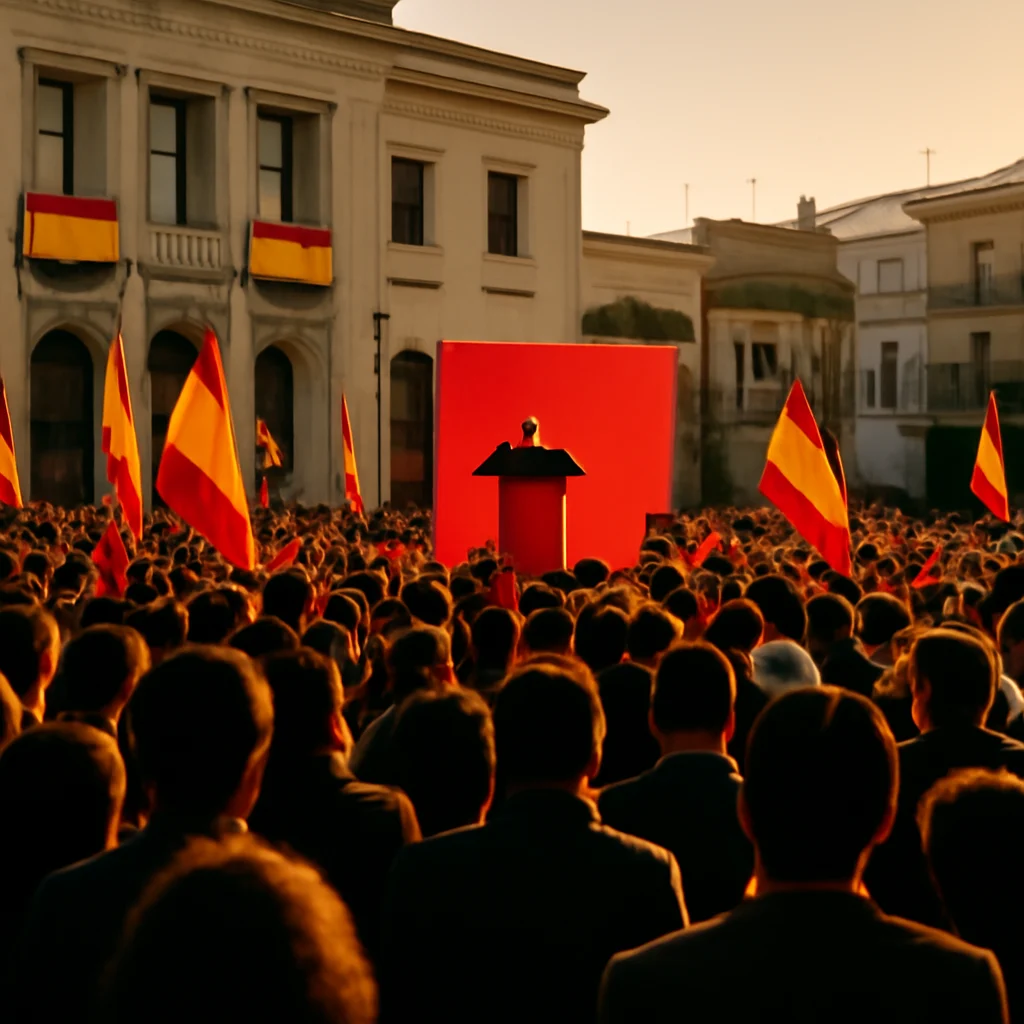
Spanish Prime Minister Pedro Sánchez has launched the Socialist Party’s campaign for the 29 November general election, placing housing affordability and the country’s cost-of-living pressures at the heart of his message.
The PSOE leader began the campaign in Dos Hermanas, near Seville, in front of more than 5,000 supporters. The Andalusian city has become an important political base for the Socialists and a symbolic starting point for Sánchez’s previous leadership campaigns.
Housing takes centre stage in Spain’s election campaign
Sánchez used his speech to connect Spain’s housing difficulties with the wider social pressures facing households. He referred to Maricarmen Abascal, an 87-year-old woman who has become associated with Spain’s housing protests, presenting her experience as an example of the hardship faced by people struggling with housing costs.
Housing is expected to remain a major issue during the campaign. Spain has experienced strong demand for homes in many areas, while affordability has become a concern for younger people, families and pensioners. The issue also has a direct connection to public policy, including the supply of affordable housing, rental costs and access to social support.
The prime minister has already announced 21 urgent housing measures following nationwide protests. The details and implementation of those measures are likely to receive close attention as the election approaches.
Why Dos Hermanas matters to the PSOE
The decision to begin the campaign in Dos Hermanas was politically significant. The city is the largest municipality in Andalusia where the Socialists remain in power after the most recent regional elections.
Sánchez also began his campaigns for the PSOE general secretariat there in 2017, as well as his campaigns in 2019 and 2023. Party officials have described Dos Hermanas as a “lucky city” for the Socialist leader.
The location nevertheless comes as the PSOE seeks to recover from a series of difficult election results. The party lost ground in the 2022 Andalusian election, the 2023 local and general elections, the 2024 European Parliament election and the most recent Andalusian elections.
Those results give the forthcoming national contest added importance for Sánchez and the PSOE. The campaign will test whether the party can rebuild support among voters who have moved to the opposition or disengaged from the political process.
Political confrontation with the People’s Party
Sánchez presented the election as a choice between the government’s social agenda and what he characterised as fear-based opposition politics. He criticised the People’s Party, or PP, arguing that it had spent years using messages of fear against the government.
He also attacked the PP’s record in opposition and government, claiming that the party resorts to confrontation when out of office and spending cuts when in power. The language signals a sharply contested campaign in which housing policy will sit alongside arguments over economic management, public services and the direction of Spain’s government.
Alberto Núñez Feijóo, the PP president and opposition leader, launched his own pre-election campaign in Madrid on the same day. He promised to work for supporters and for Spaniards seeking political change.
Feijóo responded by presenting himself as a manager with experience of preparing and balancing budgets, maintaining public services and dealing with both favourable and difficult economic conditions. His remarks were also directed at Sánchez, underlining the expected focus on competing claims about competence and credibility.
A larger overseas electorate
The election will also involve a significantly larger electorate among Spanish citizens living abroad. After Sánchez called the early general election for 29 November, 2,769,645 Spanish passport holders resident overseas were included in the electoral arrangements.
That figure is more than 19% higher than the overseas electorate recorded for the 2023 election, an increase of 444,335 voters. The expansion has been linked to the impact of Spain’s so-called Grandchildren’s Law, which widened access to Spanish nationality for some people with family ties to Spain.
Spain’s overall electoral register has grown by 1.26 million people since 2023. At the same time, 1.6 million young people have reached voting age and will be eligible to vote for the first time.
The changes could make turnout, youth participation and overseas voting important factors in the final result. However, the political impact will depend on participation rates and how these groups distribute their support among the competing parties.
What happens next?
The campaign now moves into a national contest in which housing, public services, economic policy and political leadership are likely to dominate. The PSOE will seek to turn its focus on housing into wider support, while the PP will argue that Spain needs a change of government.
The 29 November vote will determine the composition of Spain’s national parliament and begin the process of forming the next government. Until voters cast their ballots and the official results are confirmed, neither party can claim a mandate to govern.
Conclusion
Sánchez’s opening campaign event shows that housing will be a central theme of Spain’s general election. The PSOE is attempting to reconnect with voters through a social-policy message, while the PP is presenting the contest as a choice about management and political change. With a larger overseas electorate and millions of first-time young voters, the election could carry consequences well beyond the campaign’s opening exchanges.