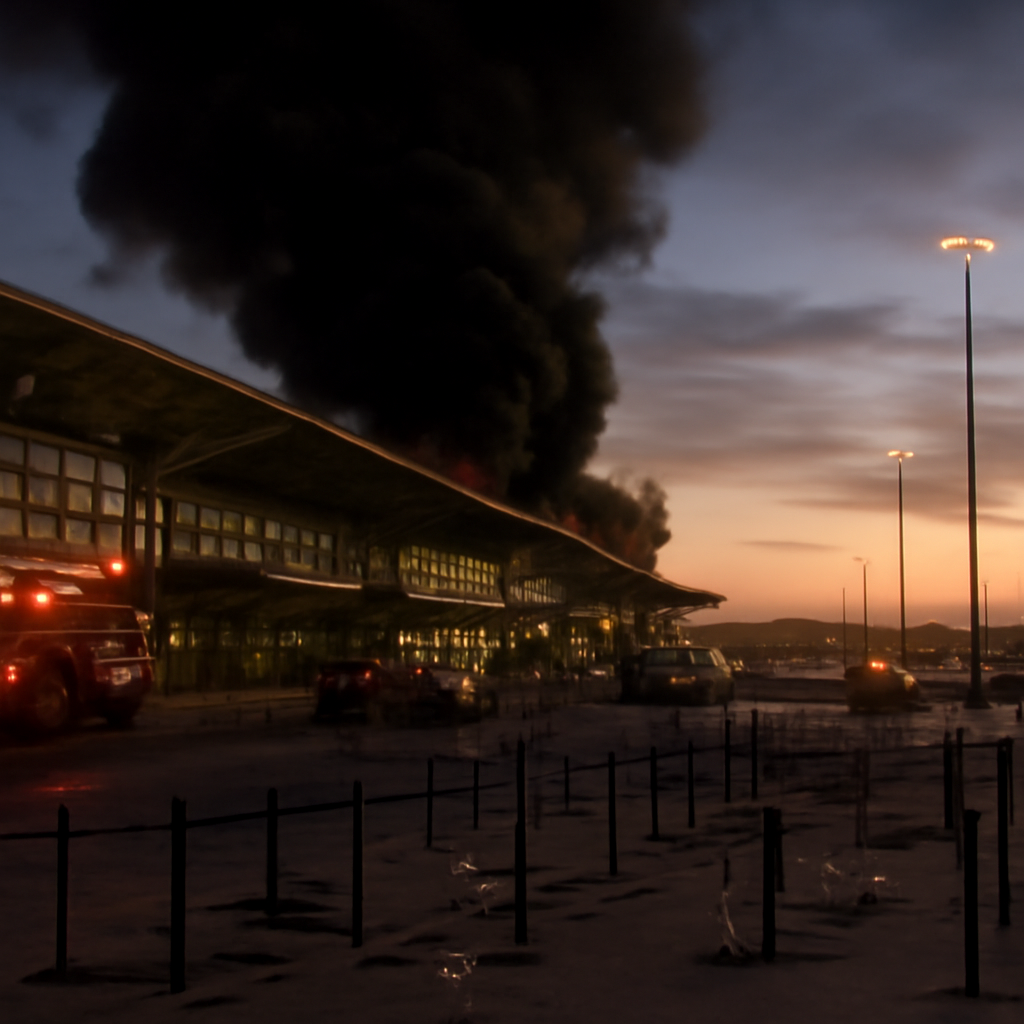
Riyadh airport flights have been suspended again after a new wave of Houthi missile attacks caused further damage and reportedly killed one person. The development follows Saturday’s deadly strike, which killed 13 people and injured more than 300, deepening security concerns across Saudi Arabia and the wider Middle East.
Saudi authorities said King Khalid International Airport would remain closed while safety checks were completed. The latest disruption has affected international travel, airport operations and a major energy conference taking place in the Saudi capital.
Riyadh airport flights suspended as missile threats continue
Saudi Arabia’s aviation authority extended the suspension of flights to and from Riyadh after additional missile and drone threats were detected. Officials said the closure was necessary to verify the airport’s safety following damage linked to the attacks.
Footage broadcast by Saudi state television showed passengers surrounded by smoke and falling debris inside the terminal during Saturday’s strike. The attacks have also reportedly damaged fuel tanks, warehouses and aircraft at the airport, including a parked Airbus A320. At least five other aircraft were said to have sustained damage.
The military has been forced to spread interceptor missile systems across a large area to protect airports, government buildings, oil installations and other critical infrastructure. The Houthis have warned that airports in several parts of the kingdom could remain targets.
Travel disruption and safety checks
Passengers have been advised to check directly with airlines and airport authorities before travelling. The suspension comes as Saudi Arabia hosts the 25th WPC Energy Conference, where officials have sought to present an image of stability despite the security crisis.
- Flights to and from King Khalid International Airport have been suspended.
- Authorities are carrying out additional safety and damage assessments.
- Further missile and drone threats have been reported.
- Some schoolchildren and office workers have been advised to remain at home.
Saudi Arabia faces pressure over air defence failures
The repeated attacks have prompted an urgent review of how Houthi missiles are penetrating Saudi air defences. The Houthis have also targeted Khamis Mushait and King Fahd International Airport in Dammam, widening the threat beyond Riyadh.
Saudi Arabia has been involved in Yemen’s conflict since 2014, when it intervened against the Iran-aligned Houthi movement. The latest escalation is placing additional pressure on Crown Prince Mohammed bin Salman as the government attempts to protect strategic infrastructure while maintaining economic activity.
Saudi Energy Minister Abdulaziz bin Salman told delegates at the energy conference that fear had no place in the country’s public outlook. His comments were intended to underline the resilience of Saudi energy infrastructure and the determination of the population, although the airport disruption demonstrates the scale of the challenge.
Humanitarian crisis deepens in Yemen
Fighting has also continued around Taiz, Yemen’s third-largest city and one of its most populous governorates. Saudi aircraft reportedly carried out eight strikes against gatherings of Houthi forces, with as many as 60 fighters from both sides said to have died on Sunday.
Taiz governor Nabil Shamsan issued an urgent appeal for the Houthi siege to be lifted. He warned that medicine shortages could soon leave hospitals without adequate emergency surgery and intensive-care services.
The competing claims underline the complexity of the conflict. The Houthis said Saudi forces had conducted 124 raids by Sunday, while Saudi Arabia continued efforts to locate Houthi leader Abdul-Malik al-Houthi.
Read more
For more long-term coverage of international affairs and Irish news, follow trusted reporting on global security, diplomacy and breaking developments.
Iran offers mediation as regional tensions rise
Iran’s Foreign Minister Abbas Araghchi spoke with Saudi Foreign Minister Faisal bin Farhan about the possibility of mediation between Riyadh and the Houthis. Iran has long been accused by Saudi Arabia and its allies of training and supplying the Houthi movement, making any diplomatic role highly sensitive.
Meanwhile, Iran’s hardline security official Mohsen Rezaei claimed that vessels were being targeted in the Strait of Hormuz. His comments added to concerns about shipping security, energy supplies and the possibility that the conflict could spread beyond Yemen and Saudi Arabia.
The United Nations Security Council is expected to consider a resolution that would designate the Houthis as a foreign terrorist organisation. Such a move could further complicate negotiations and humanitarian aid efforts.
Political divisions in Yemen
The exiled leader of Yemen’s Southern Transitional Council, Aidarous al-Zubaidi, has called on southern forces to fight across all fronts. The group supports an independent South Yemen, reflecting grievances that have existed since the country’s unification in 1990.
However, the Southern Transitional Council faces competition from other armed factions, including the Southern Giants Brigades. These rivalries add another layer to a conflict already involving the Houthis, Saudi Arabia, the internationally recognised Yemeni government and regional powers.
Explore more
Keep up with Ireland breaking news, international affairs and the latest developments through Daily Digest, alongside analysis from Irish news today and global news coverage.
What happens next?
The immediate priority is the safe reopening of Riyadh airport and the protection of passengers, staff and aircraft. Any further attacks could prolong the suspension and create wider disruption for aviation, energy markets and regional commerce.
Diplomatic efforts may offer a route towards de-escalation, but the competing military and political agendas make a rapid settlement uncertain. The humanitarian situation in Taiz also requires urgent attention as hospitals face shortages of medicines and specialist services.
Conclusion
The renewed suspension of Riyadh airport flights highlights the growing reach of Houthi attacks and the vulnerability of critical infrastructure in the region. With Saudi Arabia reviewing its air defences, Iran discussing mediation and Yemen facing a worsening humanitarian crisis, the next few days will be closely watched. For travellers, the clearest advice is to verify flight information with airlines and authorities before heading to the airport.
Image Courtesy: The Irish Times