

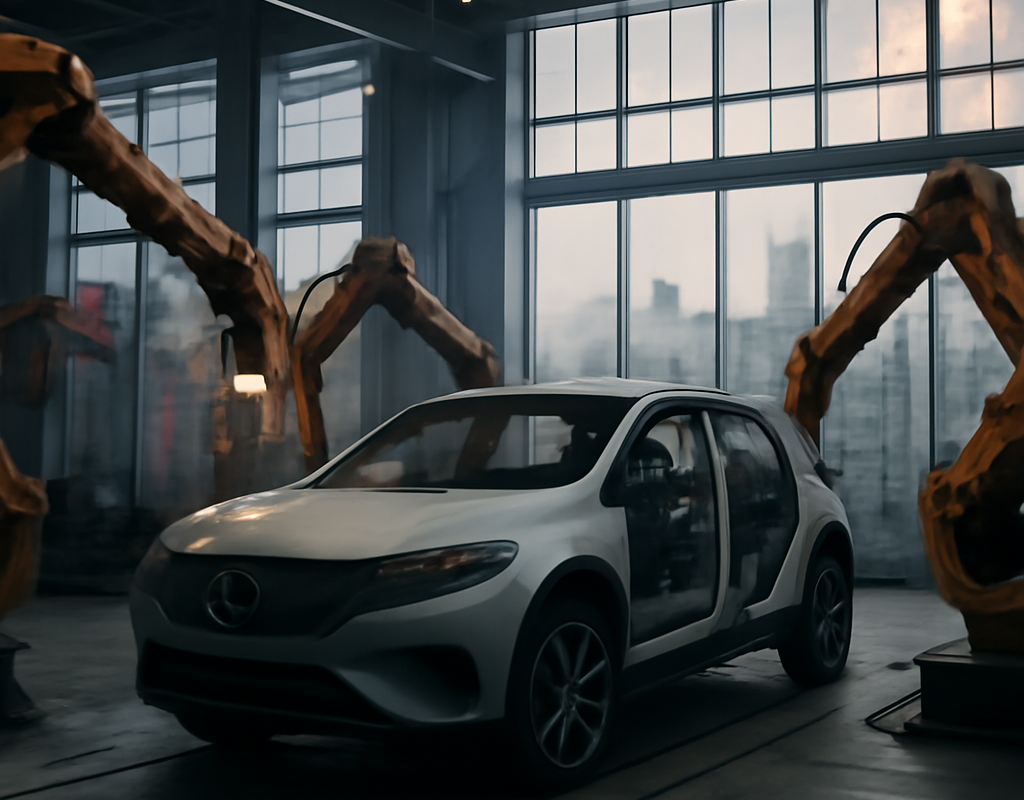
Mercedes-Benz has cut its 2026 profit outlook after weaker demand in China and rising material costs added to the pressure facing Germany’s car industry. The company now expects core profit to remain broadly flat at around €5.8 billion, abandoning its previous forecast of at least 15% growth.
The announcement makes Mercedes-Benz the third major German carmaker to reduce its full-year guidance this year, following similar moves by BMW and Volkswagen. It also highlights the growing importance of Chinese competition, cost control and production efficiency to Europe’s automotive sector.
Mercedes-Benz lowers earnings and margin forecasts
Mercedes-Benz said its 2026 earnings before interest and taxes for the group’s core operations are now expected to remain at approximately €5.8 billion. Earlier guidance had pointed to growth of at least 15%.
The company also reduced its forecast for the adjusted return on sales in its car division. The expected margin is now between 2% and 3%, compared with the previous range of 3% to 5%.
Preliminary third-quarter figures showed core profit of €1.77 billion. The car division recorded a margin of 2.5% during the quarter. Mercedes-Benz is due to publish its complete third-quarter results on Wednesday.
- 2026 core profit outlook: approximately €5.8 billion
- Previous expectation: at least 15% profit growth
- New car-division margin forecast: 2% to 3%
- Preliminary third-quarter core profit: €1.77 billion
China market weakness weighs on German carmakers
China remains one of the most difficult markets for established European car manufacturers. Mercedes-Benz vehicle deliveries in China fell by a further 29% during the first nine months of 2026, after deliveries reached their lowest level since 2016 last year.
The decline reflects a combination of softer demand for premium vehicles and intense competition from Chinese manufacturers. Companies including BYD and Xiaomi have strengthened their position in electric vehicles and other technology-focused segments, increasing pressure on international brands.
Chinese manufacturers are competing not only on price, but also on software, battery technology and the speed at which new models reach consumers. That has made the Chinese market more challenging for traditional manufacturers whose business models rely heavily on premium pricing and established brand strength.
BMW and Volkswagen also reduce forecasts
Mercedes-Benz’s warning follows outlook reductions from BMW and Volkswagen. Shares in Mercedes-Benz fell by more than 4% after the announcement, while BMW and Volkswagen declined by about 2%.
The three companies face similar structural pressures, although their exposure differs by brand and market. Weak demand, high costs and competition from Chinese electric-vehicle manufacturers are affecting profitability across Germany’s automotive industry.
Volkswagen has also announced plans to cut 120,000 jobs worldwide by the end of the decade. If completed, the restructuring would represent one of the largest workforce reductions in the history of the automotive sector.
Cost pressures raise questions about German production
Mercedes-Benz chief executive Ola Källenius has called for German employees to work additional hours without extra pay, according to the source report. The company is also expanding production in Hungary, where Källenius has said costs are around 70% lower than in Germany.
The moves underline the difficult debate over industrial competitiveness in Germany. Manufacturers are attempting to reduce production costs while continuing to invest in electric vehicles, digital systems and updated manufacturing facilities.
Relocating or expanding production in lower-cost EU countries can help companies manage expenses, but it also raises concerns about jobs and the future role of Germany as a manufacturing base. For workers and suppliers, changes in production capacity can have consequences beyond the carmakers themselves.
What the outlook means for Europe’s automotive industry
The Mercedes-Benz announcement is significant beyond the company’s share price. Automotive manufacturing remains closely connected to employment, exports, engineering and regional supply chains across the European Union.
The immediate consequences include:
- greater pressure on manufacturers to lower costs;
- more scrutiny of production locations and labour agreements;
- continued investment in electric vehicles and vehicle software;
- stronger competition between European and Chinese brands;
- potential restructuring among manufacturers and suppliers.
European carmakers are also operating during a major technological transition. They must fund electric-vehicle development and comply with changing emissions requirements while protecting margins in a market where consumers are increasingly sensitive to price.
What happens next for Mercedes-Benz?
Mercedes-Benz’s full third-quarter results will provide more detail on sales, cash flow, regional performance and the company’s response to weaker Chinese demand. Investors will also be watching for any change to production plans, staffing arrangements or investment priorities.
The company’s revised guidance is not a forecast of a collapse in earnings. It does, however, show that the growth expected earlier in the year is no longer considered realistic under current market conditions.
For Europe’s automotive sector, the wider question is whether current weakness is temporary or part of a deeper shift in global competitiveness. The answer will depend on demand in China, the pace of electric-vehicle adoption, input costs and the ability of European manufacturers to compete on technology as well as brand reputation.
Conclusion
Mercedes-Benz has abandoned its expected 2026 profit growth and now sees core earnings remaining near €5.8 billion. The downgrade, driven by falling China deliveries and higher costs, adds to mounting evidence that German carmakers are facing a difficult structural adjustment. The next full results will show whether the company’s revised outlook is conservative or points to further pressure ahead.