

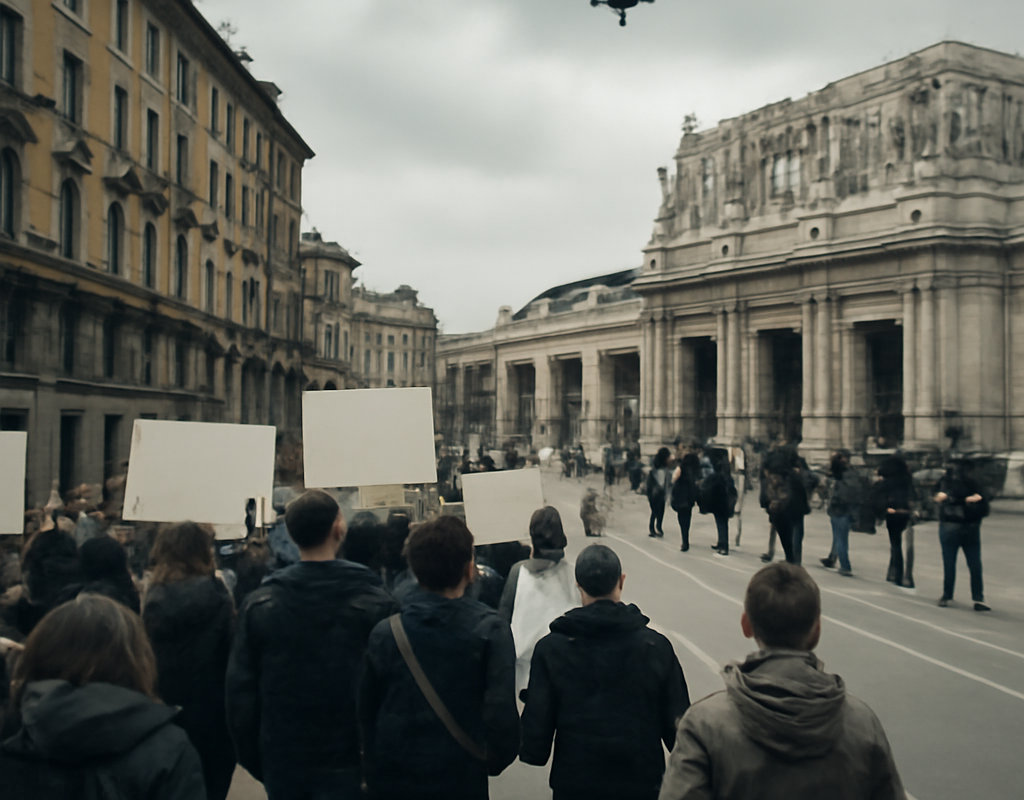
Italy has deployed an additional 500 soldiers to Milan as demonstrations over living costs, wages, military spending and government policy take place across the country. The heightened security follows violent clashes in Milan and Turin the previous weekend, including arrests, damage to businesses and confrontations with police.
Protests were planned in Rome, Milan, Turin, Naples, Genoa, Bologna, Florence, Padua and Verona on 24 October. Authorities increased surveillance and carried out more than 150 searches as officials warned that changing protest locations could make it harder to prevent spontaneous gatherings.
Why Italy increased security
Milan is the main focus of the security operation after unrest on 17 and 18 October. The disturbances involved clashes with police, vandalism and looting in parts of the city centre. Police said approximately 2,000 young people took part in the earlier unrest and that 45 people were arrested, including 34 minors.
In response, the government led by Prime Minister Giorgia Meloni authorised the deployment of 500 additional soldiers to Milan. The troops reinforce security personnel already assigned to the city rather than representing a separate military operation.
Authorities have also introduced or expanded:
- Drone surveillance in areas considered vulnerable to disorder
- Checks at railway stations and transport hubs
- Rapid-response units capable of moving between gathering points
- Investigative searches linked to the previous violence
Italy’s Interior Minister Matteo Piantedosi has indicated that investigators are examining whether some of the earlier disturbances were coordinated. Police searches took place in Milan, Monza and about 20 other cities, targeting people suspected of involvement, including students and minors. The investigation remains ongoing, and those searched or arrested should not be treated as guilty unless established through the legal process.
Protests reflect several political and economic grievances
The demonstrations are not organised around a single demand. Participants are raising concerns about household costs, low wages, fuel prices, housing, access to education and healthcare, as well as the government’s defence and foreign-policy choices.
In Rome, demonstrators were expected to attend a national march opposing military involvement and increased defence spending. Student and activist groups in Turin called for action against rearmament while linking that issue to the cost of living and access to public services.
In Naples, protesters were mobilising around economic hardship and rising prices. A separate demonstration was expected in Castel Volturno, near Naples, against plans for a migrant detention and repatriation centre. Religious organisations, charities, migrant groups and agricultural workers were among those supporting that protest.
The range of issues illustrates why the security situation is difficult to assess. Different groups may share concerns about living costs or government policy without belonging to the same organisation or pursuing identical objectives.
Changing meeting points complicate policing
The newly formed “17 October Movement”, which has been associated with recent mobilisation, cancelled locations previously advertised for protests and said new meeting points would be announced shortly before marches began.
That approach has complicated preparations for Italian police. Fixed protest routes allow authorities to plan barriers, transport measures and emergency access. Last-minute changes can increase uncertainty and raise the possibility of smaller gatherings forming in different parts of a city.
Officials are particularly concerned about possible interaction between student organisations, trade unions and more radical activist groups. However, participation in a protest does not by itself indicate involvement in violence, and public authorities must distinguish between peaceful assembly and criminal conduct.
Government faces pressure after Milan unrest
The latest demonstrations place additional pressure on Meloni’s government after it promised a tougher response to attacks on police officers and businesses. The government’s security measures are intended to prevent a repeat of the previous weekend’s disorder, while the protests are also keeping broader questions about inequality and social exclusion in the public debate.
Italy’s authorities must balance public safety with the right to peaceful protest. Any restrictions, searches or arrests will be subject to Italy’s legal safeguards and judicial procedures. The reported investigations may provide further information about the causes of the earlier violence, but the available details do not establish that the wider protest movement was responsible for every incident.
Protests form part of wider European discontent
The Italian demonstrations are taking place alongside protests reported in France, Spain, Portugal and Albania. The issues vary between countries, but common themes include living costs, public services, employment conditions and dissatisfaction with government decisions.
This does not mean the protests represent a single Europe-wide movement. Each demonstration has its own organisers, demands and national political context. For Italy, however, the scale and diversity of the mobilisation make the response significant for national politics and public-order policy.
What happens next?
Italian authorities are expected to review security arrangements as demonstrations continue and investigators examine the violence in Milan and other cities. The immediate priorities are preventing clashes, protecting transport infrastructure and businesses, and ensuring that peaceful protesters can assemble safely.
Further legal developments may follow from the searches and arrests, but the source information does not confirm final court outcomes. The political debate is likely to continue over military spending, household affordability, policing powers and the proposed migrant detention and repatriation centre.
Conclusion
Italy’s decision to deploy 500 additional soldiers in Milan reflects the government’s concern about renewed violence after last weekend’s clashes. At the same time, the protests show that anger extends beyond public order to living costs, wages, services, defence policy and migration measures. The key test for Italy’s authorities is whether they can protect public safety while preserving the right to lawful peaceful assembly.