Italy and Azerbaijan are seeking a broader economic partnership built around energy, transport and technology, as regional stability creates new opportunities along the Middle Corridor. Speaking in Baku, Italian Deputy Prime Minister and Foreign Minister Antonio Tajani said Rome wanted a more ambitious relationship with its strategic partner.
The discussions formed part of the Azerbaijan-Italy Business Forum, co-led by Tajani and Azerbaijan’s Economy Minister Mikayil Jabbarov. Business representatives from both countries examined potential cooperation in infrastructure, manufacturing, artificial intelligence, logistics, agriculture and critical raw materials.
Italy and Azerbaijan target stronger trade and investment
Tajani said Italian exports to Azerbaijan rose by 14% during the first eight months of 2026. Bilateral trade reached €10.2 billion in the previous year, making Italy Azerbaijan’s largest commercial partner, while Azerbaijani investment in Italy was estimated at about €3 billion.
Italy is also Azerbaijan’s leading European Union importer of energy. However, officials stressed that the relationship should move beyond oil and gas towards a wider economic model involving industrial production, technology and joint investment.
Jabbarov said agreements signed during the forum covered:
- Artificial intelligence and high-performance computing
- Industrial production and construction
- Public transport
- Investment cooperation
- Digital technologies and market access
He said Azerbaijan wanted to improve the competitiveness of locally manufactured goods and expand their access to international markets. Industrial parks and free economic zones were identified as potential platforms for cooperation with Italian companies.
The Middle Corridor and Europe’s changing trade routes
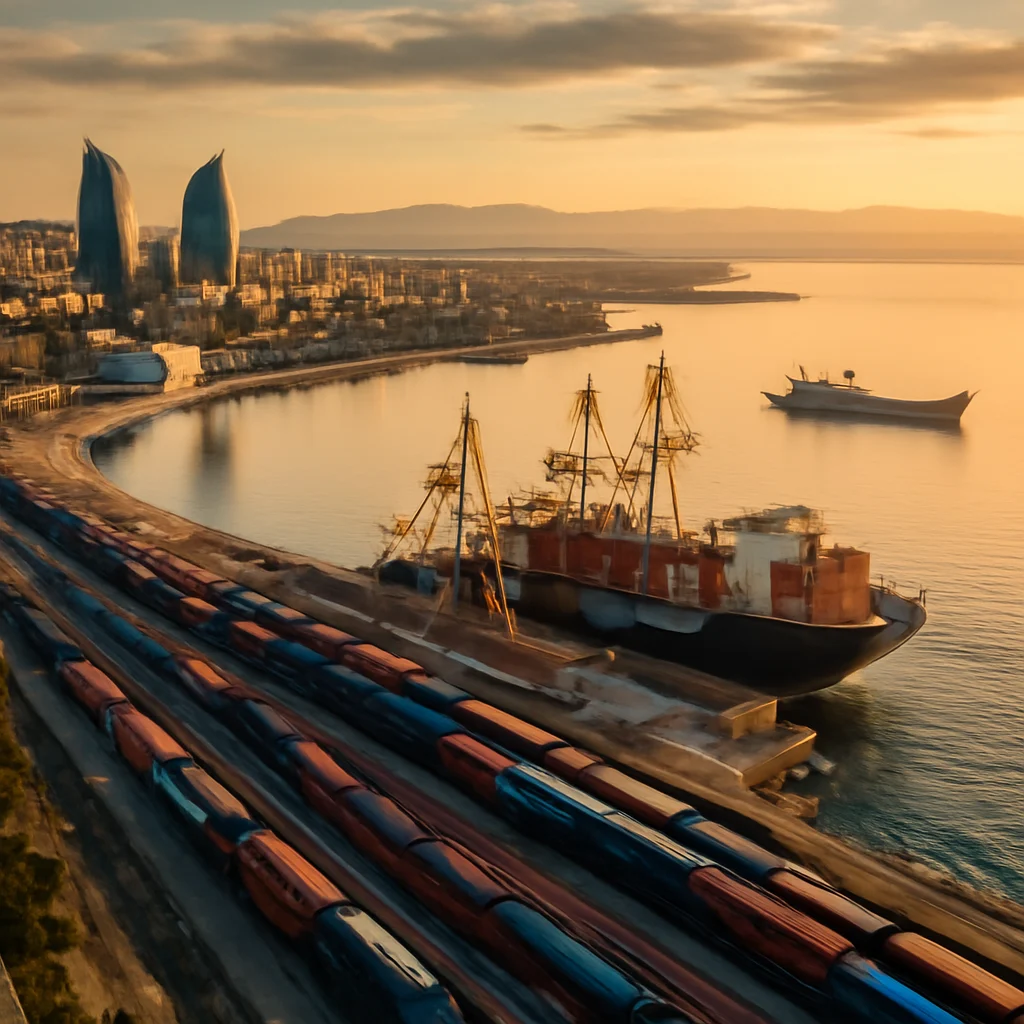
A central theme was the Middle Corridor, an emerging rail and maritime route linking Asia with European markets through Central Asia, the Caspian Sea and the South Caucasus. Goods can then move towards the Black Sea and onward to the Mediterranean.
Italy sees the corridor as an opportunity to contribute engineering expertise, machinery, rail technology and logistics services. Tajani also referred to a potential Green Energy Corridor that could strengthen energy connections between the region and Europe.
The route has attracted growing attention as governments and companies assess alternatives to vulnerable supply chains. For Italy, deeper involvement could reinforce its position as a commercial link between Europe and Asia, a role previously highlighted by Prime Minister Giorgia Meloni during talks with Azerbaijan’s President Ilham Aliyev.
Peace seen as a condition for new investment
Tajani linked the region’s economic prospects to the peace process between Azerbaijan and Armenia. He said Italy supported efforts to promote stability, arguing that peace could help create the conditions needed for long-term investment and improved connectivity.
“Peace is a good choice for paving the way for new investments,” Tajani told Euronews. He also said countries should work towards peace during periods of wider international tension.
The comments underline the connection between European affairs, transport planning and regional security. Improved stability in the South Caucasus could make infrastructure projects more attractive, although the success of major corridors will depend on financing, political cooperation and practical transport links.
Critical raw materials and industrial partnerships
Italian and Azerbaijani officials also discussed critical raw materials, an area of growing importance for European industry and supply-chain resilience. The two countries signed a Joint Declaration on Strategic Cooperation in Critical Raw Materials in Rome in October.
Tajani said cooperation could extend beyond Azerbaijan and Italy, including work in Africa and other regions. He argued that reducing raw-material costs would be essential for companies seeking to compete globally.
The forum promoted a model based not only on exports, but also on joint ventures, industrial partnerships and technology transfer. Areas identified by business representatives included:
- Metallurgy and industrial automation
- Robotics and electronics
- Pharmaceuticals
- Agricultural machinery
- Transport and logistics
- Construction materials and infrastructure
Agreements involving major companies and SMEs
Several corporate and institutional agreements were announced. Leonardo signed a memorandum with Azerbaijan’s Economy Ministry covering high-performance computing systems and artificial intelligence. Italy’s Cassa Depositi e Prestiti agreed to work with Azerbaijan’s Business Development Fund.
Support for small and medium-sized enterprises was another priority. Italy’s SIMEST discussed financing, grants, joint-venture support and supplier credit for companies entering overseas markets. The organisation also signed an agreement with the Italy-Azerbaijan Chamber of Commerce and Azerbaijan’s Small and Medium Business Development Agency.
Other agreements included cooperation involving Baku Steel Company, construction and building-materials groups, Iveco and AZ Tex Import, and the modernisation of the Garadagh Glass Plant by Falorni Tech and North West Construction.
What the partnership could mean for Europe
The talks show how European Union countries are seeking new commercial, energy and logistics relationships in the wider South Caucasus. Azerbaijan’s location gives it potential importance for transport and energy diversification, while Italy can offer industrial expertise, financing channels and access to the European single market.
For now, the agreements represent planned cooperation rather than completed projects. Their impact will depend on implementation, investment decisions and the development of the transport and energy infrastructure discussed at the forum.
Nevertheless, the message from Baku was clear: Italy and Azerbaijan want to build a relationship that extends beyond traditional energy trade. The Middle Corridor, critical materials, digital technology and industrial partnerships are becoming central to their economic agenda.
The key takeaway: Italy and Azerbaijan are positioning their partnership around the Middle Corridor and broader industrial cooperation, with both sides linking future investment to regional peace, connectivity and economic diversification.