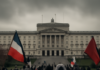
A dispute over the removal of an Israeli flag at an exhibition in the European Parliament has triggered a political confrontation on the anniversary of the 7 October attacks. Parliament President Roberta Metsola said the incident was being taken seriously, while French MEP Rima Hassan acknowledged removing the flag but disputed elements of the criticism directed at her.
The argument has unfolded against the backdrop of the continuing Israel-Gaza conflict, renewed debate about antisemitism in France and heightened sensitivities surrounding public commemoration of the 2023 attacks. The episode is now part of wider European political discussions about protest, parliamentary conduct and the boundaries of political expression.
What happened at the European Parliament?
The confrontation took place during an exhibition dedicated to people affected by the Hamas attacks in Israel on 7 October 2023. According to the source report, an Israeli flag displayed at the event was knocked over on Monday evening.
Rima Hassan, a French member of the European Parliament from La France Insoumise, acknowledged removing the Israeli flag. Her office said that neither the Israeli nor European Union flag had been stepped on or damaged, and disputed the suggestion that she deliberately toppled the EU flag.
Hassan presented her action as a protest against the role of the Israeli state in the exhibition. She also objected to speeches that she said denied the existence of Palestine. Those claims and the circumstances of the incident have become central to the political dispute.
Parliament President says incident is being investigated
Addressing the chamber, European Parliament President Roberta Metsola said she regarded the incident as extremely serious. She said appropriate measures were being taken against the MEP involved, without naming Hassan directly.
Metsola framed the issue in terms of safety, property and the ability of people to participate in political debate without intimidation. Her comments indicate that the Parliament may consider internal disciplinary or procedural steps, although the source material does not specify what sanctions, if any, will follow.
The incident is therefore not an EU legislative decision or a new European Union rule. It is an internal parliamentary matter involving conduct on Parliament premises. Any action would need to follow the institution’s applicable procedures.
Why the dispute has become politically significant
The controversy has attracted strong reactions because it occurred on the third anniversary of the 7 October attacks. Hamas killed around 1,200 people and took 251 hostages during the attacks, according to the source report. Israel’s subsequent military operation in Gaza has caused a very high Palestinian death toll, with the report citing more than 70,000 deaths.
Supporters of the exhibition viewed the flag as part of a commemoration of victims. Hassan’s supporters have treated its removal as a protest against what they regard as the political framing of the event and Israel’s conduct in Gaza. The competing interpretations have intensified an already polarised debate across Europe.
French MEP François-Xavier Bellamy condemned the action, describing it as contributing to the return of antisemitic hatred in Europe. Israel’s Foreign Minister Gideon Sa’ar also criticised the incident.
Wider debate over antisemitism and political speech in France
The dispute has also drawn attention to allegations involving France’s political parties. The source report says media allegations concerning antisemitic messages attributed to Jordan Bardella, a leading figure in the National Rally, have resurfaced. Bardella denies making the statements, and no finding establishing the allegations is reported in the supplied material.
Israeli Ambassador to France Joshua Zarka said Israel was monitoring the allegations and would respond if they were confirmed. He also criticised La France Insoumise, while Hassan is awaiting trial in a separate case involving an allegation that she promoted terrorism in a post on X. The source material does not establish the outcome of that case.
These developments illustrate the difficulty of distinguishing legitimate political criticism of a government from rhetoric that may target a people or a religious group. European institutions and national authorities must assess such disputes carefully, using verified evidence and established legal procedures.
What happens next?
The immediate next step is likely to be clarification of the European Parliament’s internal response. The supplied report does not confirm whether a formal disciplinary decision has been made, nor does it provide a timetable for any proceedings.
Several questions remain relevant:
- What procedure will the European Parliament use to examine the incident?
- Will any formal sanction or finding be issued?
- How will Parliament manage future exhibitions and commemorations involving the Israel-Gaza conflict?
- Will the dispute lead to further debate about political speech and antisemitism among MEPs?
The case may also continue to affect relations between political groups in the Parliament. However, it should not be confused with European Parliament legislation, a European Commission proposal or a decision by the Council of the European Union.
Why this matters beyond Brussels
The dispute has significance beyond the Parliament building because it reflects broader tensions in European politics. Institutions are being asked to recognise the suffering of Israeli victims while also addressing the humanitarian consequences of the war in Gaza. Public commemorations can become flashpoints when participants disagree over which history is being represented and how responsibility is discussed.
For European audiences, the central issue is not only the fate of one flag. It is whether political protest can take place in a way that respects victims, protects debate and avoids intimidation or antisemitic expression. The Parliament’s response will be watched as an indication of how it balances those principles.
Conclusion
The Israeli flag dispute has exposed deep divisions inside the European Parliament on the anniversary of the 7 October attacks. The incident is currently an internal parliamentary controversy rather than a new EU policy or law, and the next important development will be the institution’s formal response, if one is announced. The case underscores the need for European political debate to address both antisemitism and the suffering of civilians in the Israel-Gaza conflict without abandoning due process or respectful discussion.