

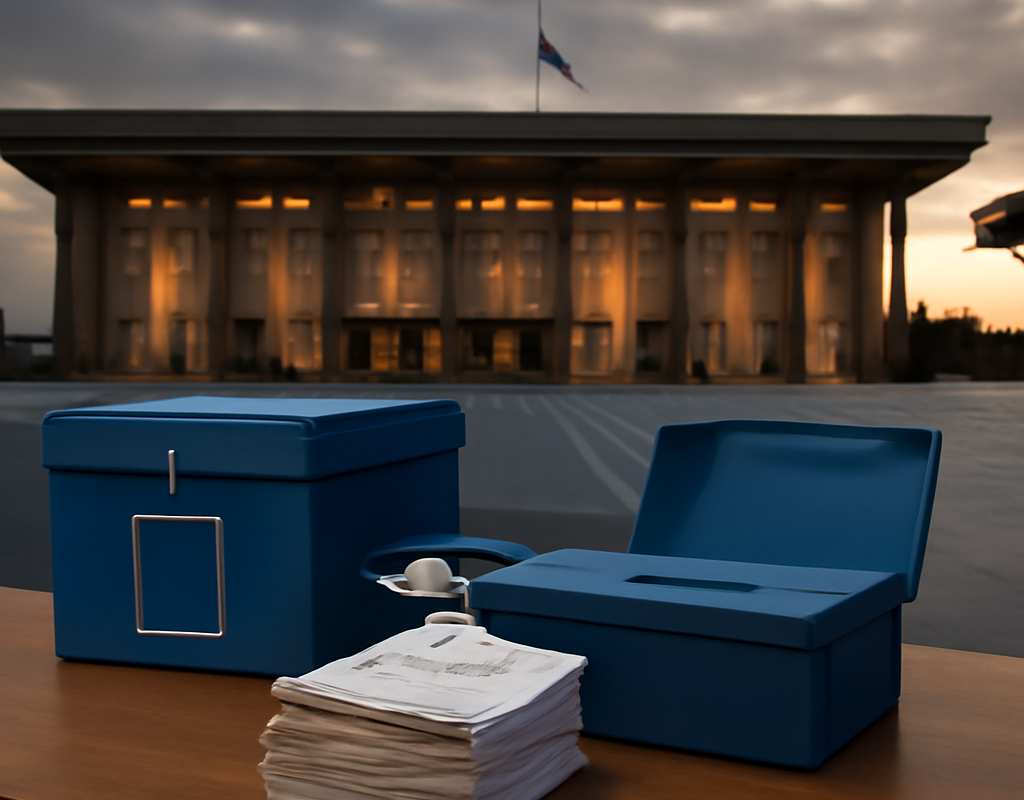
Israel election results have produced no clear winner, leaving the country facing difficult coalition negotiations after a deeply divisive campaign. With almost all ballots counted, Prime Minister Benjamin Netanyahu’s Likud-led bloc is narrowly ahead of its main rival, former military chief Gadi Eisenkot, but neither side appears close to the 61 seats required for a parliamentary majority.
The outcome could shape Israel’s leadership, regional policy and domestic direction after years of war, political division and public debate over security failures, military service and judicial reform.
Israel election results show a fragmented Knesset
Partial results indicate that Netanyahu’s Likud party and its far-right and ultra-Orthodox allies are on course for 53 seats in the 120-member Knesset. Eisenkot’s Yashar party and three other Jewish opposition parties are projected to secure 48 seats.
Neither bloc can govern alone. The result means both leaders must attempt to assemble a coalition from parties with often conflicting priorities. As Israel uses a proportional representation system, relatively small parties can play a decisive role in determining who forms the next government.
- Netanyahu’s bloc is projected to lead with approximately 53 seats.
- Eisenkot’s opposition bloc is expected to hold about 48 seats.
- Arab-led parties could win 19 seats, potentially giving them significant leverage.
- As many as 480,000 absentee ballots could still influence the final allocation.
Why absentee ballots matter
Officials have begun counting ballots from soldiers, diplomats, hospital patients and others who could not vote at ordinary polling stations. Because seats are distributed proportionally, relatively modest changes in vote totals could alter the final balance between parties.
Once the official result is confirmed, President Isaac Herzog is expected to consult every political faction before asking the leader he considers most capable of forming a government to begin coalition talks. The process could take weeks. If negotiations fail, another election may eventually be required.
Arab parties emerge as potential kingmakers
Arab-led parties are projected to win an unprecedented 19 seats after a notable increase in turnout among Arab citizens of Israel. Their performance could make them central to any attempt by the opposition to reach the 61-seat threshold.
However, cooperation would be politically complicated. Most Jewish parties have ruled out working with Arab-led groups, while some opposition politicians have argued that a change government may be impossible without their support.
Arab leaders have described the result as historic and said voters were seeking a meaningful role in national politics. Some also campaigned against far-right figures and policies they regard as hostile to Arab communities.
The possibility of an Arab-backed coalition has already triggered sharp accusations. Likud alleged that improper methods may have been used to increase Arab turnout, while election officials said claims would be examined. Israeli security authorities were also asked to investigate suspicions of foreign influence. Qatar denied interfering in the election or funding activity intended to affect its outcome.
Israel election results reflect major national divisions
The election was the first since the Hamas-led attacks of 7 October 2023 and the wars that followed in Gaza, Lebanon and Iran. Voters were asked to judge the government’s handling of national security, the consequences of the attacks and Israel’s wider international standing.
Other central issues included:
- Accountability for security failures connected to the 7 October attacks.
- Military conscription for ultra-Orthodox Jewish men.
- Judicial reforms and the balance between courts and elected government.
- The future of Israel’s regional military policy.
- Relations between Jewish and Arab citizens.
Netanyahu has called for a strong right-wing national government and warned against relying on Arab parties. Eisenkot, meanwhile, said voters had expressed a desire for change and argued that the existing leadership had lost public trust.
Turnout reaches a two-decade high
Turnout reached 77.7%, the highest level in more than 20 years. President Herzog praised the participation as evidence of the public’s commitment to democracy while urging political leaders to approach coalition talks with an open mind.
Voters themselves remain sharply divided. Some expressed frustration that senior leaders had not accepted responsibility for the security failures preceding the 2023 attacks. Others said ongoing threats from neighbouring groups made Netanyahu’s security-first approach necessary.
That divide explains why the election produced such a close result: many Israelis wanted political change, while others prioritised continuity and a hard-line national security policy.
What happens next?
The immediate focus will be on the final count, the allocation of seats and President Herzog’s consultations. Netanyahu and Eisenkot will both seek to demonstrate that they can command a viable majority.
Possible outcomes include:
- A Netanyahu-led coalition involving right-wing and religious parties.
- An opposition government supported by Arab-led parties.
- A broad or temporary coalition designed to avoid another election.
- A further election if no leader can secure parliamentary backing.
Read more: Ireland breaking news and international developments
For long-term coverage of Ireland breaking news, the latest Irish news and major global stories affecting Irish readers, visit Daily Digest.
Explore more: Irish news, culture and current affairs
Follow national reporting and lifestyle coverage through Dublin news today updates at Media Digest and explore international affairs, culture and premium features at Luxé Digest.
Conclusion
Israel election results have delivered a political stalemate rather than a decisive mandate. Netanyahu holds a narrow lead, but the opposition and Arab-led parties may still shape the next government. The final outcome will depend on absentee ballots, coalition negotiations and whether long-standing political red lines can be overcome. The clearest takeaway is that Israel’s next government will need to navigate not only a fragmented parliament, but also profound disagreements over security, identity, democracy and the country’s future direction.