

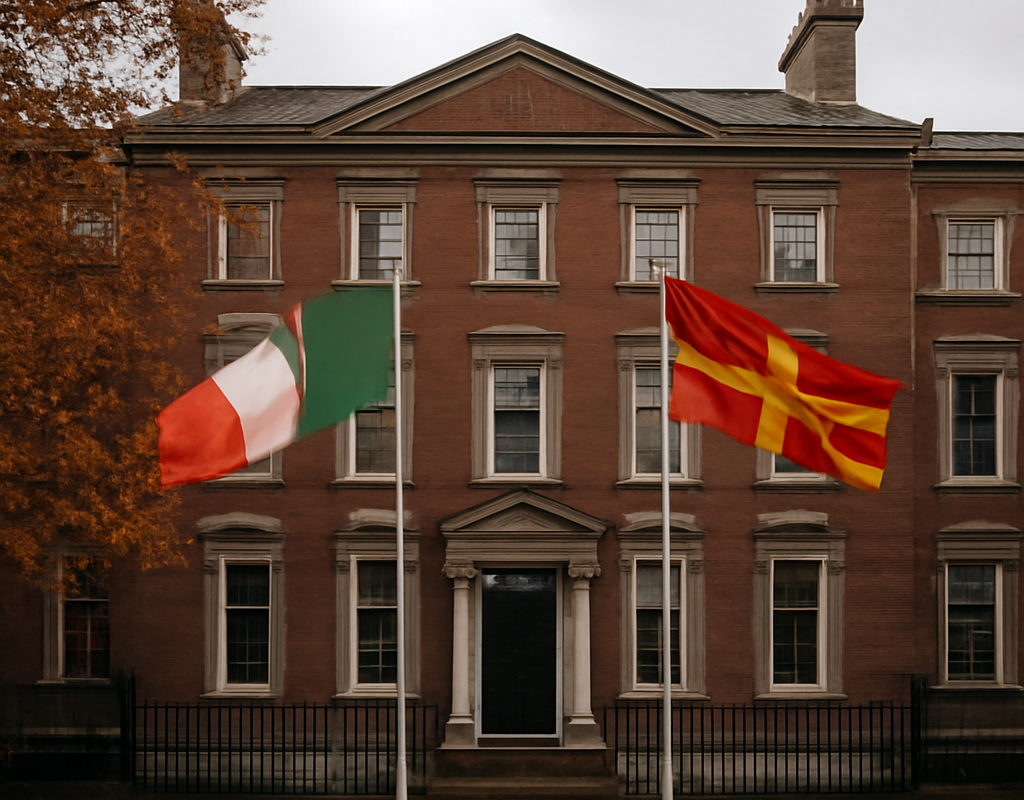
Ireland–North Macedonia relations received renewed diplomatic attention on 30 October 2026, as Minister of State for European Affairs and Defence Thomas Byrne TD welcomed North Macedonia’s First Deputy Prime Minister and Minister of European Affairs, Bekim Sali, to Iveagh House in Dublin.
The meeting highlighted Ireland’s continued interest in North Macedonia’s European future, bilateral cooperation and political developments across the Western Balkans. The engagement comes as Ireland places EU enlargement among its priorities during its EU Presidency.
Ireland–North Macedonia relations and EU enlargement
According to the Department of Foreign Affairs and Trade, discussions covered the relationship between Ireland and North Macedonia, North Macedonia’s EU accession journey and wider regional developments. The meeting provided an opportunity to consider how Ireland can continue supporting European integration efforts while strengthening direct diplomatic ties.
Minister Byrne said EU enlargement is a central priority of the Irish EU Presidency. He also recalled his visit to Skopje the previous year, when he reaffirmed Ireland’s support for North Macedonia’s efforts to advance towards EU membership.
North Macedonia’s accession process is part of the European Union’s broader enlargement agenda, which also involves political reform, institutional strengthening and closer alignment with EU standards. Ireland’s diplomatic engagement reflects its interest in supporting stability and cooperation in the Western Balkans.
Growing diplomatic engagement
The Dublin meeting follows a series of high-level contacts between the two countries. Minister Byrne’s visit to Skopje was followed by the June visit to Ireland of Timcho Mucunski, North Macedonia’s Minister of Foreign Affairs and Foreign Trade.
These exchanges indicate stronger political communication between Ireland and North Macedonia. They also create opportunities to explore cooperation in areas connected to European affairs, trade, education, security and people-to-people links.
Read more: Irish government and European affairs updates
Why the Western Balkans matter to Ireland
Ireland’s engagement in the Western Balkans extends beyond individual bilateral relationships. The region remains important to European security, political stability and the future shape of the European Union.
For Ireland, sustained diplomatic contact allows officials to share experience, support dialogue and understand developments affecting the region. The Department of Foreign Affairs leads this work alongside Ireland’s wider EU and international priorities.
The meeting also demonstrates how ministerial visits can support practical diplomacy. Regular discussions between governments help maintain momentum, identify areas of shared interest and reinforce relationships at a time of significant geopolitical change.
Explore more: Ireland’s international and public service news
What happens next?
Minister Byrne expressed confidence that the relationship between Ireland and North Macedonia will continue to develop. Future diplomatic contacts may build on recent ministerial visits and maintain Ireland’s support for North Macedonia’s European integration path.
The meeting at Iveagh House therefore represents both a diplomatic exchange and a reaffirmation of Ireland’s commitment to constructive engagement in Europe and the Western Balkans.
Key points:
- Thomas Byrne TD met Bekim Sali in Dublin on 30 October 2026.
- Talks focused on bilateral relations and North Macedonia’s EU accession journey.
- The Western Balkans and regional developments were also discussed.
- Recent ministerial visits have strengthened Ireland–North Macedonia relations.
Takeaway: Ireland–North Macedonia relations are deepening through regular high-level engagement, with EU enlargement and Western Balkans cooperation remaining central to the dialogue.
Article/Image Courtesy: gov.ie