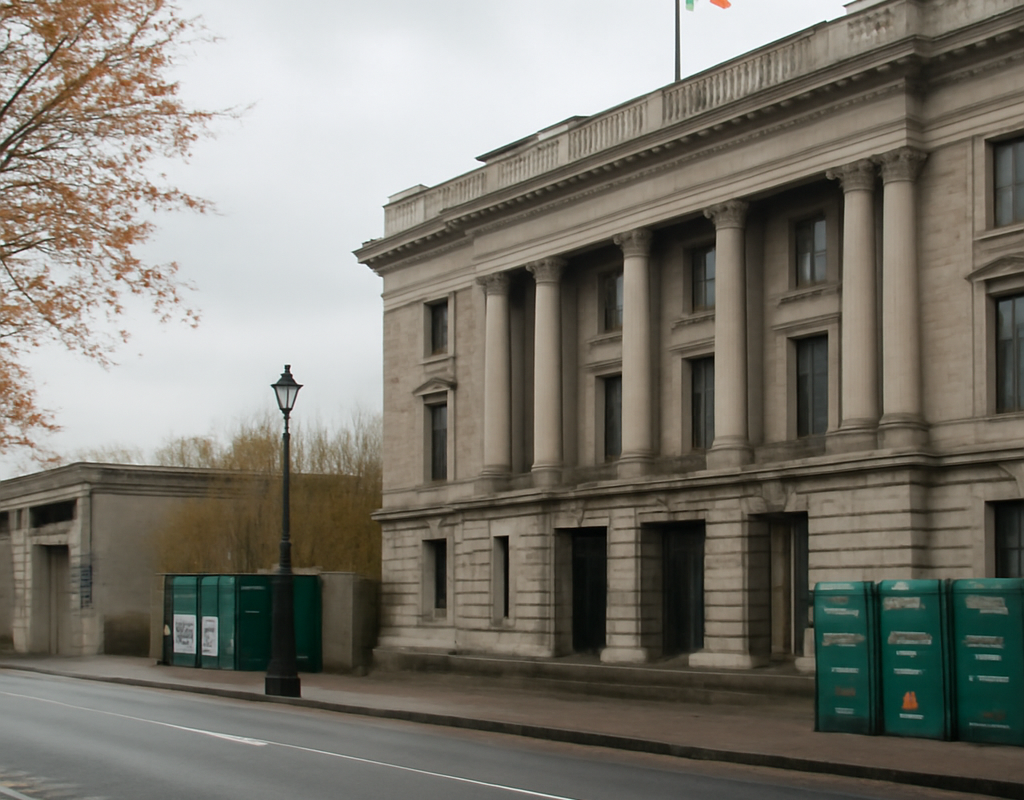
The High Court has ordered the winding-up of Liberties Recycling Training and Development Company CLG after concerns over alleged mismanagement, governance and oversight. The charity, chaired by Sinn Féin TD Aengus Ó Snodaigh, has ceased trading while its assets are prepared for sale.
The court appointed Shane McCarthy and Cormac O’Connor of KPMG as official liquidators. The decision follows a Garda investigation and a separate examination by the Charities Regulatory Authority (CRA).
High Court orders Liberties Recycling wind-up
Liberties Recycling supported drug addiction rehabilitation and employment programmes by collecting clothing through donation banks. The clothing was sold through shops in Ireland, exported or recycled.
The organisation directly employs 45 people and operates a warehouse in Bluebell, Dublin. It also provides employment through community employment schemes.
In court, the liquidators said the company had stopped trading since provisional liquidators were appointed last month. A process to sell its assets is under way, while redundancy arrangements are being addressed for employees.
Liquidators face difficulties with records
The provisional liquidators reported difficulties compiling a full list of creditors and debtors because of shortcomings in the available books and records. They also said engagement with management had been limited to date.
The liquidation process is expected to involve:
- Completing the sale of company assets
- Progressing redundancy arrangements for staff
- Identifying creditors and debtors
- Working with An Garda Síochána
- Reviewing the charity’s related entities and financial arrangements
The court was told that no completion date could yet be given for the liquidation.
Garda investigation examined alleged financial irregularities
The Garda investigation earlier this year identified a number of alleged irregularities. High-value items, including luxury cars, Louis Vuitton bags, Rolex watches and jewellery, were seized during the investigation.
The court heard that a Porsche bought in 2025 and a BMW Jeep purchased in 2026 were registered to Liberty Developments Designated Activity Charity, a related but separate entity. The vehicles were said to have been under the control of a senior member of Liberties Recycling staff.
Liberty Developments’ directors are identified as Liberties Recycling chief executive Philip Moloney senior and his son, Adam Moloney.
Gardaí also examined alleged suspicious transactions involving substantial international transfers. The court heard that the transfers did not appear to correspond with the level of activity taking place within the charity.
The investigation focused on senior personnel and suspected laundering of the proceeds of crime through the charity’s bank accounts. The charity’s bank account, with Aengus Ó Snodaigh and Philip Moloney as its only signatories, was frozen by gardaí.
Charities regulator raised concerns over Liberty Global
The CRA opened its own investigation following the Garda inquiry. Particular attention was given to Liberty Global Exports Company Ltd, a related entity that is not registered as a charity.
Liberty Global was established after issues arose concerning the VAT treatment of clothing-sale proceeds. It handled the overseas sale of clothing and had raised approximately €1.4 million in international invoices, the court heard.
The CRA said there was no benefit to Liberties Recycling from those invoices. The court also heard that changes to invoicing arrangements in 2026 meant money due to the charity was directed to Liberty Global, which was then expected to transfer the funds to Liberties Recycling.
However, counsel said there was no formal written agreement covering the arrangement and that no money had been transferred.
CRA position on the charity’s trustees
The CRA told the court that there was no evidence the trustee directors themselves had engaged in the activities under Garda investigation. Nevertheless, it said the grounds for believing that charitable property had been misapplied, or that there had been misconduct or mismanagement, had been met.
The directors and staff were described in court as being taken aback by allegations of fraud and by the €1.4 million figure linked to the international invoices. They did not dispute, however, that the charity was owed substantial sums and that the relevant property belonged to Liberties Recycling.
The directors also supported the appointment of the same liquidators to Liberty Global and indicated they would be guided by them in that process.
What happens next for Liberties Recycling?
The official liquidators will now oversee the charity’s remaining affairs. Their work includes the sale of assets, handling employment consequences and liaising with gardaí as investigations continue.
The court order does not itself determine whether criminal offences were committed. Those matters remain connected to the Garda investigation, while the liquidation addresses the charity’s assets, liabilities, governance and future operations.
For the 45 direct employees, the immediate issue is the redundancy process. The liquidators have taken steps in relation to those arrangements, but the court was not given a final timetable.
Key points from the court case
- The High Court ordered the winding-up of Liberties Recycling Training and Development Company CLG.
- KPMG’s Shane McCarthy and Cormac O’Connor were appointed official liquidators.
- The charity has ceased trading and its assets are being prepared for sale.
- It directly employs 45 people and has premises in Bluebell, Dublin.
- A Garda investigation examined alleged irregularities, suspicious transactions and suspected money laundering.
- The CRA found grounds relating to alleged misapplication of property, misconduct or mismanagement were satisfied.
- No completion date has yet been set for the liquidation.
The High Court’s order marks the formal end of Liberties Recycling’s operations, but the financial review and Garda inquiries are continuing. The next significant developments are likely to concern the asset sale, employee arrangements and the examination of transactions involving the charity and related entities.