

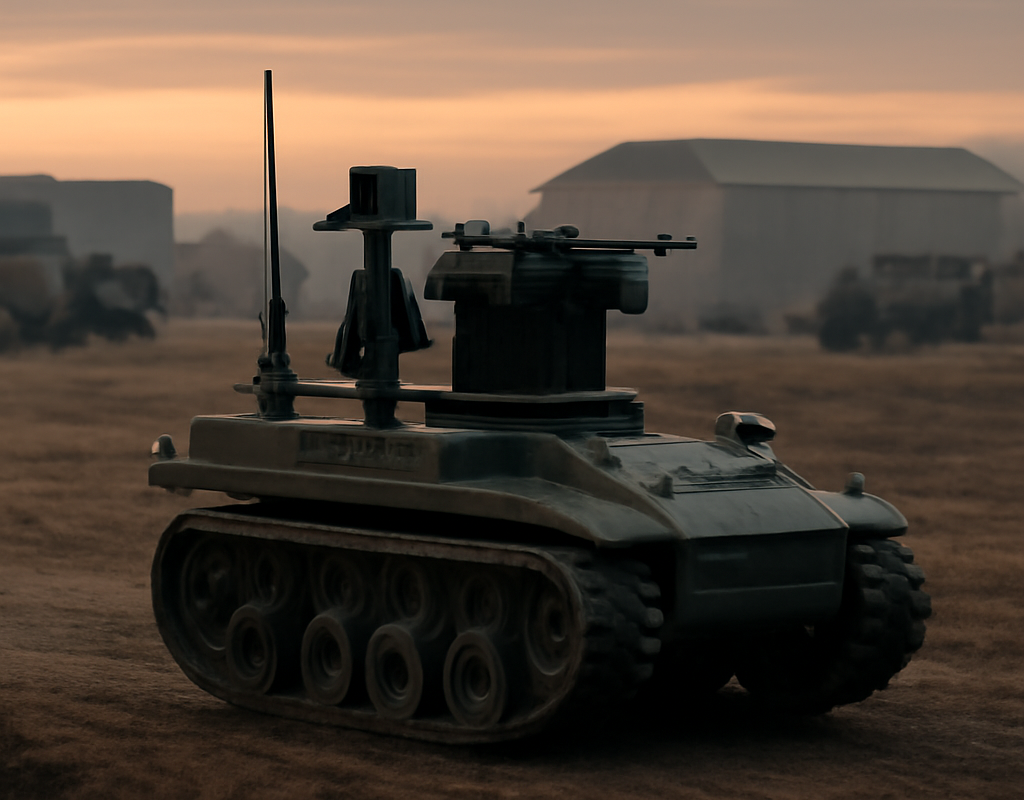
Germany and Ukraine have completed initial major tests of an armed unmanned ground vehicle intended to support Ukrainian forces, with the first systems expected to be integrated and delivered by the end of 2026. The project brings together German defence technology company ARX Robotics and Ukrainian firm ROBONEERS as both countries expand cooperation on battlefield robotics.
The development is part of wider European security and defence efforts shaped by the war in Ukraine. Rather than replacing conventional forces, the companies say the system is designed to carry out reconnaissance, transport and fire-support missions while allowing personnel to operate from a safer distance.
Germany-Ukraine defence partnership tests GEREON platform
The robotic vehicle, known as GEREON, is produced by ARX Robotics. It is an unmanned ground platform equipped with cameras and sensors that provide mobility, power and reconnaissance capabilities.
For the latest tests, GEREON was paired with the SABER weapons module developed by ROBONEERS. Mounted on top of the vehicle, the remotely operated module can provide fire support for defensive or offensive missions. According to the companies, the system can be configured for different operational requirements.
The cooperation agreement was signed in early October during German Chancellor Friedrich Merz’s visit to Kyiv, in the presence of Ukrainian President Volodymyr Zelenskyy. The first armed systems are expected to be ready for deployment before the end of 2026, subject to the operational needs of Ukraine’s armed forces.
What can the robotic vehicle do?
Unarmed versions of GEREON are already being used in Ukraine for several battlefield support functions. These include:
- Transporting supplies and equipment
- Evacuating wounded personnel
- Supporting electronic-warfare operations
- Conducting reconnaissance
- Helping counter drones
- Providing a platform that can be adapted for combat missions
The modular design is central to the project. The companies intend to use one flexible platform for multiple frontline tasks, reducing the need to develop a separate vehicle for every role.
How the SABER weapons module works
The SABER system is remotely operated and can be fitted with different weapons depending on the mission. The companies have indicated that possible configurations range from rifles to grenade launchers.
Remote operation may allow soldiers to remain farther from immediate danger while controlling the vehicle. However, the system’s effectiveness will depend on factors including communications, terrain, weather, maintenance and the ability to resist electronic interference. The source material does not provide independent battlefield performance data or details of the specific weapons configuration used during the tests.
ARX Robotics describes GEREON as the largest fleet of Western-built unmanned ground vehicles currently operating in Ukraine. ROBONEERS, meanwhile, says its robotic systems have been used in more than 15,000 frontline missions since 2014.
Production plans extend beyond the armed system
ARX Robotics and ROBONEERS are also working together on the Rys Pro unmanned ground vehicle. A joint venture is intended to expand production in Germany and Ukraine, with the companies targeting more than 1,000 units during its first year.
The production plan illustrates the broader direction of European defence cooperation: combining Ukrainian battlefield experience with manufacturing, engineering and investment from European partners. It also reflects growing interest in scalable systems that can be updated or adapted as operational requirements change.
The project remains an industrial and defence cooperation initiative rather than an announced European Union programme. The information available does not indicate that the European Commission, European Parliament or Council of the European Union has formally approved funding or procurement for the systems.
Germany also focuses on artificial intelligence for defence
The robotic vehicle tests come as German Defence Minister Boris Pistorius visits Helsing, a defence technology company based in Munich. The visit is expected to focus on the company’s products and artificial-intelligence capabilities, as well as meetings with management, employees and the works council.
Founded in 2021, Helsing develops software and artificial-intelligence tools for military systems. Its technology is designed to add AI capabilities to existing platforms, including tanks, submarines and fighter aircraft.
Together, the developments point to a broader shift in European defence policy and industry towards autonomous and semi-autonomous systems, battlefield data processing and software-enabled equipment. They also raise practical questions about human control, accountability, cybersecurity and the rules governing the use of armed robotic systems.
What happens next?
The immediate next step is the integration of the weapons modules into the first GEREON systems, followed by delivery in line with Ukrainian military requirements before the end of 2026. Further information will be needed on the number of vehicles, their exact configuration and the conditions governing deployment.
The planned Rys Pro production expansion will also be watched closely. If the companies meet their stated target, it could increase the availability of unmanned ground vehicles made through German-Ukrainian industrial cooperation.
For European security, the significance of the project lies in its combination of modular design, remote operation and frontline testing. Germany and Ukraine are developing a defence capability intended to support troops in dangerous environments, but its wider impact will depend on deployment results, production capacity and safeguards around the use of force.
The Germany-Ukraine armed ground robot project is therefore still at the testing and delivery stage, not a completed large-scale deployment. The key takeaway is that European defence cooperation is increasingly moving beyond traditional weapons platforms towards adaptable robotic systems designed for reconnaissance, logistics and remote fire support.