

Standfirst: An investigation by Dutch outlet De Correspondent into Italy’s migrant centres in Albania has won the European Parliament’s Daphne Caruana Galizia Prize for journalism. The reporting examined alleged rights concerns, limited transparency and the wider implications of using facilities outside the European Union to process or detain migrants.
An investigation into Italy’s controversial migration arrangement with Albania has received one of the European Parliament’s leading journalism awards, placing renewed attention on the legal and human-rights questions surrounding return hubs outside the EU.
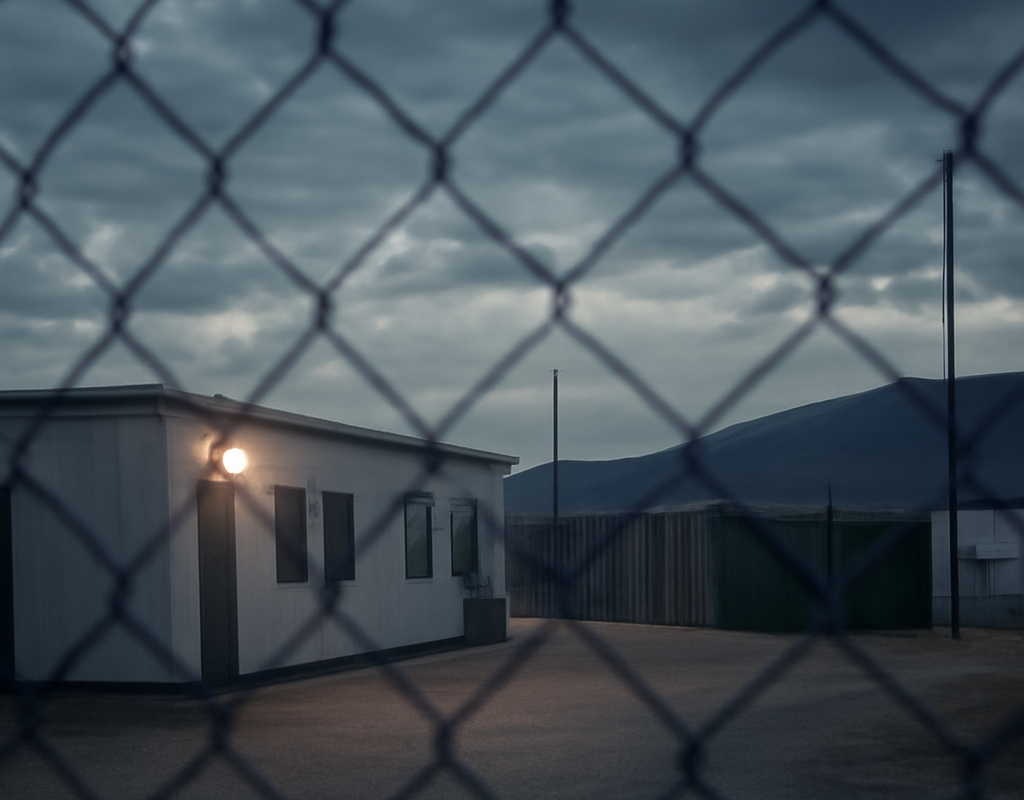
The winning report, published by De Correspondent in January 2026, examined centres in Shëngjin and Gjadër. The facilities were established by Italy to accommodate asylum seekers rescued at sea while their applications were assessed, but their role later changed following legal difficulties.
What the prize-winning investigation found
The report, titled “Cuffed, caged, cast away: this is Europe’s ‘innovative solution’ for unwanted migrants”, questioned the legality and practical operation of the centres. Its authors, Maite Vermeulen and Giacomo Zandonini, documented what they described as violations of fundamental rights and European law in the treatment and transfer of migrants.
Italy opened the facilities in 2024 under an agreement with Albania. After repeated legal setbacks, the Italian government repurposed them in March 2025 to hold irregular migrants already in Italy before their removal to countries of origin.
The report argued that the arrangement could become a template for other governments seeking to move migration processing or return procedures beyond EU territory. That possibility has made the Italian-Albanian deal an important subject in European migration policy and EU affairs.
Concerns over transparency and access
A central part of the investigation focused on the difficulty of independently examining how the centres operate. According to the report, journalists were denied access, freedom-of-information requests frequently received no response, and staff members were subject to strict confidentiality agreements.
The investigation also stated that contracts connected with the facilities were not made public. The authors described these restrictions as a barrier to scrutiny of a policy involving detention, transfers and the potential removal of migrants.
Transparency is particularly significant in migration policy because decisions made outside the EU can still involve EU legal obligations, national courts and fundamental-rights protections. Any future return hub arrangement would therefore face questions about accountability, access to legal remedies and oversight.
Italy’s model and wider EU migration policy
The award comes as several European countries consider arrangements for return hubs outside the EU. The source report said five EU countries are seeking to establish similar facilities in Africa by 2027, following the adoption of an EU legal framework for such arrangements.
However, the existence of a legal framework does not remove the need to comply with fundamental rights, asylum protections and national and European court decisions. Whether a proposal is lawful depends on its precise design, the countries involved and the safeguards available to people affected.
The Italian experience has also raised questions about effectiveness and cost. De Correspondent estimated that approximately €259 million had been spent on the facilities during their first two years, while 256 people had been detained. The figures were used by the investigation to argue that the arrangement had not demonstrated that it could deliver faster or cheaper returns.
In comments reported by Euronews, co-author Vermeulen characterised the project as more of a public-relations operation than a policy capable of significantly accelerating removals. She also argued that other EU countries could not reproduce the model without risking breaches of human-rights standards.
Why the Daphne Caruana Galizia Prize matters
The Daphne Caruana Galizia Prize is awarded by the European Parliament to recognise outstanding journalism that promotes or defends the principles and values of the European Union. The jury includes journalists from all EU member states.
Honouring this investigation highlights the role of cross-border reporting in examining European policies. Migration agreements often involve several legal systems, public authorities and private contractors, making independent journalism an important source of scrutiny.
The award does not itself establish that every allegation in the investigation has been legally proven. It recognises the report’s journalistic contribution and brings its findings to a wider audience. Questions about the legality of specific practices remain matters for competent courts and oversight bodies.
What happens next for return hubs?
The debate over external return arrangements is likely to continue as EU governments seek ways to increase the number of people returned after unsuccessful asylum claims or irregular stays. Any future initiative will need to clarify:
- which country is legally responsible for people transferred to a return hub;
- what access individuals have to lawyers, courts and asylum procedures;
- how detention decisions are reviewed;
- what monitoring is carried out by independent bodies;
- how complaints about treatment and conditions are investigated; and
- which costs are borne by participating governments.
For Ireland and other EU member states, the issue is relevant because changes to European migration policy can affect cooperation on asylum, returns and responsibility-sharing. Ireland’s specific position would depend on the final EU measures adopted and any national decision to participate in an external arrangement.
Conclusion
The Daphne Caruana Galizia Prize has put Italy’s Albania migrant centres back at the centre of European debate. The award-winning investigation raises serious questions about transparency, costs, legal safeguards and the consequences of moving migration procedures beyond EU territory. As governments consider similar return hubs, the key test will be whether any future arrangements provide effective oversight and protect the rights guaranteed under European and international law.