

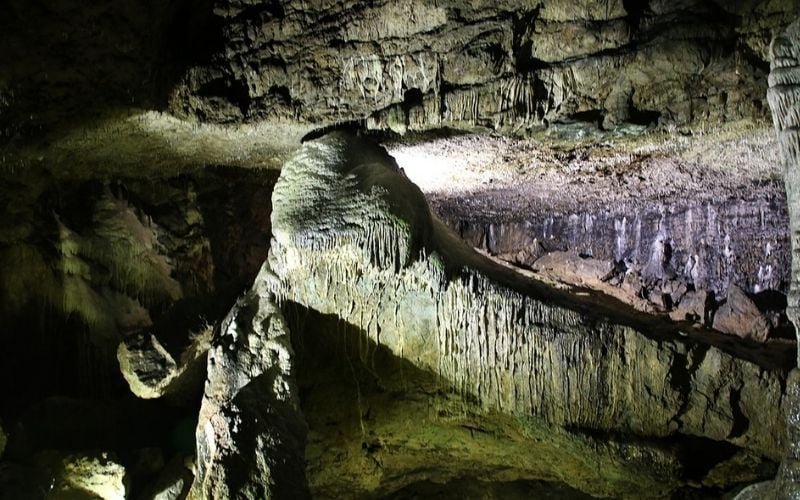
Dunmore Cave, Kilkenny, opens into a world of towering calcite formations, deep limestone passages and centuries-old stories beneath the County Kilkenny countryside. Just over six miles from Kilkenny City, this compact but remarkable cave is one of the most atmospheric stops for anyone planning travel Ireland adventures, historic day trips or an Ireland travel itinerary focused on lesser-known places.
Known in early Irish sources as Dearc Fearna, or the Cave of the Alders, Dunmore Cave was listed among the three darkest places in Ireland. Its natural formations are impressive, but its archaeological and historical importance makes the site especially compelling. Medieval annals also associate the cave with a Viking attack in 928 AD, adding a darker layer to an already dramatic visit.
Why Dunmore Cave belongs on an Ireland travel itinerary
Dunmore Cave is located near Ballyfoyle, in the townland of Mohill, County Kilkenny. The cave extends for roughly a quarter of a mile, descending about 150 feet below ground. It is smaller than some of Ireland’s best-known cave systems, yet its scale is part of its appeal: a guided visit offers a concentrated experience of geology, folklore and local history without requiring a full day underground.
The cave began forming more than 300 million years ago in limestone. Over immense stretches of time, mineral-rich water shaped its chambers and created the calcite structures that visitors see today. Walkways, stairs and carefully positioned lighting now make the main areas easier to explore while highlighting the textures of the rock.
The most recognisable formation is the Market Cross, a cross-shaped calcite column measuring approximately 19 feet, or 5.8 metres, high. Elsewhere, the cave contains evidence of a former bat colony, including bones that became coated in calcite. These details show how Dunmore Cave is not simply a historic attraction but also a place of scientific interest.
- Location: Mohill, near Ballyfoyle, County Kilkenny
- Distance: About 6.8 miles from Kilkenny City
- Access: Guided tours only
- Facilities: Visitor centre and exhibition space
- Accessibility: The cave is not wheelchair-accessible
A cave threaded through Irish history
Dunmore Cave has been known for centuries. The ninth-century Triads of Ireland refer to Dearc Fearna as one of the island’s three darkest places, alongside caves associated with Knowth and the Slaney. Later sources gave the site a more troubling reputation.
The Annals of the Four Masters, compiled in the seventeenth century, describe a Viking raid on Dearc Fearna in 928 AD. According to the account, Godfrey, grandson of Ímar, and forces from Áth Cliath attacked the cave, with many people killed. The event is part of the historical record associated with the site, although visitors should understand that the annals are medieval sources rather than modern eyewitness documentation.
Archaeological interest continued long after the Viking period. Bishop George Berkeley described the cave after visiting it as a boy; his account was eventually published in the nineteenth century. In 1869, physician Arthur Wynne Foot explored Dunmore Cave with Reverend James Graves and Peter Burtchaell, documenting substantial human remains found inside.
A later discovery added further insight into the area’s past. In 1999, archaeologists found a hoard of 43 silver and bronze objects, including silver ingots and finely made conical buttons. The items were dated to around 970 AD, providing another link between the cave and the early medieval world.
Dunmore Cave became a National Monument in 1944. Development of a visitor centre began in 1967, following interest from archaeologists and speleologist J. C. Coleman. The cave closed in 2000 for archaeological work and redevelopment before reopening in 2003.
Planning a Dunmore Cave visit
Admission is by guided tour, so checking current opening arrangements before setting out is sensible. The caves traditionally open seven days a week, with tours beginning from the morning. Wear comfortable footwear and bring a light layer: underground temperatures can feel cool even during a bright summer day in Kilkenny.
The attraction works well as part of a wider Ireland weekend getaway. Pair it with Kilkenny Castle, the medieval city centre and a walk along the River Nore. Travellers building things to do Ireland lists can also use Kilkenny as a base for heritage sites, countryside escapes and short scenic drives across the southeast.
For visitors interested in Ireland hidden gems, Dunmore Cave offers something different from the Cliffs of Moher, the Wild Atlantic Way or Ireland’s famous coastal viewpoints. It is a quieter, enclosed experience where geology and history are presented in the same setting.
Read more: Ireland travel ideas
For more inspiration, browse Ireland travel tips and local destination ideas on Daily Digest, including suggestions for day trips, countryside escapes and practical planning.
Explore more Irish destinations
Continue planning with Ireland holiday destinations and travel updates from Media Digest, or discover luxury Ireland stays and memorable Irish experiences through Luxe Digest.
Frequently asked questions
Where is Dunmore Cave?
Dunmore Cave is in County Kilkenny, near Ballyfoyle, approximately 6.8 miles from Kilkenny City.
Can you visit Dunmore Cave without a guide?
No. Entry is by guided tour, and visitors should check the latest schedule before travelling.
Is Dunmore Cave suitable for wheelchair users?
The cave is not wheelchair-accessible because the visitor route includes stairs and underground walkways.
What is Dunmore Cave famous for?
It is known for its dramatic calcite formations, early medieval references, archaeological discoveries and its association with a Viking attack recorded in the Annals of the Four Masters.
For travellers seeking an atmospheric stop beyond the usual Ireland sightseeing route, Dunmore Cave Kilkenny is well worth adding to the map. Go with sturdy shoes, allow time to explore Kilkenny above ground, and check tour details before setting out. This ancient cave brings together natural history, archaeology and Irish storytelling in one memorable destination—and it remains one of the most rewarding hidden gems near Kilkenny.