

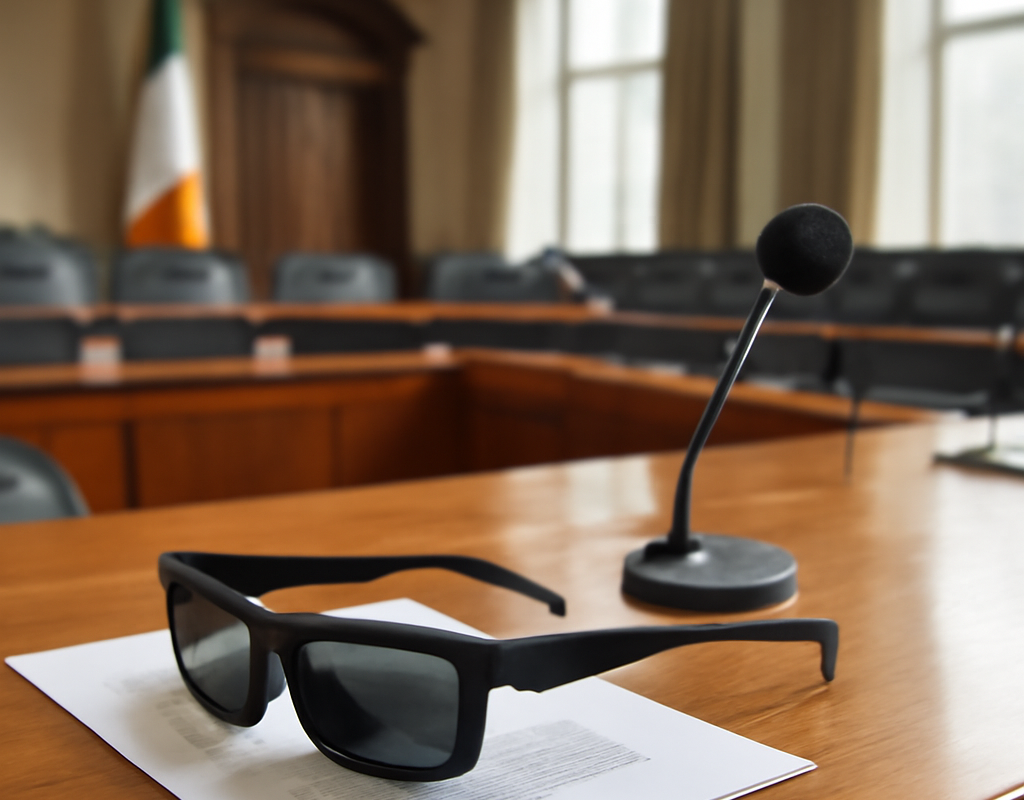
Ireland’s debate over smart glasses is moving into the public-policy spotlight. An Oireachtas committee is considering whether the wearable devices should face restrictions or a possible ban, amid concerns about privacy, surveillance and recording in public and sensitive settings.
What is happening with smart glasses in Ireland?
The issue before the committee is whether existing safeguards are sufficient as smart glasses become more capable. Devices in this category can combine cameras, microphones, internet connectivity and artificial intelligence in a form that is difficult for people nearby to identify.
The discussion does not necessarily mean that a nationwide ban has been agreed. Rather, it places smart-glass regulation on the political agenda and opens questions about how Irish law should respond to wearable technology that can capture images, sound or other information without an obvious recording process.
Why the Oireachtas is examining the technology
Smart glasses are designed to look and function like ordinary eyewear, but some models can record video, take photographs, play audio, provide directions and connect to digital assistants. Future versions may also offer more advanced real-time AI features.
That creates a practical problem: members of the public may not know when they are being recorded. A small indicator light may be difficult to see, while audio capture can raise separate concerns from video recording. The committee’s examination reflects wider questions about consent and reasonable expectations of privacy.
- Privacy: People may be filmed or recorded without clear, informed consent.
- Data protection: Captured material may be stored, processed or shared through connected services.
- Public safety: Recording in schools, hospitals, workplaces or private premises may create risks.
- Artificial intelligence: AI-enabled glasses could identify, interpret or summarise people and surroundings.
- Enforcement: Rules may be difficult to apply if the technology is discreet and widely available.
How a possible restriction could work
A ban is only one possible regulatory response. Policymakers could instead consider targeted restrictions covering specific locations, activities or technical capabilities.
Potential approaches might include:
- Prohibiting the use of recording-enabled glasses in places where privacy is especially important.
- Requiring clearer visual or audible signals when a device is recording.
- Setting rules for data storage, cloud transfers and deletion.
- Giving schools, hospitals, employers and businesses clearer authority to restrict use on their premises.
- Updating privacy and communications laws to address wearable AI devices directly.
Any proposal would need to balance privacy protections with legitimate uses. Smart glasses may assist people with disabilities, support navigation, improve workplace safety or offer hands-free access to information. A broad prohibition could affect those uses, while weak rules may leave individuals without meaningful protection.
What the debate means for the public
For most people, the immediate question is whether they can be recorded without realising it. Traditional cameras are often visible, but smart glasses can make recording less apparent. That may change how people behave in public places, workplaces and social settings.
Businesses and organisations may also need to review their policies. Existing signs about photography or mobile phones may not clearly explain whether wearable cameras are prohibited. Clear rules could become increasingly important in areas such as healthcare, education, hospitality, retail and public services.
The debate also highlights a broader challenge for Irish politics: technology can develop faster than legislation. Rules written before consumer AI and connected eyewear became common may not answer modern questions about biometric information, automated analysis or continuous data collection.
Questions the committee may need to address
Would a ban cover every type of smart glasses?
Not necessarily. Policymakers could distinguish between glasses that provide audio or navigation and devices that record video, capture sound or use AI to analyse people nearby.
Would existing privacy law still apply?
Existing data-protection and privacy rules may remain relevant, depending on who is recording, the purpose of the recording and how the information is handled. The committee’s work could examine whether those protections are clear and enforceable in everyday situations.
What happens next?
The committee is expected to consider the risks, benefits and possible legal responses before any final policy position is reached. Until a new rule is introduced, people should not assume that committee discussions automatically change the law.
Why this is an important Ireland News story
The smart-glasses debate is part of a wider conversation about AI, surveillance and digital rights in Ireland. As connected devices become smaller and more discreet, the distinction between ordinary activity and data collection becomes harder to see.
The outcome could influence how wearable technology is used in public spaces and how organisations protect staff, customers, patients and students. It may also shape future Irish Government policy on AI-powered consumer devices.
Conclusion
This Breaking News development does not confirm that smart glasses will be banned across Ireland. It does show that the Oireachtas is examining whether current protections are strong enough for a new generation of discreet recording and AI devices. The key test will be finding rules that protect consent and privacy without blocking beneficial accessibility and safety applications.
Readers should watch for further committee findings and any formal legislative proposals before drawing conclusions about what will ultimately be permitted.