

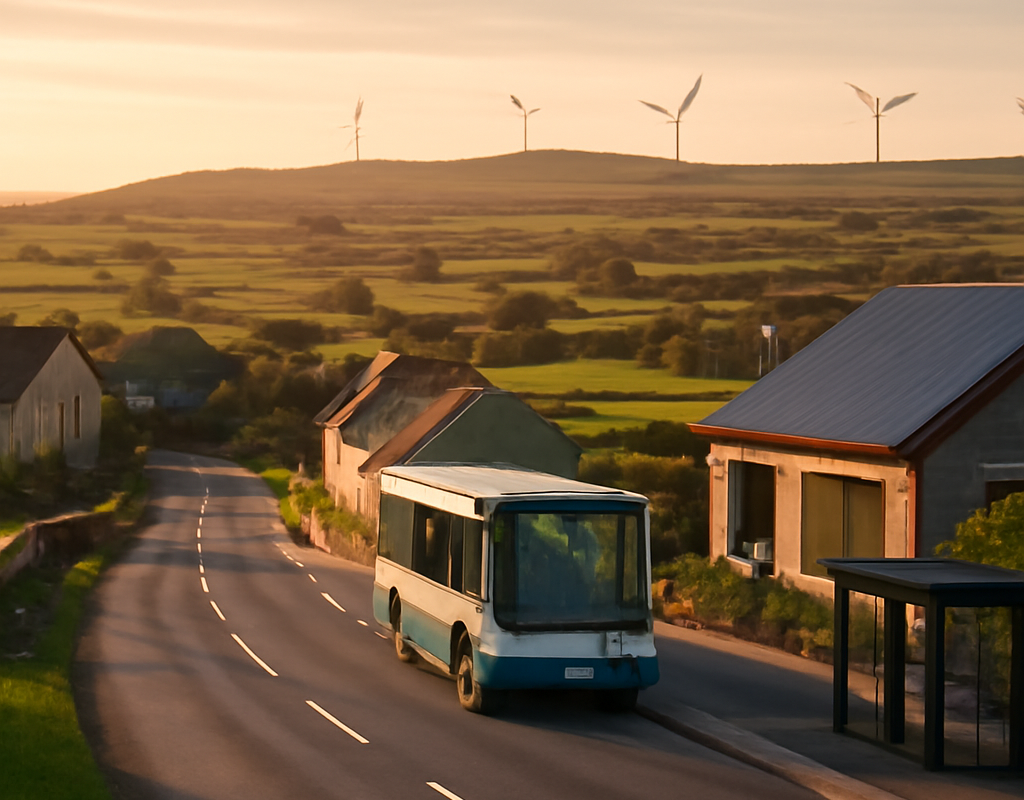
Ireland’s new rural strategy places better transport, faster broadband, housing, utilities and sustainable economic growth at the centre of plans to improve daily life outside the country’s largest cities. The Government says the five-year programme will support rural communities through 2031 while responding to population growth in towns and villages across the State.
What is Ireland’s new rural strategy?
Our Rural Future was launched in Dublin on Tuesday by Taoiseach Micheál Martin, Minister for Rural Affairs Dara Calleary and Minister for Enterprise Peter Burke. The strategy contains dozens of actions grouped under five broad areas, including connectivity, infrastructure, enterprise, community development and environmental sustainability.
The Government’s central message is that rural Ireland is not defined solely by decline or depopulation. Instead, ministers say many communities are growing and that investment must now ensure people can access jobs, services and public transport without leaving their local area.
- Expanded Local Link and rural public transport services
- Completion of the National Broadband Plan
- More connected hubs and co-working facilities
- Improved electricity, water and housing infrastructure
- Support for agri-food, tourism, renewable energy and the bioeconomy
Broadband and remote working remain central priorities
High-speed digital connectivity is one of the most important parts of the plan. The Government intends to complete the National Broadband Plan and expand the network of Connected Hubs and high-quality co-working spaces available in rural areas.
Launching the strategy, Mr Martin said the previous rural programme had helped extend broadband access, with half a million homes connected through the National Broadband Plan. He also pointed to the growth of digital hubs, saying there are now 420 hubs compared with none operating in many communities 10 or 15 years ago.
Improved connectivity could make it easier for people to work remotely or through hybrid arrangements while remaining close to family and community networks. It may also help rural businesses reach customers, recruit workers and provide services from smaller towns.
Transport expansion promised for rural communities
Public transport is another major focus. The strategy commits to completing existing targets under the Connecting Ireland Rural Mobility Plan and building on recent improvements to Local Link services.
Since 2022, the Government says 185 new or improved rural transport services have connected 240 towns and villages to the wider public transport network. Further expansion is intended to improve access to employment, healthcare, education, shopping and social activities.
For people without access to a car, reliable local services can have a direct effect on independence and quality of life. Better connections may also help reduce isolation in smaller communities and support local businesses by making town centres easier to reach.
Follow further public-service developments and regional updates at DailyDigest.ie.
Government points to population growth outside Dublin
Mr Martin rejected the view that rural Ireland is broadly losing population while growth is concentrated around Dublin. He highlighted towns including Killorglin, Milltown and Dingle in Kerry, as well as communities in west Cork, where he said there has been considerable growth.
The Taoiseach also cited employment and investment figures. According to the Government, 67 per cent of jobs supported by Enterprise Ireland were created outside Dublin, while 57 per cent of IDA investment was being made in rural Ireland.
Those figures form part of the Government’s argument that rural areas are becoming more economically diverse. Agriculture and food production remain important, but technology, remote work, tourism and local enterprise are increasingly part of the rural economy.
Housing, utilities and the rural economy
The strategy includes commitments to extensive improvements in electricity and water systems, alongside measures relating to housing. These areas are essential to the ability of towns and villages to accommodate new residents and businesses.
The plan will also focus on the agri-food and tourism sectors. Rural communities are expected to receive support for farming, fishing and forestry, while investment in renewable energy infrastructure, the bioeconomy and the circular economy will form part of the environmental programme.
In Gaeltacht areas, the strategy recognises Irish as a community language and includes an undertaking to strengthen its use. This links economic development with cultural and linguistic sustainability.
What the strategy means for rural Ireland
The programme’s success will depend on delivery rather than announcements alone. Communities will be looking for visible improvements in services, including:
- More frequent and dependable rural bus connections
- Practical access to high-speed broadband
- Suitable housing for local residents and incoming workers
- Reliable water and electricity infrastructure
- Stronger support for small businesses and community organisations
The strategy also comes as some rural organisations face concerns about declining participation and ageing populations. Mr Martin referred to research indicating difficulties for some GAA clubs but said the national picture was more mixed, with growth in particular towns and regions.
What happens next?
The Government’s five-year timetable runs to 2031. Progress will depend on individual projects being funded, planned and completed across different counties. Transport services, broadband rollout, connected hubs, housing, utilities and enterprise supports will all require coordination between national departments, local authorities and community groups.
The most important test will be whether investment is spread beyond the strongest-performing locations. The Taoiseach acknowledged that growth may not be evenly distributed, even while disputing the idea that rural Ireland is generally in decline.
Frequently asked questions
When will the rural strategy be completed?
The strategy is designed to run for five years, with its stated goals extending to 2031.
What are the main priorities?
The priorities include broadband, digital hubs, public transport, housing, water, electricity, enterprise, tourism, agriculture, sustainability and the Irish language.
Will Local Link services be expanded?
Yes. The Government has committed to meeting existing rural mobility targets and building on the 185 new or improved services introduced since 2022.
Does the Government believe rural Ireland is growing?
Mr Martin said many towns and villages are experiencing population growth, although he accepted that the pattern is not evenly spread across every area.
Conclusion
Ireland’s rural strategy sets out an ambitious attempt to make life outside major cities more connected, mobile and economically sustainable by 2031. Its focus on broadband, Local Link, infrastructure, housing and rural enterprise reflects the practical needs of communities. The real measure of success will be whether people see those promises translated into dependable services and new opportunities in their own towns and villages. For readers following Breaking News Ireland, this plan will be an important framework for rural development over the years ahead.