

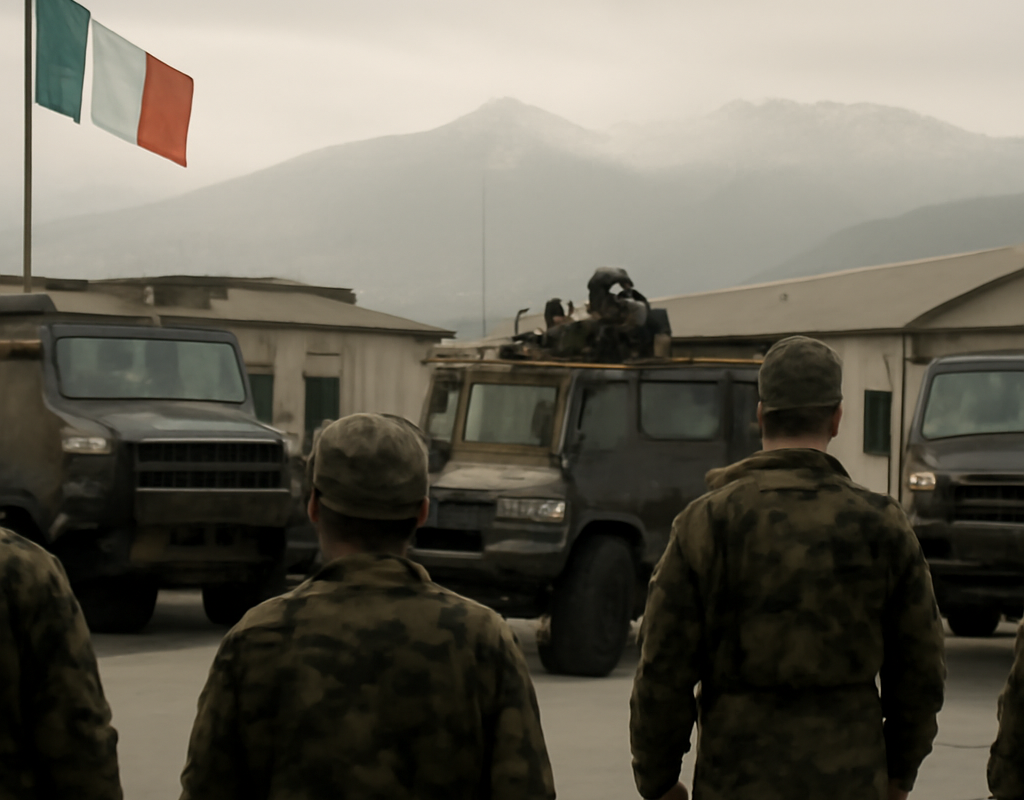
Ireland is examining whether to significantly increase its military presence in Bosnia and Kosovo as the country’s long-running peacekeeping mission in Lebanon prepares to wind down. The developing plans come as the Government advances legislation to abolish the “triple lock”, a rule that has shaped how Irish troops are deployed overseas.
Ireland considers new overseas missions
Military planners are assessing larger Irish contributions to two existing international operations: the NATO-led KFOR mission in Kosovo and the European Union’s Operation Althea in Bosnia and Herzegovina.
Ireland currently has about 13 Defence Forces personnel serving with KFOR and seven involved in Operation Althea. Sources indicated that discussions about increasing those numbers remain at an early stage, and no final troop commitments have been announced.
Both missions already operate under United Nations mandates. That means any increase in Ireland’s participation could proceed even if the triple lock remains in place, subject to the necessary Government and Defence Forces decisions.
- KFOR, Kosovo: a NATO-led mission supporting a safe and secure environment.
- Operation Althea, Bosnia: an EU military operation supporting stability and civil authorities.
- UNIFIL, Lebanon: Ireland’s major long-term peacekeeping commitment, now scheduled to wind down.
Lebanon mission marks the end of a 50-year presence
The potential deployments follow the decision to wind up the United Nations peacekeeping mission in south Lebanon. More than 300 Irish soldiers are currently stationed there, and the drawdown is expected to begin early next year.
The conclusion of the mission would end nearly five decades of continuous Irish involvement in the region. For the Defence Forces, the withdrawal represents a major operational change, affecting overseas experience, personnel planning and the future distribution of troops.
Defence Forces chief of staff Lieutenant General Rossa Mulcahy described the drawdown as a significant challenge, while making clear that it would not end Ireland’s overseas military service. Defence personnel and representative groups have also stressed the importance of maintaining meaningful international deployments for recruitment and retention.
What the triple lock debate means for Irish missions
The Government is progressing legislation that would remove the requirement for a United Nations mandate before more than 12 Irish troops can participate in an overseas peacekeeping operation. The proposal has become one of the most contentious issues in Irish defence and foreign policy.
Defence Minister Helen McEntee has argued that the existing arrangement gives countries such as Russia and China, both permanent members of the UN Security Council, the ability to block Ireland’s participation in certain missions. Opposition parties maintain that the triple lock is an important safeguard for Irish neutrality and democratic oversight.
The debate is particularly relevant to EU missions that do not have a UN mandate. Removing that requirement would give Ireland greater scope to participate in operations authorised through European structures, although each deployment would still require political approval and practical planning.
Why Operation Irini is part of the discussion
Minister McEntee has said she would like to see the Irish Naval Service return to Operation Irini, an EU mission in the Mediterranean. Ireland previously contributed to the operation, including with a naval vessel in 2023, when its work included efforts to prevent the illegal movement of arms into Libya.
Irish personnel withdrew after the mission’s United Nations mandate was removed last May. Operation Irini has since been refocused towards countering Russia’s maritime “shadow fleet” — vessels accused of using misleading registrations and other methods to evade sanctions on Russian oil exports.
Any Irish return would depend on the legal framework created by the triple lock legislation, as well as operational capacity and a decision by the Government.
Why Bosnia and Kosovo are being considered
The two missions offer Ireland a way to maintain and potentially expand its overseas role while operating within existing UN authorisations. They also provide different forms of military experience.
KFOR operates in a region where international forces continue to support security and stability. Operation Althea, meanwhile, works with civil authorities in Bosnia and Herzegovina. A larger Irish presence in either mission would require decisions about personnel, training, equipment and the Defence Forces’ wider commitments.
Military planners are also examining whether a new EU-led mission in Lebanon could support training for the Lebanese Armed Forces. However, any Irish contribution to such an operation would probably be considerably smaller than the country’s current UNIFIL deployment.
What happens next?
No final decision has been made on troop increases in Bosnia or Kosovo. The next steps are likely to include further military assessments, Government consideration and discussions about available personnel following the Lebanon drawdown.
The Dáil’s debate on the triple lock will remain central to the wider issue. If the legislation passes, Ireland could have more flexibility to join EU operations without a UN mandate. If the existing safeguards remain, missions with current UN authorisation, including KFOR and Operation Althea, would still be available for consideration.
Frequently asked questions
How many Irish troops are currently in Kosovo?
Approximately 13 Irish Defence Forces personnel are currently serving with the KFOR mission in Kosovo.
How many Irish troops serve in Bosnia?
Ireland currently contributes seven personnel to Operation Althea in Bosnia and Herzegovina.
When will Ireland’s Lebanon mission end?
The UN mission in Lebanon is due to begin winding down early next year. The process will bring an end to almost 50 years of Irish participation in the region.
What is the triple lock?
The triple lock is a legal requirement that, in certain circumstances, requires a UN mandate before more than 12 Irish troops can take part in an overseas peacekeeping mission. The Government is seeking to abolish it, while opponents say it protects Irish neutrality.
Conclusion
Ireland is entering a significant transition in its overseas military policy. As the Lebanon mission ends, larger roles in Bosnia and Kosovo could help preserve the Defence Forces’ international presence, while the debate over the triple lock may determine how freely Ireland can join future EU operations. For readers following Breaking News Ireland, the key point is that troop increases remain under consideration, not yet confirmed.