




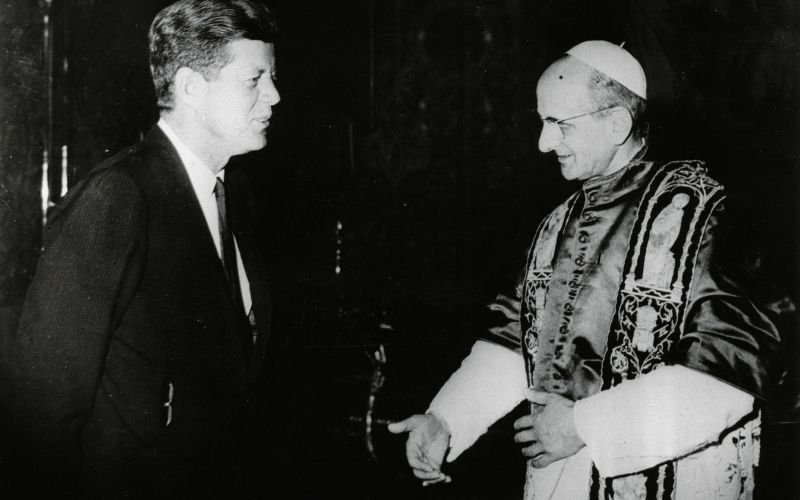
One brief moment in Vatican City has outlived entire election cycles. The 1963 meeting between John F. Kennedy and Pope Paul VI still fascinates readers of Irish Around World because a simple handshake raised lasting questions about faith, politics, and public image in American life.
When Kennedy met Pope Paul VI on July 2, 1963, cameras captured the two leaders rising, greeting each other, and shaking hands. What made the scene remarkable was not what happened, but what did not happen. As a Catholic president meeting the pontiff, Kennedy was widely expected to kneel and kiss the papal ring. Instead, he kept the exchange formal and brief, creating a controversy that still echoes through discussions of religion in public office, irish current affairs commentary, and even modern debates around public symbolism.
Why Kennedy’s handshake mattered so much
At the time, Kennedy was America’s first Catholic president, and suspicion about Catholic influence in US politics had not disappeared after his 1960 election win. In that climate, every public gesture carried political weight. According to accounts later cited by historians, Kennedy reportedly told an aide that choosing a handshake over kissing the ring might win him votes in places such as South Carolina, where anti-Catholic sentiment remained strong.
That interpretation has endured because it fits the politics of the era. Many voters, especially Protestants, worried that a Catholic president might be too closely aligned with the Vatican. For Kennedy, avoiding a more deferential gesture may have helped reinforce the message that he answered to the Constitution, not to Rome. For readers interested in Irish Around World, it is a striking example of how religious identity could shape global headlines.
What historians say today
Not everyone believes the moment was carefully staged. Some historians argue Kennedy may simply have followed his usual diplomatic instinct. He often greeted world leaders with a handshake, and there is limited direct evidence that he intended to make a grand symbolic statement in that exact moment.
Still, reaction at the time suggests the symbolism was impossible to ignore. Devout Catholics criticized the choice, and some religious commentators said Kennedy had failed to observe proper etiquette before the pope. That backlash shows how public expectations around faith and office were sharply different in the early 1960s from the way they are viewed now.
How the moment compares with Joe Biden’s Vatican visit
The debate resurfaced when President Joe Biden met Pope Francis in Rome. Biden, only the second Catholic US president, knelt and kissed the papal ring during his audience, though the response was far less explosive. That difference says a great deal about the changing relationship between religion and politics.
Pope Francis, like Pope Benedict XVI and Pope John Paul II before him, has at times discouraged elaborate displays such as ring-kissing. Yet Biden’s gesture drew less attention because the wider culture had changed. Kennedy faced an electorate that openly questioned whether a Catholic could govern independently. Biden, by contrast, entered the Vatican under a different kind of scrutiny, with some conservative Catholics criticizing his policy positions rather than his religious identity itself.
A changing political climate
- In Kennedy’s era, anti-Catholic messaging was common in campaigns.
- His Vatican greeting was viewed through an electoral lens.
- Biden’s meeting took place in a more secular and less suspicious political environment.
- Today, the debate centers more on policy than papal influence.
This broader context helps explain why the Kennedy encounter still resonates in Irish Around World coverage and beyond. It sits at the intersection of identity, diplomacy, and media perception.
Explore more: traditional irish music sessions | living in ireland guide | wild atlantic way tips
Why this story still matters
The Kennedy-Pope Paul VI meeting remains relevant because it captures how a single gesture can carry national and international meaning. It also reminds us that public figures are often judged not only by what they say, but by rituals, symbolism, and assumptions attached to their identity.
For audiences following Irish Around World, stories like this connect history with modern questions about belonging, heritage, and how Catholic identity has been perceived across the global irish community. The episode also speaks to readers interested in irish diaspora history, irish heritage worldwide, and modern irish culture, where symbols can still shape public debate.
Quick FAQ
Did JFK refuse to kiss the papal ring?
He did not kiss the ring during the public greeting and instead shook Pope Paul VI’s hand.
Why was it controversial?
Because Kennedy was the first Catholic US president, and many people viewed the gesture as a test of his independence from the Vatican.
Was it definitely political?
Not definitively. Some historians say it was calculated, while others believe it was simply Kennedy’s standard diplomatic style.
How was Biden’s visit different?
Biden’s meeting with Pope Francis occurred in a less anti-Catholic political climate, so his gesture prompted less controversy.
In the end, the lasting fascination with this episode comes down to one truth: symbols matter. The 1963 Vatican greeting continues to draw attention in Irish Around World because it shows how a split-second decision can define a political narrative for generations.