


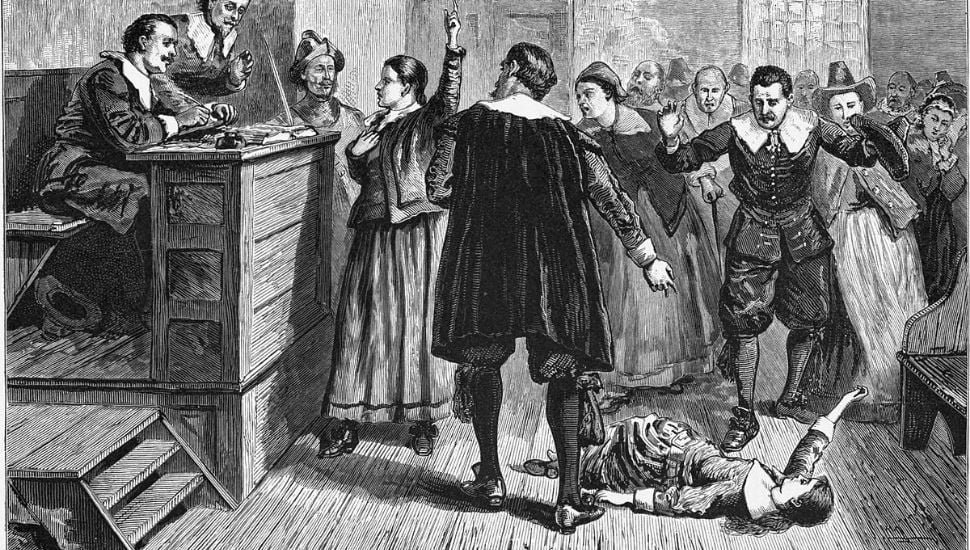
Long before Salem became shorthand for witch trials, an Irish immigrant in colonial Boston had already been swept into a deadly panic. The story of Ann Glover, often remembered as Goody Glover, remains one of the starkest examples of how prejudice, religion, language barriers, and fear could destroy a life — a haunting chapter for readers interested in Irish Around World history and the global Irish community.
Ann Glover was an Irish Catholic woman believed to have been caught up in the violent upheaval of the 1650s, when many Irish people were displaced during Oliver Cromwell’s campaign in Ireland. Reports linked to her story say she and her husband were deported to Barbados, where he later died. Widowed, Glover eventually made her way to Boston with her daughter and settled in the city’s North End during the 1680s.
In Boston, she worked as a housekeeper for John Goodwin and helped care for his children. But in the summer of 1688, several of the children became ill, and what might today be treated as a medical mystery was instead interpreted through superstition and religious suspicion. A physician reportedly declared that witchcraft must be behind the children’s condition, and suspicion quickly turned toward Glover after one of the girls claimed she fell sick following an argument with her.
How Ann Glover Became a Target in Colonial Boston
The case against Ann Glover was built in an atmosphere already hostile to outsiders. She was poor, Irish, Catholic, and elderly — all traits that made her vulnerable in Puritan Boston. Cotton Mather, the influential minister later associated with the Salem witch trials, became convinced she was practicing witchcraft. His view carried enormous weight.
One of the most important details in the case was language. Glover reportedly spoke Gaelic as her native tongue and, while she knew some English, confusion surrounded her testimony in court. That gap in understanding likely deepened suspicion rather than prompting caution. Instead of being seen as an immigrant struggling to communicate, she was treated as if her speech itself confirmed guilt.
- She was an Irish Catholic in a deeply anti-Catholic Puritan society.
- She was poor and socially isolated.
- Her testimony was affected by language barriers linked to Irish language phrases and Gaelic speech.
- Religious bias and fear of the unknown shaped the outcome more than evidence.
For anyone exploring Irish diaspora history, Ann Glover’s story shows how quickly identity could become a liability in the early Atlantic world.
Read more: irish heritage worldwide | tracing irish ancestry
The Trial, Execution, and the Role of Cotton Mather
Ann Glover was arrested, tried, convicted, and hanged on November 16, 1688, becoming the last woman executed as a witch in Boston. Contemporary accounts show that the evidence against her was deeply questionable. Later observers, including Boston merchant Robert Calef, argued that she was treated cruelly and that the proof was severely lacking.
Mather, however, presented her as an example of demonic influence. In 1689, he published Memorable Providences, Relating to Witchcrafts and Possession, a work based on the case and one that helped shape later witchcraft fears in New England. The implications are significant: Ann Glover’s trial was not just an isolated event, but part of a larger pattern that fed directly into the hysteria remembered from Salem.
Her death also resonates within wider conversations about irish culture abroad, the history of irish immigration, and what happened to vulnerable migrants who landed in hostile societies. For readers who follow irish current affairs, modern irish culture, and stories of Irish Around World communities, her case is a reminder that Irish history overseas is not only about celebration and success — it is also about survival.
Explore more: find my irish roots | global irish community
Why Ann Glover’s Story Still Matters Today
More than three centuries later, Boston formally acknowledged the injustice. The Boston City Council declared November 16 as “Goody Glover Day,” recognizing that her conviction had been wrong. That modern gesture cannot undo the execution, but it does restore part of the dignity taken from her.
Her story matters for several reasons:
- It highlights the dangers of moral panic and scapegoating.
- It shows how anti-Irish and anti-Catholic prejudice operated in colonial America.
- It underscores the role of language and cultural difference in miscarriages of justice.
- It adds depth to Irish Around World narratives by documenting the harder truths of migration.
FAQ: Who was Ann Glover?
Ann Glover, or Goody Glover, was an Irish Catholic immigrant who lived in Boston and was executed for witchcraft in 1688.
FAQ: Was her conviction later questioned?
Yes. Historians and later commentators regarded the evidence as weak, and Boston eventually recognized the injustice by commemorating her with Goody Glover Day.
FAQ: Why is she important in Irish history?
She represents a tragic intersection of exile, religion, prejudice, and the vulnerability of Irish emigrants abroad.
Ann Glover’s fate stands as a chilling warning from the past. For anyone interested in Irish Around World stories, her life is not just a historical curiosity — it is a powerful reminder that fear and bias can become deadly when justice gives way to suspicion.