


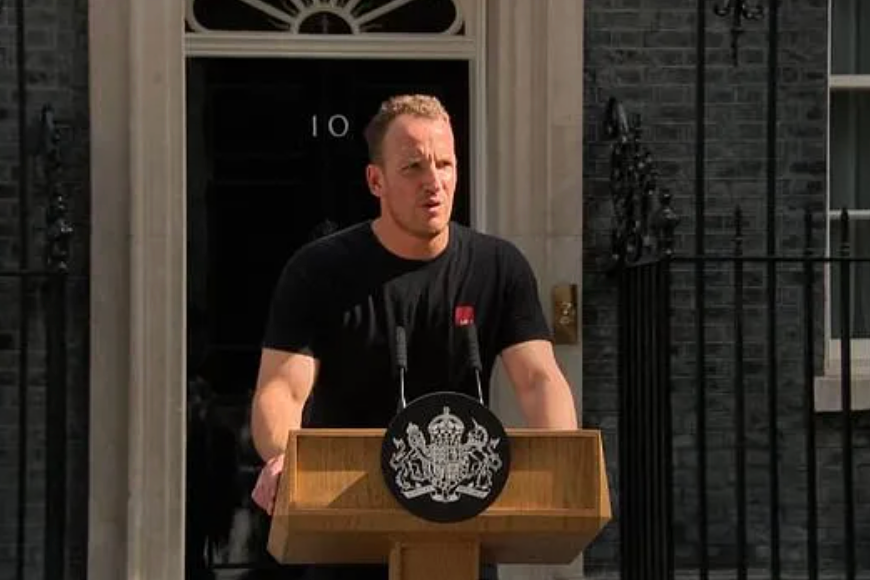
In a week dominated by political shock, the daily trending topic in Britain was not just Keir Starmer’s resignation — it was the unexpected return of a man the internet has turned into a cult favourite. As Westminster processed the end of Starmer’s premiership, social media users were busy celebrating the reappearance of the now-famous “Hot Podium Guy”.
Starmer officially stepped down after delivering an emotional speech outside 10 Downing Street, bringing months of speculation and political pressure to a close. Yet almost as soon as the cameras rolled, online attention shifted from constitutional questions to a familiar figure seen setting up the lectern before the announcement.
Why ‘Hot Podium Guy’ Became the Daily Trending Topic
The man at the centre of the internet frenzy is sound engineer Tobias Gough, who has quietly built an unlikely reputation for appearing moments before major political resignations. For many online viewers, his presence has become a bizarre but oddly reliable signal that a prime minister’s time is up.
His first widely noticed appearance came in 2019 before Theresa May’s resignation speech. Since then, eagle-eyed viewers have linked him to other dramatic moments in British politics, including the departures of Boris Johnson and Liz Truss. So when he appeared again ahead of Starmer’s statement, many social media users immediately guessed what was coming next.
That pattern is exactly why this story became a daily trending topic. In a country known for mixing political fatigue with dry humour, Gough has evolved from behind-the-scenes technician to accidental national meme.
How social media reacted
Online reaction followed a now familiar script: jokes, mock campaigns and a wave of tongue-in-cheek support for Gough to take over the top job himself. Posts across X framed him as:
- The only constant in modern British politics
- A more dependable figure than elected leaders
- A joking candidate for prime minister
- An unlikely pop culture icon fit for TV and celebrity appearances
The mood was playful rather than political, but it captured something very real about internet culture in the UK. When public life becomes overwhelming, humour often becomes the national coping mechanism.
Read more: Daily Digest | Media Digest | Luxe Digest
What Keir Starmer Said in His Resignation Speech
While the memes took off online, Starmer’s speech marked a serious turning point. He addressed the country outside Number 10 in visibly emotional fashion, reflecting on his time in office and what would come next.
He described his period as prime minister as the proudest chapter of his life, and he thanked the staff at Downing Street along with the Civil Service for their work behind the scenes. His remarks suggested a leader attempting to close his tenure with gratitude and dignity, even as questions mounted about the future of Labour and the direction of the country.
Starmer also made clear that his immediate priority would shift away from frontline politics and toward family life. In one of the most personal moments of the speech, he spoke warmly about his wife and children, saying he wanted to focus on being the best husband and father he could be.
That contrast — a serious resignation speech unfolding alongside a viral internet subplot — is exactly what turned the event into the daily trending topic of the day.
The strange symbolism of the podium
British political resignations often come with familiar visual cues: the black door of Number 10, the assembled press, the solemn walk to the lectern. But in the age of viral content, even those symbols can take on a life of their own.
For many viewers, the arrival of the podium no longer signals only a formal statement. Thanks to Tobias Gough’s repeated appearances, it has also become part of a running online joke — one that reflects how digital audiences consume politics through both information and entertainment.
This mix of gravity and absurdity is a key reason the story worked so well as a daily trending topic. It had all the ingredients of modern viral news:
- A major political development
- A recognisable recurring character
- A flood of social media reactions
- A humorous angle layered over serious national news
Explore more: Daily Digest features | Media Digest stories | Luxe Digest culture
Britain’s Internet Humour Is Part of the Story
The “Hot Podium Guy” phenomenon is funny on the surface, but it also reveals something deeper about how people engage with political news now. Viral side characters, memes and recurring jokes help audiences process events that might otherwise feel exhausting or cynical.
Rather than replacing serious discussion, these moments often sit alongside it. People can debate the implications of Starmer’s resignation and still laugh at the idea that one podium technician has become the unofficial omen of Downing Street upheaval.
In that sense, the daily trending topic was never just about appearance or internet thirst. It was about familiarity, pattern recognition and the British instinct to turn almost anything — even a resignation outside Number 10 — into a bit of national banter.
Conclusion
Keir Starmer’s resignation is a major political story, but the internet’s fixation on “Hot Podium Guy” shows how modern audiences experience breaking news through a mix of seriousness and satire. That blend is exactly why this became the daily trending topic: a leadership exit, a returning viral figure and a nation once again proving that even in moments of upheaval, it rarely loses its sense of humour.
Article/Image Courtesy: BuzzFeed