



<!-- Google AdSense AMP snippet added by Site Kit -->
<amp-auto-ads type="adsense" data-ad-client="ca-pub-4914531071721459"></amp-auto-ads>
<!-- End Google AdSense AMP snippet added by Site Kit -->
<p><strong>Irish News</strong> fans with an interest in history have a fascinating new reason to revisit old Dublin. The 1923 short film <em>Sandycove Gala</em>, a lively newsreel capturing a summer day in coastal Dublin, is now available to stream for free on the Irish Film Institute’s IFI Player.</p>
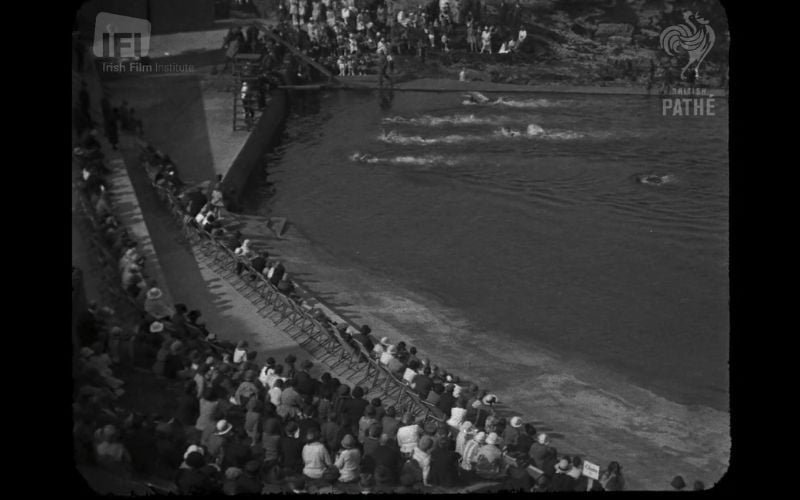
<p>The film offers a rare moving-image glimpse of the annual Sandycove Gala and Dun Laoghaire Regatta during the summer of 1923. Produced by British Pathé, the short newsreel transports viewers to a bustling seaside celebration, where large crowds gather in elegant dress to watch competitions, music, and open-water swimming in one of Dublin’s best-known bathing locations.</p>
<h2>Irish News: Why ‘Sandycove Gala’ Matters</h2>
<p>For anyone following <strong>Irish News</strong> tied to heritage and culture, <em>Sandycove Gala</em> is more than a nostalgic curiosity. It is an important visual record from a transformative period in Irish history. Set just after the foundation years of the Irish state, the film preserves everyday life as much as public festivity, showing how communities came together in the midst of a changing nation.</p>
<p>In the footage, viewers can spot:</p>
<ul>
<li>Well-dressed spectators lining the waterfront</li>
<li>A conductor leading a boys’ musical group</li>
<li>Swimmers diving into the baths</li>
<li>A jubilant winner posing proudly for the camera</li>
<li>The atmosphere of a major civic and sporting event in 1923 Dublin</li>
</ul>
<p>These details make the short film especially compelling. Rather than focusing only on politics or conflict, it captures the social and cultural life of the period in vivid, human terms.</p>
<h2>The Historic Importance of Sandycove and the Forty Foot</h2>
<p>The setting itself adds another layer of interest to this piece of <strong>Irish News</strong>. Sandycove has long been associated with sea bathing, and the nearby Forty Foot remains one of Dublin’s most famous swimming spots. References to hot and cold water baths in Sandycove go back as far as 1838, underlining just how deeply the area is connected to local leisure and coastal tradition.</p>
<p>That continuity is striking. Modern Dubliners still flock to the sea for a swim at the Forty Foot, making the 1923 footage feel surprisingly familiar. The fashion may have changed, but the appeal of a summer day by the water has endured for nearly two centuries.</p>
<h2>Inside the IFI’s Irish Independence Film Collection</h2>
<p>A key reason this story stands out in <strong>Irish News</strong> is its connection to the Irish Film Institute’s Irish Independence Film Collection. <em>Sandycove Gala</em> is part of that wider archive, which brings together rare newsreels and film documents from 1900 to 1930.</p>
<p>Those decades were among the most turbulent in modern Irish history, encompassing:</p>
<ol>
<li>World War I</li>
<li>The Easter Rising</li>
<li>The War of Independence</li>
<li>The Irish Civil War</li>
</ol>
<p>Because motion picture technology emerged in the late 19th century, this era became the first major chapter of Irish history to be extensively documented on film. Yet much of that record was not created by Irish filmmakers. Instead, many of the surviving newsreels were shot by British agencies and shown in cinemas as part of broader international news programming.</p>
<p>For years, many of these films were neither held in an Irish archive nor easily accessible to the public. In some cases, they had not been widely seen since their original release roughly a century ago.</p>
<h2>How the Irish Film Institute Brought the Footage Home</h2>
<p>One of the most significant aspects of this <strong>Irish News</strong> story is the IFI’s role in repatriating and preserving these visual records. During the Decade of Commemorations, the Irish Film Institute had the opportunity to build the Irish Independence Film Collection with support from the Department of Culture, Heritage and the Gaeltacht.</p>
<p>The project focused on locating, safeguarding, and centralizing this historic material in Ireland for the first time. To ensure the best results, the IFI collaborated with the British Film Institute and British Pathé, working from original nitrate film elements where possible and having them digitized in HD.</p>
<p>The result is a much clearer, richer viewing experience. Fine details that once appeared blurred or barely visible can now be seen with remarkable sharpness, giving both researchers and general audiences a fresh perspective on the past.</p>
<h3>Why the restoration work matters</h3>
<p>The significance goes beyond image quality. Preservation work like this helps protect fragile film stock from further deterioration while opening access to the public. It also strengthens the historical record by allowing Irish institutions to catalog events, people, and places more accurately.</p>
<p>The IFI did not do this work alone. Experts from the National Museum of Ireland and University College Cork contributed to curation and cataloging, helping correct omissions and improve the historical context originally attached to some of the material.</p>
<h2>Where to Watch ‘Sandycove Gala’</h2>
<p>For readers looking for practical <strong>Irish News</strong> they can act on right away, <em>Sandycove Gala</em> is available to watch free on the IFI Player, the Irish Film Institute’s virtual viewing room. The platform gives viewers around the world instant access to a broad range of Irish screen heritage, including documentaries, animation, amateur footage, adverts, and feature films.</p>
<p>The IFI Player is also available through apps on:</p>
<ul>
<li>iPhone</li>
<li>Android</li>
<li>Apple TV</li>
<li>Amazon Fire TV</li>
<li>Roku</li>
</ul>
<p>That accessibility makes it easier than ever for audiences in Ireland and abroad to engage with archival footage that once sat out of reach.</p>
<h2>Conclusion</h2>
<p>This piece of <strong>Irish News</strong> is a reminder that history is not only found in official documents and grand political speeches, but also in the rhythm of daily life: a regatta crowd, a seaside swim, a local celebration caught on camera. With <em>Sandycove Gala</em> now streaming free on the IFI Player, viewers have a rare chance to see 1923 Dublin in motion and appreciate how film preservation keeps Ireland’s past vividly alive for new generations.</p>

Irish News: 1923 Short Film ‘Sandycove Gala’ Streams Free on the IFI Player


- Advertisement -