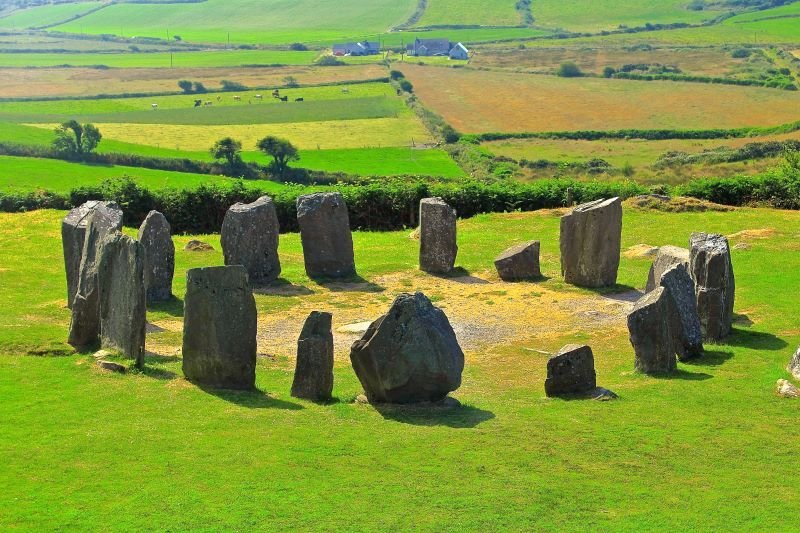
Travel Ireland becomes especially memorable when a narrow country lane ends at a Bronze Age stone circle, with sheep grazing among weathered stones and mountains rising beyond. Across the island, ancient monuments offer a quieter way to experience Ireland tourism—part archaeology, part scenic drive, and part wonderfully unpredictable countryside adventure.
Many of Ireland’s stone circles, portal tombs and megalithic cemeteries were built between roughly 4600 and 600 BC. Their original purposes remain uncertain, but evidence and alignment suggest that some served as burial places, gathering sites or ritual landscapes connected with the movements of the sun. Reaching them can be an adventure in itself, involving one-lane roads, muddy fields, wooden ladders and the occasional rural traffic jam.
Travel Ireland’s Ancient Stone Circles
Shronebirrane Stone Circle, Beara Peninsula
On the Beara Peninsula in County Kerry, Shronebirrane Stone Circle sits in the dramatic Drimminboy Valley. The approach follows a narrow road where meeting another vehicle may require patience and careful manoeuvring. Once there, the reward is a peaceful landscape enclosed by mountains on three sides.
Sheep often wander inside the circle, adding to the sense that this is a living part of the countryside rather than a museum exhibit. It is an excellent addition to Ireland road trips, especially for travellers following the Beara Peninsula or planning a wider Ring of Kerry itinerary.
Drombeg Stone Circle, County Cork
Drombeg, sometimes called the Druid’s Altar, is among Ireland’s best-known stone circles. Located in County Cork, it includes the circle itself, two remains of stone-walled huts and a communal cooking place. These nearby features suggest that the site may once have supported gatherings during the Bronze Age.
Drombeg is a practical choice for visitors interested in Cork travel, archaeology and Ireland sightseeing because it is easier to reach than some remote monuments. Its coastal setting also makes it a rewarding stop on a West Cork scenic drive.
Grange Stone Circle, County Limerick
Near Lough Gur in County Limerick, Grange Stone Circle is considered Ireland’s largest standing stone circle. The monument is located on farmland, so access depends on local arrangements and respectful visitor behaviour. Travellers may cross a field and make a small donation to visit.
Its alignment with the sun makes Grange particularly compelling around the summer solstice, while the surrounding archaeological landscape adds depth to a Limerick travel itinerary. Wear sturdy footwear and allow time to appreciate the wider area rather than treating the circle as a quick photo stop.
Kenmare Stone Circle, County Kerry
Kenmare Stone Circle is one of the easiest monuments to include in Ireland travel plans. From Kenmare town, the site—known locally as the Shrubberies—can be reached on foot in about five minutes. Unlike many circular monuments, it has an unusual egg-shaped layout and a central boulder burial dolmen surrounded by 15 large stones.
Its location makes it ideal for visitors combining Ireland holiday destinations with cafés, pubs, walking routes and accommodation in Kenmare. It is also a convenient stop for travellers exploring the Ring of Kerry.
Read more
Planning a wider Ireland travel itinerary? Explore Ireland’s ancient heritage sites and historic places for more ideas beyond the main tourist trail.
Remote Dolmens and Megalithic Landscapes
Kilmogue Portal Tomb, County Kilkenny
Also known as the Mullinavat Dolmen, Kilmogue Portal Tomb lies outside the village of Mullinavat in County Kilkenny. The route follows a narrow dirt road through quiet farmland, where progress may occasionally be slowed by livestock.
This is precisely the appeal of Ireland hidden gems: the journey feels connected to everyday rural life. Visitors should drive carefully, avoid blocking gates and leave room for farmers, walkers and animals.
Ahakista Stone Circle, Sheep’s Head Peninsula
Ahakista Stone Circle, also called Gorteanish Stone Circle, overlooks Dunmanus Bay on the Sheep’s Head Peninsula in County Cork. A short uphill walk on a rocky path leads to the Bronze Age monument, which consists of 11 stones, four of them still standing.
The site pairs naturally with the Sheep’s Head Way, making it a strong option for Ireland hiking trails, coastal photography spots and outdoor activities. Waterproof footwear and a light rain jacket are sensible at any time of year.
Kealkill Stone Circle, County Cork
Kealkill Stone Circle, near Bantry, offers beautiful views but requires a little effort. Visitors cross two often-wet fields and climb a rock wall using a wooden ladder before reaching the circle and two prominent standing stones.
That access makes Kealkill best suited to travellers comfortable with uneven ground. Afterward, Bantry and the surrounding coast provide excellent opportunities for local food, walking and a relaxed West Cork countryside escape.
Poulnabrone Dolmen, County Clare
One of Ireland’s most photographed portal tombs, Poulnabrone Dolmen stands in the Burren, County Clare. Built between approximately 3800 and 3200 BC, the tomb’s distinctive stone structure contrasts sharply with the Burren’s pale limestone pavement.
Grazing cattle and open skies reinforce the monument’s connection to the landscape. It is a natural highlight of trips that include the Cliffs of Moher, Galway travel or a Wild Atlantic Way route, although visitors should never climb on the stones.
Carrowmore Megalithic Cemetery, County Sligo
Carrowmore in County Sligo is one of Ireland’s most important prehistoric landscapes, with numerous tombs, boulder circles and portal tombs spread across the site. Some monuments are estimated to be up to 6,000 years old.
Allow at least two hours for a meaningful visit. Tomb 7 combines a boulder circle with a dolmen at its centre, while Tomb 57 features 33 large boulders forming a circle nearly 20 metres across. The mountain backdrop makes Carrowmore one of the country’s standout Ireland photography spots.
Explore more
For more ideas for scenic routes, heritage breaks and local experiences, browse Ireland travel inspiration and countryside escapes or discover luxury stays and memorable Irish holidays.
Practical Tips for Visiting Ireland’s Megalithic Sites
- Wear suitable footwear: Mud, wet grass and uneven limestone are common.
- Plan your route: Some sites are reached by narrow roads with limited turning space.
- Respect private land: Follow signs, use gates correctly and make any requested donation.
- Protect the monuments: Do not climb, move stones or leave litter.
- Check daylight: Remote sites are easier and safer to visit during daylight hours.
- Expect variable weather: Conditions can change quickly, particularly on exposed peninsulas.
FAQs About Ireland’s Stone Circles and Dolmens
What is the best ancient site for a first visit?
Kenmare Stone Circle is convenient because it is close to town. Drombeg is another accessible option with archaeological features nearby.
Can I visit these sites during a road trip?
Yes. Drombeg, Poulnabrone, Carrowmore and Shronebirrane can all enrich regional Ireland road trips, provided you allow extra time for slow rural roads.
Are these monuments suitable for families?
Some are, but remote sites may involve fields, ladders or uneven paths. Check conditions before bringing young children or anyone with limited mobility.
For travellers seeking more than crowded attractions, ancient monuments offer some of the most rewarding things to do in Ireland. Go now with sturdy shoes, a flexible schedule and respect for local communities: the next unassuming sign may lead to a stone circle, dolmen or prehistoric landscape you will remember long after your Ireland trip ends.