

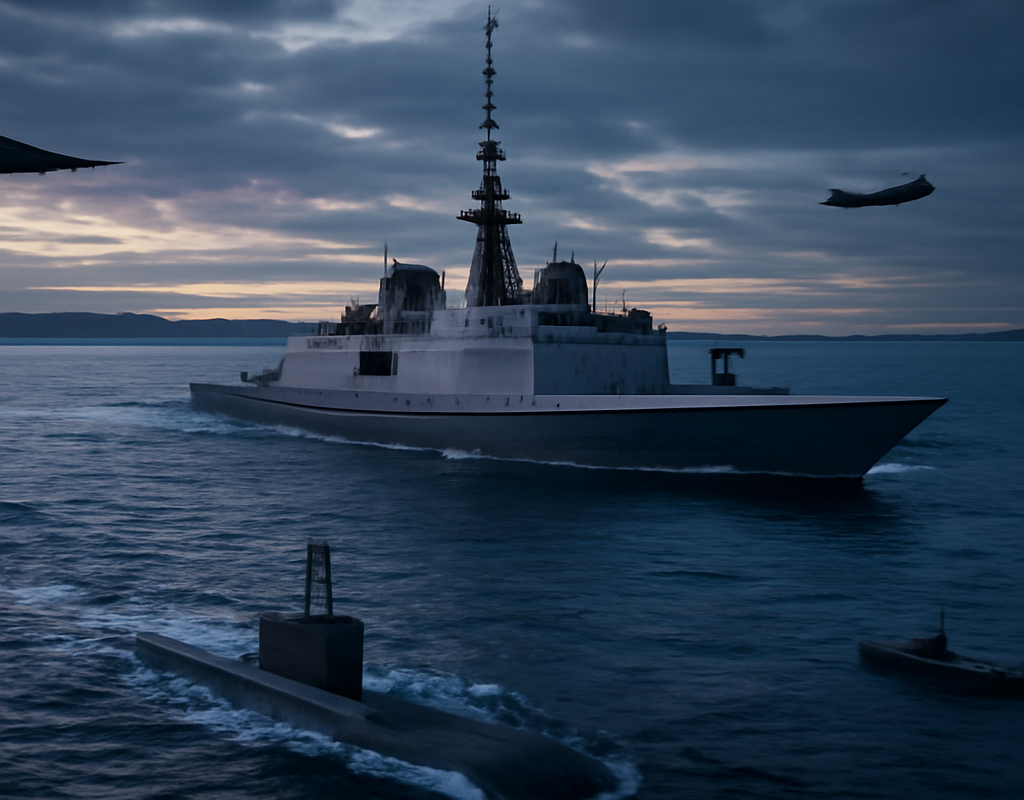
France is accelerating efforts to strengthen its naval power as attacks on commercial shipping, Russia’s maritime activity and uncertainty over transatlantic defence cooperation put renewed focus on Europe’s ability to protect critical sea routes.
The country’s plans are being showcased at Euronaval, a major naval defence exhibition taking place near Paris from 3 to 6 November 2026. The event has brought together governments, armed forces and defence companies as European countries examine how to improve maritime security and develop more autonomous military capabilities.
France places naval power at the centre of European security
Maritime corridors have become increasingly important security flashpoints. Attacks on commercial vessels in the Red Sea and strikes affecting shipping in the Black Sea have highlighted the vulnerability of trade routes, ports and offshore infrastructure.
France has a particularly prominent role in Europe’s naval strategy. It has the world’s second-largest exclusive economic zone and maintains a broad range of maritime capabilities, including submarines, frigates, support vessels and an aircraft carrier. It is also the only European country operating a nuclear-powered aircraft carrier.
Speaking at Euronaval, French Defence Minister Catherine Vautrin said France was renewing its attack submarines, frigates and support ships. She also referred to plans for a future aircraft carrier, the France Libre, and the third-generation nuclear-powered ballistic-missile submarine known as SNLE 3G.
Modernising the fleet
The SNLE 3G programme is intended to replace the current generation of submarines that support France’s continuous at-sea nuclear deterrent. The aircraft-carrier programme and submarine renewal form part of a wider effort to maintain France’s ability to operate independently at sea.
That effort also has a wider European dimension. France has been advocating greater strategic autonomy at a time when governments across the continent are reassessing their defence planning and the future of the transatlantic relationship. Naval power is central to that debate because it can support deterrence, protect shipping and operate across distant maritime zones.
Shadow fleet concerns add pressure
France has also intensified action against vessels suspected of belonging to Russia’s so-called shadow fleet. The term generally refers to ships used to transport energy products while attempting to evade Western sanctions, often through opaque ownership structures or questionable flag registrations.
Since September 2025, French authorities have intercepted and boarded at least six tankers suspected of links to the shadow fleet, according to the source report. The activity reflects wider concerns about sanctions enforcement, maritime safety and the legal difficulties surrounding vessels operating under irregular or potentially fraudulent registrations.
These operations illustrate how naval capabilities are being used for more than traditional combat missions. European maritime forces are increasingly expected to monitor shipping, enforce restrictions, protect infrastructure and respond to threats below the threshold of open conflict.
Naval drones and European defence industry
Uncrewed and autonomous systems are among the most visible themes at Euronaval this year. France has signed an agreement aimed at creating a domestic ecosystem of drone manufacturers able to respond quickly to naval requirements.
François Watteau, who leads the Naval Combat Programme Management Unit at France’s Directorate General of Armaments, said naval drones could combine artificial intelligence with longer-range operations and lower costs. Such systems may be used for surveillance, reconnaissance, mine detection and other missions, although their precise deployment will depend on military requirements and future procurement decisions.
France is also prioritising domestic and European suppliers in defence procurement. The source report said 92% of suppliers to the French Ministry of the Armed Forces were based in France in 2024. Large companies such as Naval Group and Thales remain central to the country’s naval and defence-industrial base, while smaller manufacturers are seeking a greater share of the market.
Balancing major contractors and smaller firms
France’s industrial strategy has created opportunities for established shipbuilders, technology groups and specialist manufacturers. However, smaller companies have raised concerns that large contractors capture much of the available business.
That tension matters beyond France. A strong European defence industry depends not only on major national champions but also on smaller firms that supply components, vessels, sensors and autonomous technologies. The challenge for governments is to combine rapid delivery with competitive procurement and a resilient supply chain.
Defence spending faces a political test
France’s naval ambitions will depend partly on future budget decisions. The government has proposed increasing the country’s 2027 defence budget to €63.4 billion, approximately €6.5 billion more than the 2026 allocation. The source report described this as an increase of 11.4%.
The proposal is not immune from political change. France’s upcoming elections are expected to shape the country’s defence priorities, including the scale and timing of naval programmes. Several presidential candidates are due to attend Euronaval, underlining the political importance of defence policy.
Military programming laws covering the 2024–2030 period have already provided a framework for higher defence spending and expanded maritime investment. Nevertheless, individual programmes still require sustained funding, industrial capacity and political support over many years.
What France’s naval plans mean for Europe
France’s programme is national, but its implications extend across Europe. European governments face shared risks linked to shipping security, sanctions evasion, underwater infrastructure and the protection of trade routes.
Potential areas for cooperation include:
- joint maritime surveillance and information-sharing;
- development of autonomous and uncrewed naval systems;
- protection of ports, cables, pipelines and offshore energy infrastructure;
- coordinated action against sanctions evasion; and
- greater cooperation between European defence manufacturers.
France’s approach also raises questions about how Europe should divide responsibility between national forces, European Union initiatives and NATO structures. Building naval capacity does not automatically create a common European fleet, but it can strengthen the capabilities available to European security operations.
What happens next?
The immediate focus will be on the equipment and partnerships presented at Euronaval, as well as the political debate surrounding France’s proposed defence budget. Future decisions will determine which naval programmes receive funding, how quickly new systems can be delivered and how much cooperation takes place with other European countries.
For now, France is signalling that maritime security, industrial capacity and strategic autonomy will remain central to its defence policy. The country’s fleet renewal shows how European naval planning is shifting from long-term demonstrations towards systems that can be delivered and deployed more quickly.
France’s naval expansion is therefore both a national modernisation programme and part of a wider European response to growing maritime risks. The key test will be whether increased spending produces practical capabilities and stronger cooperation before further pressure emerges along Europe’s critical sea routes.